Celiac disease

Celiac specialist discusses why it is still under diagnosed in the U.S.

Janes_Tiffany_Atlanta_GA

We are very lucky to have Dr. Cynthia Rudert, MD practicing in Atlanta. She is the only nationally recognized celiac specialist in the Southeast.

Recently I was fortunate enough to interview the very busy Dr. Rudert about celiac and her thoughtful answers were so informative that the interview will be posted in several parts. Unlike many doctors I’ve encountered, Dr. Rudert is always learning as much as she can about celiac so can help her many patients with the condition, as well as those with severe gluten-intolerance. I boldfaced some of the most crucial comments in Dr. Rudert’s reply below.

——————————————————————–

Dr. Rudert, you have been treating people with celiac for many years now, but it seems that many doctors still think the condition is rare. Since we now know the condition affects almost 1 out of every 100 Americans, it is far from rare. What do you consider the main problem is, in getting the word out to the medical community about this greatly under diagnosed disease?

Celiac Disease is the most common autoimmune illness of humankind. If one were to take all the patients with Crohn’s Disease and all the patients with Ulcerative Colitis and add in all those with Cystic Fibrosis and then triple the numbers that would be equal to the number of individuals with Celiac Disease. For my Math friends: 3X (Crohn’s +Ulcerative Colitis +Cystic Fibrosis ) = Celiac Disease. Approximately 98% of those with Celiac are not diagnosed or misdiagnosed. Read More »

How Blood Tests for Gluten Sensitivity & Celiac Disease Actually Work

This article focuses on the two main antibody blood tests for celiac disease. It will tell you what each test looks for and what the results mean.

The two blood tests recommended when testing for celiac disease are the AGA-IgA test for gliadin (wheat proteins) as well as the tTG-IgA test for tissue transglutaminase.

Recent research indicates the blood tests most doctors are using, tTG & EMA, are not as reliable as first thought. Young children, elderly, smokers, the very ill and the not very ill can be missed. EMA, or endomysial antibodies has fallen out of favor so they will not be discussed.

Preparation for Testing

Make sure when being tested that you are on a gluten-containing diet, because the antibodies the tests look for would disappear if you are were gluten-free. Once you go gluten-free, future testing is unreliable.

AGA – The Test for Gluten Sensitivity

The AGA-IgA has fallen out of favor for CELIAC DISEASE, but it tests whether an immune reaction against GLUTEN (gliadin) is present in the system – it detects a GLUTEN SENSITIVITY reaction. You can have gluten sensitivity without developing the lesion that is characteristic of celiac disease. That is, you can have gluten sensitivity without celiac disease.

tTG – The Test for Celiac Disease

tTG tests for tissue transglutaminase antibodies, or antibodies against your own tissues. The tTG blood test does NOT tell you if you have celiac disease per se. It tells you the likelihood that villous atrophy will be discovered if an endoscopy with biopsy is performed. The higher the number, the more likely you have enough damage that one of the samples would show villous atrophy.

One thing to consider is that you have over 20 feet of small intestine. Biopsy samples are tiny and only about 5 are taken. How much damage is required before a positive biopsy sample is found?

Also, you can also have the beginning stages of celiac disease and the test results will be “negative” now, but if you were tested at a later date they could rise, making you positive. That is, the levels of antibodies now may not indicate probable intestinal damage enough to be found on endoscopy with biopsy. But they can rise over time – one month, six months, a year.

In one study we reviewed while creating the medical manual, Recognizing Celiac Disease, of the children who tested positive in the study, 40% had tested negative 5 years previously.

No test is 100% accurate. Determining celiac disease is still a judgment call. Even if the tests come back negative, try a strict 100% gluten free diet to see if symptoms improve. If they do, ask your doctor to take multiple vitamin and mineral levels to determine whether deficiencies exist.

Page 30 in Recognizing Celiac Disease lists the vitamins and minerals the NIH recommends checking: vitamins A, D, E, K, B12, folic acid and minerals calcium, iron, phosphorous.

The symptom charts in the book list which deficiencies cause which symptoms so you can determine which nutrient levels to test and give your doctor reasons to test for them. (Doctors will not take nutrient levels unless there is a reason to take them.) Correct the nutrient deficiencies and you will correct the symptoms in many cases.

A diagnosis is just a diagnosis. Good health is the most important thing.

For more information on the tests click here.

For more information on Recognizing Celiac Disease click here.

——————–
Author Information: John Libonati, Philadelphia, PA
President-elect, Celiac Sprue Association (CSA).
Publisher, Glutenfreeworks.com.
Editor & Publisher, Recognizing Celiac Disease.
John can be reached at john.libonati@glutenfreeworks.com.

Celiac Disease Physician Education Program Goes Nationwide

Libonati_John_Philadelphia_PA

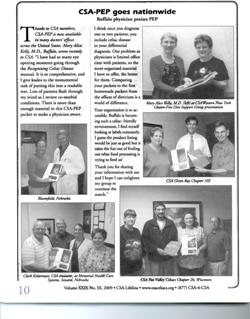
The Celiac Sprue Association – USA (CSA) recently ran the article below in Lifeline, CSA’s quarterly newsletter. The CSA-PEP refers to the CSA Celiac Disease and Gluten Sensitivity Physician Education Program.

CSA-PEP Goes Nationwide: Buffalo Physician Praises PEP

Lifeline_CSA-PEP_3rd_Quarter_2009_250x319Thanks to CSA members, CSA-PEP is now available in many doctors’ offices across the United States.

Mary Alice Kelly, MD, Buffalo, wrote recently to CSA.

“I have had so many eye opening moments going through the Recognizing Celiac Disease manual. It is so comprehensive, and I give kudos to the monumental task of putting this into a readable text. Lots of patients flash through my mind as I review co-morbid conditions.

There is more than enough material in this CSA-PEP packet to make a physician aware.

I think once you diagnose one or two patients, you include celiac disease in your differential diagnosis. Our problem as physicians is limited office time with patients, so the more organized material I have to offer, the better for them. Comparing your packets to the first homemade packets from the offices of dietitians is a world of difference.”

Read the full article here.

About the CSA Celiac Disease & Gluten Sensitivity Physician Education Program (CSA-PEP):

The CSA-PEP was created to increase diagnosis and improve treatment while increasing celiac disease awareness in the medical community and the public. It will provide 60,800 doctors and 10,000 medical students with information and resources that will aid them in identifying, diagnosing and treating people with celiac disease and gluten sensitivity.

To find out more about the CSA-PEP and get involved, visit their website here.

recognizing_celiac_disease_website_cover_132x162 Recognizing Celiac Disease is the definitive guide to understanding, diagnosing and managing celiac disease. It is a reader-friendly, celiac disease reference manual written for both medical professionals and the general public.

For more information visit, www.recognizingceliacdisease.com.
——————-
Author Information: John Libonati, Philadelphia, PA
President-elect, Celiac Sprue Association (CSA).
Publisher, Glutenfreeworks.com.
Editor & Publisher, Recognizing Celiac Disease.
John can be reached at john.libonati@glutenfreeworks.com.

Celiac Disease Alert: Six Ways Gluten Can Kill You

“I only cheat once in awhile. You know, like twice a week…”

Photo: Suite101.com

If you have celiac disease, you damage your body EVERY TIME you ingest gluten. That may sound bad, but it gets worse.

You can DIE from celiac disease in a variety of ways. None of them are fun. Some take longer than others. Some may not kill you per se, but rather they may stop you from enjoying life, make you suffer from chronic pain or limit your potential.

Celiac disease is a deadly serious condition caused by eating what is essentially a poison to susceptible people – gluten proteins in wheat, barley, rye and oats.

Here are just 6 examples how celiac disease from gluten ingestion can kill you: Read More »

Can a celiac disease book save a life? A story how this one saved seven…

Saving a life means more than just keeping a person from dying. It means helping them get well.

While practicing medicine as a registered nurse, Cleo Libonati regularly saved people’s lives. Now her book “Recognizing Celiac Disease” is doing the same for people across the country and around the world.

Here is a letter telling how one family credits the book with saving their lives…

————————
Dear Cleo,

I have been “sick” most of my life (I turn 40 in July) with random things, too many to list here. I have been really sick the last 10 years, but started feeling as though I was “dying by the inch” in 2004. I finally broke down and went to my primary when premature ventricular contractions were occurring every 5-10 seconds that felt as though my heart was going to jump right out of my throat. I had many other random multiple sclerosis type symptoms, but the severity of the PVC’s were what scared me the most, that is until 2006. I began to have many gastro symptoms that kept me in the bathroom several times a day with alternating elimination problems, I couldn’t keep food down, and pain in the left side of my swollen, hard, tender abdomen every time I ate. I had an EGD and colonoscopy on 2/15/07. The three days before the test were the best I had felt in 4 years. Since I worked in Oncology and was used to seeing patients doing prep for them, I put myself on clear liquids 2 days before the Go-Lytely. So, I was gluten-free without knowing it for 3 days prior to testing. Read More »

So the Doc says no gluten, answers to FAQs

For individuals just diagnosed with celiac disease or other gluten intolerant auto immunity issues, the prospects of learning a whole new way of eating can be daunting at first, especially for those eating the standard American diet (S.A.D.). Following are answers to a list of frequently asked questions:

What grains contain gluten?
Wheat, barley, rye, and any flours derived from these grains. There is controversy over oat’s status.

What are hidden sources of gluten?
Soy sauce (the second ingredient is wheat), barbecue sauce, marinades, teriyaki sauce, Asian sauces, or anything that contains soy sauce in the list of ingredients. Modified food starch, malted drinks, malt vinegar, most cold cereals, grain based veggie burgers, meatballs, breaded foods, durum and semolina pasta (another name for wheat flour), some seasoning blends, and many prepackaged foods.

What foods are safe to eat?
Most whole foods are safe, especially fruits, veggies, legumes, oils, nuts and seeds, and lean meats, and for some people, dairy. Safe grains include rice, corn, millet, tapioca, sorghum, teff, buckwheat (not related to wheat), potato starch, bean flours, nut flours, and coconut flour. Some people may tolerate gluten free oats, but caution is advised as there is controversy over their gluten free status. Visit this link for more information. Read More »

Three weeks until free Celiac screening October 10 at the U. of Chicago

Steib_Anne_Chicago_IL

There are 3 weeks until the free Celiac testing event at the University of Chicago, Saturday, October 10. For complete details please read here.

Please call to set up an appointment as the event is expected to fill up fast..UofC

For more info: Call The University of Chicago Celiac Disease Center at 773.702.7593.

——————–
Author Information: Anne Steib, Chicago, IL
Anne Steib
gfreegurl@yahoo.com
http://www.examiner.com/x-13312-Chicago-GlutenFree-Food-Examiner

Celiac Disease Health in Depth: Natural Remedies for Chronic Constipation

About 20% of people with untreated celiac disease have chronic constipation instead of the classic symptom of diarrhea. As the rate of diagnosis improves, constipation is becoming recognized as a common symptom of celiac disease.

Constipation is a common problem in the general population of the United States. According to the National Institutes of Health, about 4 million people have frequent constipation. It is one of the most common digestive complaints in the United States, resulting in about 2.5 million doctor visits and 92,000 hospitalizations annually, although most people treat themselves. This high rate of constipation results in annual laxative sales of over $735 million in this country.

This article will discuss the following topics:

1. How to recognize constipation.

2. Natural remedies that have been shown to help constipation.

3. How to induce a bowel movement.

WHAT IS CONSTIPATION?

Constipation involves problems with stool formation, consistency, and evacuation. It is characterized by one or more of these features:

· Hard, dry stool or soft, putty-like stool.

· Difficult defecation.

· Infrequent defecation, less than one bowel movement per day.

· A feeling of incomplete evacuation following bowel movement.

Constipation can give rise to many different ailments including indigestion, a white coated tongue, bad breath, gas, hemorrhoids, hernia, body odor, depression, fatigue, headache, insomnia, and varicose veins.

The three main causes of constipation are abnormal bowel motility, malabsorption and dysbiosis. Each one, or all three together can cause constipation.

1. Abnormal bowel motility is altered peristalsis, where food passes through the intestine too slowly, due to ineffective muscle action of the intestines. It may take the form of spastic colon or atonic colon.

· Spastic colon is characterized by a spasms, (irregular and excessive muscle contractions of the intestinal walls), so that the muscles resist stretching and thereby decrease the diameter of the inside of the intestine. This restricts the passage of food.

Hard, dry stools are produced as the colon absorbs too much water from the slowly advancing stool. Spasms can result from magnesium deficiency, chronic stress, lack of exercise, lack of water or lack of fiber in the diet.

Spastic constipation is associated with variable degrees of abdominal pain or distress, erratic frequency of bowel action, and variation in stool consistency. Read More »

Gluten-free and still sick? If so, read this story about celiac disease…

[UPDATE: Recognizing Celiac Disease has been converted and expanded into our Gluten Free Works Health Guide.]

Libonati_John_Philadelphia_PA

If you have been diagnosed with celiac disease, are following the gluten free diet yet are still sick, you may find this true story very helpful…

A few months ago, I was visiting the office of a celiac disease support organization. A woman in the office started asking me questions about her symptoms. She was diagnosed with celiac disease and following the gluten-free diet. She was suffering from peripheral neuropathy and a host of other health issues. We looked up her symptoms in our book “Recognizing Celiac Disease”and noticed trends that pointed to certain nutrient deficiencies. Symptom after symptom pointed to low folic acid, low thiamin, and low omega-3 fatty acids. When we looked up Thiamin Deficiency, she said she had almost every symptom listed.

At that point she said she couldn’t possibly have nutrient deficiencies. After her latest endoscopy with biopsy, her gastroenterologist told her that her villi in her small intestine had recovered and she was absorbing normally.

But, was she truly absorbing normally? Read More »

Free Celiac Disease screening October 10 at the University of Chicago

Anne_Steib_Exam_Pic

With Celiac awareness on the rise, more and more people are getting tested and properly diagnosed. Many people have lived with troubling symptoms for years before getting a doctor to order the correct tests and give a formal diagnosis. Once people receive their diagnosis, they can cut gluten from their lives, allow their bodies to heal and feel better than they have in years.

Current studies predict that 1 out of 100 Americans have celiac, that is over 3 million Americans, and of those, 97% are undiagnosed. The longer an individual goes with undiagnosed celiac, the greater their risk to develop other serious illnesses.

On average, a child will visit 8 pediatricians before being correctly diagnosed with celiac disease.

UofC_logo

As a result The University of Chicago Celiac Disease Center offers a free blood screening every October. This year, it will be held October 10, 2009. Pre-registration is required, and opens September 1, 2009. Please call 773.702.7593 to register. The free blood screening will take place on the 4th floor of The University of Chicago Duchossois Center for Advanced Medicine. Read More »