 Gluten Free Works Gluten Free Resources News and Tips
Lucille & Richard King Midland MI USA 48640 989-631-5640 jdeere4688@tm.net
Author Archives: John Libonati
Celiac Sprue Association – Michigan, Mid-Michigan Celiacs Chapter 59
Nyla E. Wilson Clio MI USA 48420 810-686-2539
College Inn Recalls “No MSG Chicken Broth” Due to Undeclared Wheat Gluten

This just in from CSA Chapter #9 – Voorhees NJ. College Inn is recalling College Inn No MSG Chicken Broth.
From the FDA website: http://www.fda.gov/Safety/Recalls/ucm193165.htm
 December 4, 2009 – PITTSBURGH – As a precautionary measure, due to mislabeling, College Inn is initiating a voluntary recall of College Inn® No MSG Chicken Broth sold in individual 14 ½ oz cans.
All other sizes and varieties of College Inn® Chicken Broth are correctly labeled and therefore are not affected by this voluntary recall. Read More »
Gluten-free BUSH’S BEST products – reformulated beans are now gluten-free
This just in from Mary McSurdy of Kimberton Whole Foods in Pennsylvania. Bush’s Best beans are now gluten-free. Read BUSH’S letter from December 2009 to Mary below.
 As of this date, all of our BUSH’S BEST products are gluten-free with the exception of our BUSH’S Chili Magic Chili Starter line and our Bush’s Homestyle Chili line.
We are pleased to inform you that we have reformulated our Chili Beans products to no longer contain wheat flour; therefore, changing the ingredient statement on these products to now state Modified Corn Starch. Due to store inventory rotation and other elements beyond our control, Read More »
How Blood Tests for Gluten Sensitivity & Celiac Disease Actually Work
This article focuses on the two main antibody blood tests for celiac disease. It will tell you what each test looks for and what the results mean.
The two blood tests recommended when testing for celiac disease are the AGA-IgA test for gliadin (wheat proteins) as well as the tTG-IgA test for tissue transglutaminase.
Recent research indicates the blood tests most doctors are using, tTG & EMA, are not as reliable as first thought. Young children, elderly, smokers, the very ill and the not very ill can be missed. EMA, or endomysial antibodies has fallen out of favor so they will not be discussed.
Preparation for Testing
Make sure when being tested that you are on a gluten-containing diet, because the antibodies the tests look for would disappear if you are were gluten-free. Once you go gluten-free, future testing is unreliable.
AGA – The Test for Gluten Sensitivity
The AGA-IgA has fallen out of favor for CELIAC DISEASE, but it tests whether an immune reaction against GLUTEN (gliadin) is present in the system – it detects a GLUTEN SENSITIVITY reaction. You can have gluten sensitivity without developing the lesion that is characteristic of celiac disease. That is, you can have gluten sensitivity without celiac disease.
tTG – The Test for Celiac Disease
tTG tests for tissue transglutaminase antibodies, or antibodies against your own tissues. The tTG blood test does NOT tell you if you have celiac disease per se. It tells you the likelihood that villous atrophy will be discovered if an endoscopy with biopsy is performed. The higher the number, the more likely you have enough damage that one of the samples would show villous atrophy.
One thing to consider is that you have over 20 feet of small intestine. Biopsy samples are tiny and only about 5 are taken. How much damage is required before a positive biopsy sample is found?
Also, you can also have the beginning stages of celiac disease and the test results will be “negative” now, but if you were tested at a later date they could rise, making you positive. That is, the levels of antibodies now may not indicate probable intestinal damage enough to be found on endoscopy with biopsy. But they can rise over time – one month, six months, a year.
In one study we reviewed while creating the medical manual, Recognizing Celiac Disease, of the children who tested positive in the study, 40% had tested negative 5 years previously.
No test is 100% accurate. Determining celiac disease is still a judgment call. Even if the tests come back negative, try a strict 100% gluten free diet to see if symptoms improve. If they do, ask your doctor to take multiple vitamin and mineral levels to determine whether deficiencies exist.
Page 30 in Recognizing Celiac Disease lists the vitamins and minerals the NIH recommends checking: vitamins A, D, E, K, B12, folic acid and minerals calcium, iron, phosphorous.
The symptom charts in the book list which deficiencies cause which symptoms so you can determine which nutrient levels to test and give your doctor reasons to test for them. (Doctors will not take nutrient levels unless there is a reason to take them.) Correct the nutrient deficiencies and you will correct the symptoms in many cases.
A diagnosis is just a diagnosis. Good health is the most important thing.
For more information on the tests click here.
For more information on Recognizing Celiac Disease click here.
——————–
Author Information: John Libonati, Philadelphia, PA
President-elect, Celiac Sprue Association (CSA).
Publisher, Glutenfreeworks.com.
Editor & Publisher, Recognizing Celiac Disease.
John can be reached at john.libonati@glutenfreeworks.com.
Celiac Disease Physician Education Program Goes Nationwide
The Celiac Sprue Association – USA (CSA) recently ran the article below in Lifeline, CSA’s quarterly newsletter. The CSA-PEP refers to the CSA Celiac Disease and Gluten Sensitivity Physician Education Program.
CSA-PEP Goes Nationwide: Buffalo Physician Praises PEP
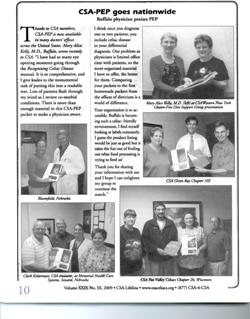 Thanks to CSA members, CSA-PEP is now available in many doctors’ offices across the United States.
Mary Alice Kelly, MD, Buffalo, wrote recently to CSA.
“I have had so many eye opening moments going through the Recognizing Celiac Disease manual. It is so comprehensive, and I give kudos to the monumental task of putting this into a readable text. Lots of patients flash through my mind as I review co-morbid conditions.
There is more than enough material in this CSA-PEP packet to make a physician aware.
I think once you diagnose one or two patients, you include celiac disease in your differential diagnosis. Our problem as physicians is limited office time with patients, so the more organized material I have to offer, the better for them. Comparing your packets to the first homemade packets from the offices of dietitians is a world of difference.”
Read the full article here.
About the CSA Celiac Disease & Gluten Sensitivity Physician Education Program (CSA-PEP):
The CSA-PEP was created to increase diagnosis and improve treatment while increasing celiac disease awareness in the medical community and the public. It will provide 60,800 doctors and 10,000 medical students with information and resources that will aid them in identifying, diagnosing and treating people with celiac disease and gluten sensitivity.
To find out more about the CSA-PEP and get involved, visit their website here.
 Recognizing Celiac Disease is the definitive guide to understanding, diagnosing and managing celiac disease. It is a reader-friendly, celiac disease reference manual written for both medical professionals and the general public.
For more information visit, www.recognizingceliacdisease.com.
——————-
Author Information: John Libonati, Philadelphia, PA
President-elect, Celiac Sprue Association (CSA).
Publisher, Glutenfreeworks.com.
Editor & Publisher, Recognizing Celiac Disease.
John can be reached at john.libonati@glutenfreeworks.com.
Celiac Disease Events in Cleveland: Nov. 15 & Dec. 6
Here are two fun upcoming events in Cleveland Ohio…sent in by Cindy Koller-Kass, President of the Celiac Sprue Association Chapter #50.
Greater Cleveland Celiac Association CSA Chapter #50 Meeting this Sunday, November 15, 2009 –
Parma Community Hospital at 2 PM in the Nelson Auditorium 7007 Powers Blvd (off Ridge Rd ) Parma. If you need specific directions–Please go to http://tinyurl.com/2e9emh
Bring your questions.
Topic: How to deal with family gatherings this Holiday Season
Come hungry! We will have a pre-Thanksgiving potluck and a Pie Baking Contest Pre-Thanksgiving Potluck … Read More »
Unilever Recalls Breyers® Ice Cream That May Contain Wheat
Unilever Issues Allergy Alert on Wheat in a Limited Number of Tubs of Breyers® Ice Cream
Fri, 23 Oct 2009 13:11:00 -0500
 Unilever United States, Inc., of Englewood Cliffs, NJ, in cooperation with the U.S. Food and Drug Administration (FDA), is voluntarily recalling a limited number of tubs of Breyers® ice cream because it was mispackaged and may contain undeclared wheat. People who have an allergy or severe sensitivity to wheat run the risk of allergic reaction if they consume this product.
On a limited number of tubs, the lid describes the product as “Breyers® All Natural Cookies & Cream” ice cream, and the tub portion of the package describes the product as “Breyers® All Natural Mint Chocolate Chip” ice cream. The product inside of the tub is “All Natural Cookies & Cream.” The ingredient statement on the tub does not declare wheat, which is an ingredient of the Cookies & Cream product. Read More »
Greater Philadelphia Celiac Support Group Meeting October 16

The Greater Philadelphia Celiac Support Group is meeting at Abington Hospital this Friday, October 16 at 5:45 pm.

Ann Whelan, publisher of the popular magazine Gluten Free Living will be speaking to the group.
Location: Abington Memorial Hospital
1200 Old York Road
Abington PA 19001 in the Lenfest Auditorium
Time: Doors open at 5:45 for visiting vendors and interacting with friends. Meeting officially begins at 7:30 pm.
_____________________________________________________
VENDORS THAT WILL BE ATTENDING THE MEETING Read More »
Gluten-free and still sick? If so, read this story about celiac disease…
[UPDATE: Recognizing Celiac Disease has been converted and expanded into our Gluten Free Works Health Guide.]
If you have been diagnosed with celiac disease, are following the gluten free diet yet are still sick, you may find this true story very helpful…
A few months ago, I was visiting the office of a celiac disease support organization. A woman in the office started asking me questions about her symptoms. She was diagnosed with celiac disease and following the gluten-free diet. She was suffering from peripheral neuropathy and a host of other health issues. We looked up her symptoms in our book “Recognizing Celiac Disease”and noticed trends that pointed to certain nutrient deficiencies. Symptom after symptom pointed to low folic acid, low thiamin, and low omega-3 fatty acids. When we looked up Thiamin Deficiency, she said she had almost every symptom listed.
At that point she said she couldn’t possibly have nutrient deficiencies. After her latest endoscopy with biopsy, her gastroenterologist told her that her villi in her small intestine had recovered and she was absorbing normally.
But, was she truly absorbing normally? Read More »