Tag Archives: Nutrition

Testing for Nutrient Deficiencies: My Results

christie bessinger gluten free works

There are a number of nutrient deficiencies associated with Celiac and other autoimmune disorders. These occur not only BEFORE diagnosis, due to flattened villi and malabsorption, but AFTER diagnosis as well.  It’s up to us to choose healthy, naturally gluten-free foods (like fruits, veggies, lean protein and brown rice) in order to feel the best we can. Even then, we may still have deficiencies.

I was diagnosed about 5 years ago. Although I have experienced dramatic improvements in my health, sleep quality, and energy level, I have still been dealing with some “weird” symptoms that I wasn’t sure were going to go away. These include eye floaters (which I’ve noticed for about 2 years now), shakiness and rapid pulse especially during the first half of the day, and carbohydrate intolerance. (Eating high carb meals have been giving me headaches). So…. I was VERY excited when I heard that Gluten Free Works was going to be offering . I couldn’t wait to try it out.
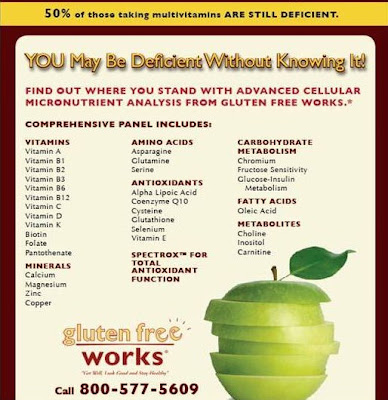
nutrition testing gluten free works


When I got my results back, I was AMAZED at how many nutrient deficiencies I still had after being Gluten-Free for this many years. I came up deficient in:

VITAMIN A (this explained the eye floaters)
CHROMIUM (I had never heard of chromium before now, but this explained my problem with carbs. I have since read that a deficiency in Chromium leads to DIABETES… so I’m glad I figured this out now, rather than later ;)
SELENIUM (had never heard of that one either) Read More »

Nutrient Deficiencies Symptom Chart: Know Where You Stand So You Can Control Your Health

nutrient deficiency symptoms
Know the Symptoms of Nutrient Deficiencies so You Can Be Healthy!

The impact of nutritional deficiencies on health should be common knowledge among the medical professional community. All doctors, nurses and other medical professionals should be able to quickly and accurately identify and diagnose functional nutritional deficiencies in patients and correct those deficiencies. Unfortunately, this is not the case.

Medical teaching institutions do not focus on nutrition, so many medical professionals are not equipped to recognize the signs of nutritional deficiencies until the patient is extremely sick. In most cases, the patient is able to function, just not at his or her potential. He or she may have weight issues, skin, hair or digestive problems, anxiety or difficulty concentrating. This is called a functional nutrient deficiency.

Read More »

I’m deficient, You’re deficient, We’re all deficient? (Part 2)

In  Part 1 of this article about nutrient deficiencies in the gluten-free population, I posed four critiques and questions that I promised to answer in today’s part 2. Without further ado, here we go…

Critique #1 questioned the small sample size of the research. I can’t do anything about that, and there’s not much to be said about it, so let’s move on.

Next, I think it’s easiest to address critique #3: How did nutrient deficiencies in the gluten-free population compare to Americans as a whole? To answer that question, I pulled data regarding nationwide averages from the USDA’s Community Nutrition Mapping Project. If I amend yesterday’s table that showed the percent of the gluten-free population who are deficient in given nutrients, and add to it a column for the national averages, this is what you find:


Nutrient GF Deficiency Nationwide Deficiency
fiber 74% 92%
calcium 82% 69%
thiamin 59% 19%
riboflavin 25% 11%
B6 35% 26%
folate 85% 40%
B12 29% 20%
iron 41% 11%


These numbers change the perspective a bit, I think. It’s not simply that the gluten-free population is nutrient deficient. When you compare us to the national averages, it gets slightly more complex. In some cases, such as folate, riboflavin, thiamin, and iron, we’re two or more times as deficient (as a group) than the nation. However, in other cases, such as B12, B6, and calcium, we still have greater rates Read More »

I’m deficient, You’re deficient, We’re all deficient? (Part 1)

I was recently reading a press release from Nature’s Path Organic about two of their new cereals. The press release made a familiar argument: the cereals “provide gluten avoiders with whole grains… unlike many gluten-free cereals which forfeit nutritional benefits…” The implication is that many gluten-free cereals (and other gluten-free processed foods, by extension) are more highly processed in order to improve taste and texture. But they do so by sacrificing nutritional quality.

There is some truth to this logic. Foods made from whole grains are inherently healthier than heavily processed foods, and I’ll use our good old enemy – wheat – to demonstrate. I compared whole grain wheat flour (less processed) with white, unenriched wheat flour (more processed) across a range of nutrient measures. Not surprisingly, the wheat underwent a profound loss in Read More »

Understanding and Treating Zinc Deficiency in Celiac Disease

The mineral zinc is classified as an essential nutrient due to the vital functions it performs in our bodies.  It is found in almost every cell of the body with highest concentrations in the liver, pancreas, kidney, bone, and muscle. High concentrations occur in the brain, middle ear, eye, prostate gland, sperm, skin, hair, and nails. This micronutrient is essential for the activity of approximately 100 enzymes. Enzymes promote biochemical reactions in the body.

Zinc supports a healthy immune system. It is needed for wound healing and DNA synthesis. It helps maintain our sense of taste and smell and is involved in energy metabolism, hemoglobin production, carbon dioxide transport, prostaglandin function, synthesis of collagen, protein synthesis, and vitamin A metabolism. Zinc is important for male fertility. It supports normal growth and development during pregnancy, childhood, and adolescence. Read More »