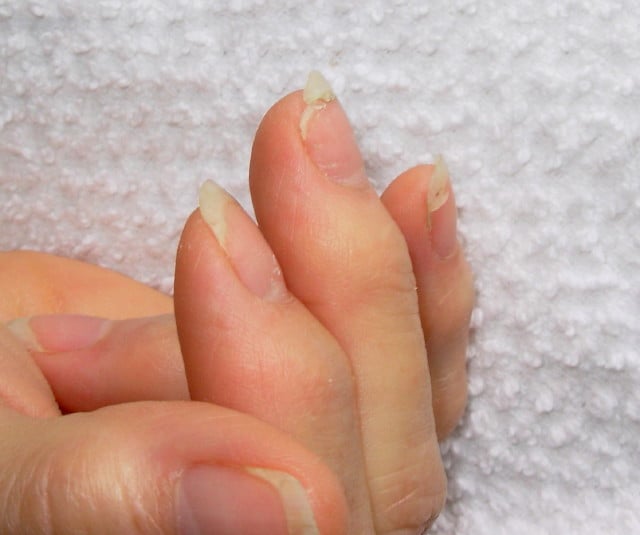
K oilonychia is a feature of an iron deficiency state characterized by abnormally shaped nails, called spoon shaped nails, meaning that the normal downward curve is reversed.
Depending on the inadequacy of iron, nails may simply remain flat or with a slight dip without progressing to a reversed curve.
These nails develop vertical ridges from the base to the nail tip that can become deep, called washboard nails.
Q: Are all nails affected?
A: All nails are affected in varying degrees. The small finger shows the least effect while the thumb shows the greatest change which begins as flattening before scooping upward.
Nail Anatomy. .
A. Nail plate; B. lunula; C. root; D. sinus; E. matrix; F. nail bed; G. hyponychium; H. free margin. Courtesy Wikipedia.
What Is Koilonychia In Celiac Disease and/or Gluten Sensitivity?
Nail Anatomy. A. Nail plate; B. lunula; C. root; D. sinus; E. matrix; F. nail bed; G. hyponychium; H. free margin. Courtesy Wikimedia.org
What Are Rounded Nails With Curved Ends?
R ounded, curved, dark and dry nails are a well known feature of vitamin B12 deficiency.
Q: How does vitamin B12 deficiency cause the nails to grow this way?
A: Vitamin B12 deficiency affects the nail plate. The nail plate is the hard keratin cover of the finger tip and toe tip, simply called “the nail.” The nail plate is produced by the living nail matrix at its base.
What Are Rounded Nails With Curved Ends In Celiac Disease and/or Gluten Sensitivity?
W hite spots in the nails is a feature of zinc deficiency and white bands signify protein deficiency characterized by abnormal appearance anywhere in one or more nails.
White spots and bands can appear separately or together in nails. There may be just one mark or many marks depending on the level of deficiency.
Q: What part of the nail is affected by zinc and/or protein deficiency?
A: Zinc and protein deficiencies affect the nail plate.
The nail plate is the hard keratin cover of the finger tip and toe tip, simply called “the nail.” The nail plate is produced by the living nail tissue at its base. Here is an illustration of the parts that make up a fingernail:
Nail Anatomy. .
A. Nail plate; B. lunula; C. root; D. sinus; E. matrix; F. nail bed; G. hyponychium; H. free margin. Courtesy Wikipedia.
What Are White Spots And White Bands In Nails In Celiac Disease and/or Gluten Sensitivity?
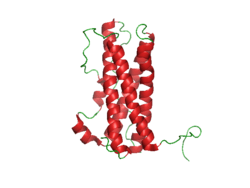
This is a depiction of immunoglobulin E (IgE) antibody which is elevated in allergic reactions.
What Is Allergic Rhinitis?
A llergic rhinitis is an immune disorder characterized by inflammation of the nasal mucosa by an IgE antibody reaction to an allergen.
An allergen is something that triggers an allergic immune response.
Q: What is the immune response?
A: Implicated in the response is an increase in T gamma-delta intraepithelial lymphocytes (IELs), which is a subset of pro-inflammatory T-cells located in the respiratory mucosa. Lymphocytes are white blood cells.
When a person with allergic rhinitis breathes in an allergen such as pollen or dust, the body releases chemicals, including histamine that cause allergy symptoms. For example, hay fever involves an allergic reaction to pollen. A similar reaction occurs with allergy to mold, animal dander, dust, and other allergens that are breathed in.
What Is Allergic Rhinitis In Celiac Disease and/or Gluten Sensitivity?
Prolactin Structure. Courtesy Boris TM at Wikipedia.
What Is Hyperprolactinemia?
H yperprolactinemia is an excess secretion of prolactin hormone causing an elevated blood level that is characterized by its effects on reproduction: in females causing amenorrhea and in males causing reduced sexual potency.
Q: What is prolactin?
A: Prolactin is a hormone produced by the the anterior pituitary gland that is transported by the bloodstream to stimulate androgen hormone production in male and estrogen hormone production in female sex glands. However, too much prolactin inhibits hormone production of estrogen in women and testosterone in men.
In pregnant females upon delivery of a baby, prolactin stimulates breast development and milk production for the purpose of feeding the infant. Sucking by the infant stimulates the release of prolactin which keeps the milk supply adequate.
Prolactin also promotes autoimmune mechanisms. Prolactin interferes specifically with B cell tolerance induction, enhances proliferative response to antigens and mitogens and increases the production of immune globulins, cytokines and autoantibodies.1
Other conditions that can stimulate prolactin release include nutritional deficiencies, thyroid stimulating hormone (TSH) produced by the pituitary gland, stress, exercise, and anterior pituitary tumors.
What Is An Elevated Prolactin Level In Celiac Disease and/or Gluten Sensitivity?
Sources:
Shelly S, Boaz M, Orbach H. Prolactin and autoimmunity. Autoimmun Rev. 2012 May;11(6-7):A465-70. doi: 10.1016/j.autrev.2011.11.009. [↩]
C heilosis is a painful feature of nutritional deficiencies, especially riboflavin and/or pyridoxine deficiency, and less frequently, from vitamin B12, folic acid, and iron. It is characterized by redness of the lips with cracking and weeping in the corner of the mouth.
Q: What is the consequence of weeping at the corners of the mouth?
A: The open sores that develop at the corners of the mouth invite infection by candida albicans, a yeast organism, and less commonly by bacteria normally present on the skin such as staphylococcus aureus.
These sores make opening the mouth very painful and so restrict eating, talking, socializing, and dental care.
What Is Cheilosis In Celiac Disease and/or Gluten Sensitivity?
Figure 1: Normal Liver Lobule. Courtesy almostadoctor.com
What Is Autoimmune Cholangitis?
A utoimmune cholangitis is a rare inflammatory self-targeted disease of the biliary tract produced by high levels of immunoglobulin G (IgG) antibodies and antinuclear antibodies (ANA).
Autoimmune cholangitis is characterized by progressive inflammation and scarring that leads to narrowing and destruction of the bile ducts and development of biliary cirrhosis of the liver.
Autoimmune cholangitis is also termed anti-mitochondrial antibody-negative primary biliary cirrhosis because there is no production of anti-mitochondrial antibodies.
Q: What happens when bile ducts can no longer transport bile out of the liver?
A:Bile that cannot be removed from the liver by the biliary tract backs up and damages the liver, causing cirrhosis. In Figure 1, bile back up would directly damage the hepatic (liver) cells seen here as grey “blocks.”
Bile is a greenish brown liquid continually made by the liver cells (hepatocytes) from phospholipids salt, cholesterol, and aging blood cells that it removes from circulation.
Bile also carries away waste products produced by normal metabolism and toxic substances that are removed by the liver for eventual elimination in stool.As such, bile must continually flow out of the liver to prevent build-up in the liver.
Bile from the hepatic cells drains into small tubes called canniculi and then into larger bile ducts to be carried out of the liver to the gall bladder for storage until needed to aid in the digestion and absorption of fat from the small intestine. Bile emulsifies fat eaten in the diet so that the pancreatic enzyme called lypase can break it down into its fatty acid and glycerol components.
Unfortunately, autoimmune cholangitis is difficult to diagnose because it mimics many other diseases such as primary sclerosing cholangitis, sarcoidosis, cancer and lymphoma.
What Is Autoimmune Cholangitis In Celiac Disease and/or Gluten Sensitivity?
A chronic relapsing dermatosis characterized by scaling, erythema (redness), and less commonly pustulation that is an associated disorder of celiac disease involving deficiencies of omega-3 fatty acids, vitamin D, and zinc – features of malnutrition.…
A joint manifestation of psoriasis, a systemic autoimmune disease, characterized by asymmetric involvement in one or more joints, especially affecting the distal phalangeal joints of fingers and toes at tips.
Have you been told that along with Celiac Disease or Gluten Intolerance, you also have Fibromyalgia? If you have, you’re not alone. What exactly is Fibromyalgia? Well, there are certainly a lot of theories out there about what it is, and how it should be treated. Up until recently, it was considered an “invisible disease” (much like Celiac), and doctors would often diagnose it if they couldn’t find anything else wrong with you. In other words, instead of telling you, “you’re a hypochondriac,” they would say, “You have Fibromyalgia,” and give you an anti-depressant like Cymbalta, to help ease your symptoms.
Thankfully, with more and more people (especially women), complaining of similar symptoms, Fibromyalgia has finally gotten recognition as a legitimate disease. Some of the typical symptoms are