L ymphocytic gastritis is an inflammatory stomach disorder that is characterized by superficial inflammation of the stomach lining (mucosa) that mainly involves the gastric antrum in children.
Lymphocytic gastritis is defined by the recognition of more than 25 intraepithelial lymphocytes (IEL) per 100 surface epithelial cells lining the stomach wall.
Q: What are intraepithelial lymphocytes?
A: Intraepithelial lymphocytes in lymphocytic gastritis are a unique T-cell population of white blood cells that are interspersed between epithelial cells in the mucosa.
What Is Lymphocytic Gastritis In Celiac Disease and/or Gluten Sensitivity?
Bread is a Major Source of Maltose. Courtesy Johnson Mathey Catalyst
What Is Maltose Intolerance?
M altose intolerance is an enzymopathy (enzyme failure) characterized by inability of the gut to properly break down maltose sugar molecules in food due to low maltase enzyme activity of the small intestinal lining.
Q: What is maltose and maltase?
A: Maltose is a double sugar made up of two molecules of glucose and is derived from starch. Maltase is the enzyme required to digest or release glucose from maltose. Maltase is produced in the microscopic brush border (microvilli) at the base of villi.
Here’s what happens when maltose is not digested:
Undigested maltose cannot be absorbed into the body but remains inside the small intestine where it acts osmotically to draw an unnatural amount of water from the body into the intestine which produces diarrhea.
Additionally, normal gut bacteria ferment the abnormal abundance of unabsorbed maltose, thereby generating an abundance of short-chain fatty acids and hydrogen gas which result in bloating and pain.1
Positive response to a breath hydrogen test (BHT), involving 1 – 3 hours of time post ingestion of maltose test dose, signifies malabsorption in the small intestine and fermentation in the colon. If BHT is positive before 60 minutes, the result implies bacteria is abnormally present in the small intestine, causing fermentation there.
What Is Maltose Intolerance In Celiac Disease and/or Gluten Sensitivity?
O bnoxious gas, or flatus, is gas that is not only offensive when passed but also lingers in the air longer than ordinary gas does.
Gas is a natural digestive product within the colon that is composed mainly of hydrogen and carbon dioxide gases. These gases are given off in the necessary bacterial breakdown of undigested fermentable food entering the colon from the small intestine.
Q: What makes gas obnoxious?
A: The production of obnoxious gas depends on the type and quantity of undigested food residue that is passed into the colon from the small intestine, dysfunctional motility instead of normal peristalsis, and dysbiosis. Dysbiosis is the condition of having unhealthy or insufficient populations of microbes responsible for digesting (fermenting) foodstuffs in the lower gut or colon.
Gases produced by intestinal microbes may modulate intestinal motor function (muscle movement) in individuals with functional bowel disease. Methane, produced by enteric bacteria in the human gut, is associated with slowed intestinal transit and constipation.1
What Is Obnoxious Gas In Celiac Disease and/or Gluten Sensitivity?
Sources:
Jahng J, Jung IS, Choi EJ, Conklin JL, Park H. The effects of methane and hydrogen gases produced by enteric bacteria on ileal motility and colonic transit time. Neurogastroenterol Motil. 2012 Feb;24(2):185-90, e92. doi: 10.1111/j.1365-2982.2011.01819.x. Epub 2011 Nov 20.
Methane is produced in the colon by intestinal methanogens (microbes) that metabolize hydrogen, one of the end products of normal anaerobic (meaning without oxygen) bacterial fermentation. Fermentation of the undigested starchy part of carbohydrates produces hydrogen in the intestine, which is the food for methane production by intestinal methanogens.
Hydrogen and methane are excreted in the flatus and in breath giving the opportunity to indirectly measure their production using breath testing. ((Triantafyllou K, Chang C, Pimentel M. Methanogens, Methane and Gastrointestinal Motility. J Neurogastroenterol Motil. 2014 Jan;20(1):31-40. Epub 2013 Dec 30. [↩]
Hypoglycemia means the level of glucose within cells is too low to meet metabolic needs of the body for this essential sugar.
Q: What are the metabolic needs for glucose?
A: Glucose is the most important simple sugar in human metabolism mainly because it is the primary source of energy for most cells of the body.
Energy contained in the glucose molecule is obtained by the body from its reaction with oxygen (oxidation). This oxidation reaction occurs in power producing mitochondria structures that are located within cells.1
Hypoglycemia is characterized by alterations in neurologic, metabolic and muscular functions:
Neurologic function because brain tissue is particularly dependent on glucose for energy,
Metabolic function of glucose-dependent tissues which include red blood cells, white blood cells, bone marrow, eye, inner heart of the kidney, and peripheral nerves because these tissues cannot metabolize fatty acids as an alternate source of energy, and
Muscle function because muscle cells continually require glucose for energy production.
Glucose is made available to cells through the regulating action of insulin, a hormone produced by specialized cells located on the surface of the pancreas.
What Is Hypoglycemia In Celiac Disease and/or Gluten Sensitivity?
Unexpected weight loss is unintentional loss of body mass composition or inability to gain weight marked by decreased serum proteins and increased stool fat.1
What Is Unexpected Weight Loss In Celiac Disease and/or Gluten Sensitivity?
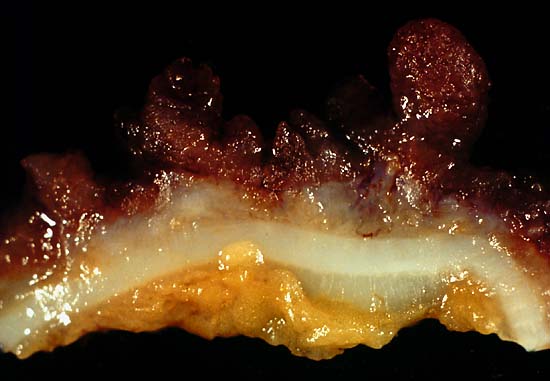
This photo is from a total colectomy done for severe, intractable chronic ulcerative colitis. It shows a close view of a lengthwise section through the colon wall. This demonstrates not only the angry red mucosa, but also, the tendency for the inflamed tissue to throw itself up into inflammatory pseudopolyps. Source: Ed Uthman, MD. Public domain.
What Is Ulcerative Colitis?
U lcerative colitis is an inflammatory disorder of the colon characterized by continuous inflammation of the mucosa and submucosa usually with small ulcers, extending from the rectum and typically involving the distal colon, rectum, and anus and producing bloody diarrhea.
While the severity of ulcerative colitis varies among patients, iron deficiency anemia often develops due to blood loss especially when there are many bloody bowel movements in a day.
The onset of ulcerative colitis is most commonly in young adulhood.
Q: Is this disease painful?
A: Yes with the passage of stool.
Psychological stress and subsequent dysbiosis exacerbate ulcerative colitis.
Psychological stress activates multiple physiological processes aimed at maintaining balance within the body. These physiological processes also have the capacity to influence the composition of microbial communities in the digestive tract, and research now indicates that exposure to stressful stimuli leads to gut microbiota dysbiosis.1
While the relative abundance of many different bacterial types can be altered during stressor exposure, findings in nonhuman primates and laboratory rodents, as well as humans, indicate that bacteria in the genus Lactobacillus are consistently reduced in the gut during stress.2
Presently, ulcerative colitis cannot be cured. This condition has a course of remissions, when symptoms subside, and flares, when symtpoms get worse. Treatment is aimed to reduce flares and promote remission. In all cases, correction of dysbiosis improves the condition.
Ulcerative colitis is associated with increased incidence of cancer of the colon.3
What Is Ulcerative Colitis In Celiac Disease and/or Gluten Sensitivity?
Sources:
Galley JD, Bailey MT. Impact of stressor exposure on the interplay between commensal microbiota and host inflammation. Gut Microbes. 2014 May 1;5(3):390-396. Epub 2014 Apr 1. [↩]
Galley JD, Bailey MT. Impact of stressor exposure on the interplay between commensal microbiota and host inflammation. Gut Microbes. 2014 May 1;5(3):390-396. Epub 2014 Apr 1. [↩]
Taber’s Cyclopedic Medical Dictionary. F. A. Davis. Philadelphia, PA [↩]
L ymphadenopathy is an alteration of lymph nodes that is characterized by enlargement of lymph nodes greater than 1.5 cm caused by proliferation (increased production) of lymphocytes within the node.
Q: What are lymph nodes?
A: Lymph nodes are part of the lymphatic system, acting to protect body fluids by filtering out and destroying bacteria and other harmful substances from lymph that is continually carried to them by lymph vessels.
Cleaned lymph is carried away from the nodes by lymph vessels to the bloodsteam where it helps forms blood plasma. Lymph nodes produce various blood cells needed to fight infection which includes lymphocytes.
Lymphocytes are small white blood cells that plays a major role in defending the body against disease. There are two types of lynphocytes: B cells, which make antibodies that attack bacteria and toxins, and T cells which attack body cells themselves when they have been taken over by viruses or become cancerous.
Lymph nodes that become enlarged doing battle with an infection or as a result of injury nearby usually resolve with treatment of the infection or injury. However, if the cause is cancer, the nodes would need to be treated as well as the cancer.
What Is Lymphadenopathy In Celiac Disease and/or Gluten Sensitivity?
Underarm showing skin darkening, which is a feature of Addison’s Disease
What Is Primary Addison’s Disease?
A ddison’s disease is an autoimmune destruction of the adrenal glands by autoantibodies that target the adrenal cortex, or outer part of these glands, and is characterized by a slow progressive failure of the adrenal glands to adequately produce its steroid hormones.
Symptoms of adrenal fatigue or failure may not develop until the majority of adrenal tissue is destroyed. When untreated, progression leads to coma, called Addisonian crisis, which is a medical emergency.
There are two adrenal glands each located on top of a kidney and enclosed in a connective tissue capsule. Each is a small, triangular shape that is made of two parts: the outer region and the inner region.
The inner region, called the adrenal medulla, produces epinephrine and norepinephrine chemicals that are needed to deal with stress.
The outer region, called the adrenal cortex, produces adrenocortical (steroid) hormones and releases them into the bloodstream in response to pituitary stimulating hormone from the brain.
Q: What is the function of steroid hormones produced by the adrenal glands?
A: Functions of the three steroid hormones produced by the adrenal glands are:
Glucocorticoids restrain inflammation and metabolism of carbohydrates, fats and proteins to maintain a normal glucose blood level. The major glucocorticoid is hydrocortisone.
Mineralocorticoids regulate the retention and excretion of fluids and electrolytes by the kidneys. The most important mineralocorticoid is aldosterone.
Androgen (testosterone) is a male sex hormone.
Secondary adrenal insufficiency may develop from other causes that are not immune related such as chronic infections, tumor, and medications.
What Is Addison’s Disease In Celiac Disease and/or Gluten Sensitivity?
What Is Vitamin B12 Deficiency Anemia? Vitamin B12 deficiency anemia is a megaloblastic anemia that is characterized by defective DNA synthesis of red blood cells due to a lack of vitamin B12. Vitamin B12 is essential…
Selenium is a mineral that is required by the body in trace amounts for a healthy immune system, normal thyroid function, and antioxidant protection.
Selenium is absolutely required in the production of at least 30 selenoproteins in the body. First, selenium is joined to the amino acids cysteine as selenocysteine and to methionine as selenomethionine before being used as components for selenoproteins. Many selenoproteins are important antioxidant enzymes such as glutathione peroxidase.
Q: How does glutathione peroxidase work?
A: Glutathione peroxidase activity helps the recycling of vitamins C and E in optimizing the performance of the antioxidant system. The antioxidant properties of selenoproteins help prevent cellular damage from free radicals. Free radicals are natural by-products of oxygen metabolism that may contribute to the development of chronic diseases such as cancer and heart disease.
In the immune system, selenium stimulates immune properties of lymphocytes (white blood cells) by contributing to higher natural killer lymphocyte activity. Natural killer lymphocytes have the ability to destroy cancer cells and bacterial and viral agents.
Other selenoproteins help protect the thyroid gland from anti-oxidants and regulate thyroid function. Specifically, selenium plays an integral role in thyroid gland metabolism.1 Functions are more fully described below.
According to the Food and Agriculture Organization, United Nations, approximately 30 percent of tissue selenium is contained in the liver, 15 percent in kidney, 30 percent in muscle, and 10 percent in blood plasma.
What Is Selenium Deficiency In Celiac Disease and/or Gluten Sensitivity?
Sources:
Stazi AV, Trinti B. Selenium status and over-expression of interleukin-15 in celiac disease and autoimmune thyroid diseases. Ann Ist Super Sanita. 2010;46(4):389-99.DOI: 10.4415/ANN_10_04_06. [↩]
Cancel your subscription?
We're sorry to see you go.
Please select a reason for cancellation.
Please provide additional details.
Your subscription is cancelled
You won't be billed again. If you change your mind, you can subscribe again at any time.
Cancelled
Cancellation request submitted
We've received your request. Your subscription remains active while we process it. We'll email you once it's confirmed.
Cancellation pending
Pause subscription
Your subscription payments will be paused. Your existing access will remain active while your subscription is paused.
Please choose a valid future date.
Resume subscription
Your subscription payments will resume on the normal billing schedule.
Access Content
Affiliate Terms
By joining our Affiliate Program, you agree to the following terms:
1. Eligibility: You must be 18 years or older to participate. We reserve the right to refuse service to anyone for any reason at any time.
2. Promotional Guidelines: Affiliates must not engage in misleading advertising or spam. Promotions must accurately represent our brand and products.
3. Affiliate Links: You must use your unique tracking link to receive credit for referred sales.
4. Prohibited Use: You may not use our branding in a way that may confuse customers or misrepresent your relationship with us.
5. Termination: We reserve the right to terminate your account at any time for breach of these terms.
6. Changes to Agreement: We may update these terms at any time. Continued participation implies acceptance of any changes.
By continuing, you agree to the terms of this Affiliate Agreement.

 What Is Lymphocytic Gastritis?