P ityriasis rubra pilaris (PRP) is a chronic generalized exfoliative dermatitis (sloughing skin) characterized by erythema (redness), scaling, dilated plugged hair follicles, and keratoderma (thickened skin) of the hands and feet that is often associated with anemia and low serum albumin.
It may manifest either as Type I classical adult onset PRP, Type II atypical adult (onset) PRP, or Type VI PRP (HIV-associated PRP pityriasis rubra pilaris) in contrast to classical juvenile (Type III) and circumscribed juvenile (Type IV) encountered among children.1
Q: Who is affected in the general population?
A: All ages are affected. Pityriasis rubra pilaris occurs all over the world but with racial variations – it is 1 in 5,000 in Great Britainand 1 in 50,000 in India.2
What Is Pityriasis Rubra Pilaris In Celiac Disease and/or Gluten Sensitivity?
Sources:
Sehgal VN, Srivastava G, Dogra S. Adult onset pityriasis rubra pilaris. Indian J Dermatol Venereol Leprol. 2008 Jul-Aug;74(4):311-21. [↩]
Sehgal VN, Srivastava G, Dogra S. Adult onset pityriasis rubra pilaris. Indian J Dermatol Venereol Leprol. 2008 Jul-Aug;74(4):311-21. [↩]
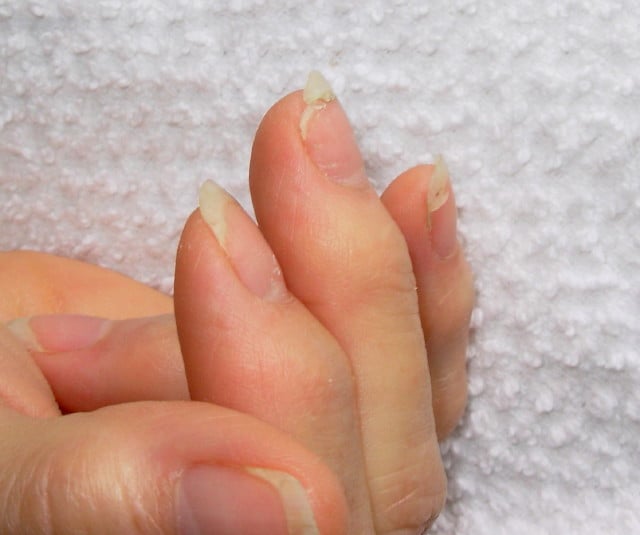
H angnail is a broken strip of epidermis (piece of skin) at root or lateral (side) edge of fingernail or toenail that causes sharp pain.
A hangnail develops because the skin around the nail is unhealthy due to inadequate nutrition. Injury from trauma including biting the skin and pushing back the cuticles or exposure to excessive detergents and water that remove protective oils promote the development of hangnail.
All ages and both sexes can be affected.
Q: Can a hangnail become infected?
A: Infection, called paronychia, may develop from invasion of sore skin by any of these pathogens: bacteria, fungus, or yeast (Candida). Infected skin is red, swollen, and painful. Topical ointment is required to treat the infection.1
What Is Hangnail In Celiac Disease and/or Gluten Sensitivity?
At one of my favorite grocery stores, they make a chile relleno casserole that is delicious. I found out it has flour so I’ve been researching how to make it gluten-free at home; it wasn’t too hard. Well I just didn’t feel like making a full-on casserole so I opted for a puffy omelet instead.
I took a couple of quick pics and decided to share them with you. Sometimes the simplest things in life can be the best. I hope you try it and enjoy it!
B rittle nails are abnormalities of the nail plate that are characterized by poor nail structure affecting all fingernails and toenails seen as thin, dry nails that easily chip, split, and are difficult to maintain a clean edge. Usually longitudinal ridging occurs from the nail base to the tips.
Q: What is the nail plate?
A: The nail plate is the hard keratin cover protecting the finger tip and toe tip. The nail plate (non-living tissue) is produced by the nail matrix (living tissue) at the base of the nail plate under the lunula (moon), which is the site of brittle nail development.
Nail Anatomy. A. Nail plate; B. lunula; C. root; D. sinus; E. matrix; F. nail bed; G. hyponychium; H. free margin. Courtesy Wikipedia.org
Poor nail structure affecting all nails may be a feature of nutritional deficiency in poor diet or malabsorption such as occurs in celiac disease.
Some other causes are: idiopathic (unknown cause), the result of aging, the effects of certain drugs, or an association with systemic autoimmune disorders such as vitiligo, alopecia areata (with pitting), psoriasis (with pitting), and lichen planus.
External (non-nutritional or disease) causes of dry, brittle nails, such as detergents and cleaners, would only affect fingernails but not toenails.
Note: It has been shown that working with your hands in water or soaking them through activities like swimming does not cause dry, brittle nails but will worsen them.
What Are Brittle Nails In Celiac Disease and/or Gluten Sensitivity?
D iffuse alopecia is characterized by abnormal hair loss or baldness.
Hair loss usually develops gradually and may be patchy or all over (diffuse). The average scalp contains about 100,000 hairs. Roughly 100 hairs are shed from the head every day.
Diffuse baldness not related to male pattern or heredity can be related to aging, nutritional deficiencies, some froms of dermatitis, radiation, endocrine disorders, especially thyroid hormone imbalance and diabetes, and undue stress.
Q: Can sudden stress cause hair loss?
A: A sudden physical or emotional stress may cause one-half to three-quarters of the hair throughout the scalp to shed. Other causes that need to be evaluated include use of common medications such as birth control pills, blood thinners, and anti-inflammatory pain drugs, and continued exposure to environmental chemicals such cleaning products.
What Is Diffuse Alopecia In Celiac Disease and/or Gluten Sensitivity?
F ine hair (lower diameter across the width) with rough texture is an abnormal hair shaft feature altered from the normal diameter and smooth quality of hair.
Q: What is the normal diameter and smooth quality of hair?
A: Although hair may appear to be a simple structure, it is actually a complex part of the anatomy whose biology is only partially understood. Hair grows from small organs (follicles) located within the complex microenvironment of the skin which has multiple layers of tissue, three glands whose secretions bathe hair, and multiple vascular systems.1
An individual hair is a thread-like shaft made up of cornified cells. It consists of the outermost layer, or cuticle, the cortex which is a horny component, and the medulla which is the central part.
Hairs receive nourishment from capillaries via the papilla at the base of their follicles (roots). Since the number of hair follicles are determined at birth, it is important to properly nourish them so they remain healthy.
What Is Fine Hair with Rough Texture In Celiac Disease and/or Gluten Sensitivity?
Sources:
Harkey MR. Anatomy and physiology of hair. Forensic Sci Int. 1993 Dec;63(1-3):9-18. [↩]
Nail Anatomy. A. Nail plate; B. lunula; C. root; D. sinus; E. matrix; F. nail bed; G. hyponychium; H. free margin. Courtesy Wikimedia.org
What Are Rounded Nails With Curved Ends?
R ounded, curved, dark and dry nails are a well known feature of vitamin B12 deficiency.
Q: How does vitamin B12 deficiency cause the nails to grow this way?
A: Vitamin B12 deficiency affects the nail plate. The nail plate is the hard keratin cover of the finger tip and toe tip, simply called “the nail.” The nail plate is produced by the living nail matrix at its base.
What Are Rounded Nails With Curved Ends In Celiac Disease and/or Gluten Sensitivity?
W hite spots in the nails is a feature of zinc deficiency and white bands signify protein deficiency characterized by abnormal appearance anywhere in one or more nails.
White spots and bands can appear separately or together in nails. There may be just one mark or many marks depending on the level of deficiency.
Q: What part of the nail is affected by zinc and/or protein deficiency?
A: Zinc and protein deficiencies affect the nail plate.
The nail plate is the hard keratin cover of the finger tip and toe tip, simply called “the nail.” The nail plate is produced by the living nail tissue at its base. Here is an illustration of the parts that make up a fingernail:
Nail Anatomy. .
A. Nail plate; B. lunula; C. root; D. sinus; E. matrix; F. nail bed; G. hyponychium; H. free margin. Courtesy Wikipedia.
What Are White Spots And White Bands In Nails In Celiac Disease and/or Gluten Sensitivity?
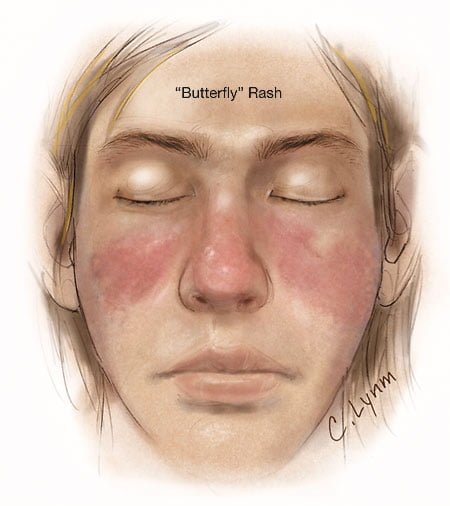
Image showing butterfly rash typical of SLE. Courtesy JAMA.
What Is Systemic Lupus Erythematosus?
S ystemic lupus erythematosus (SLE) is a chronic autoimmune inflammatory disease that is characterized by involvement of multiple organs due to the production of antibodies to components of the cell nucleus.1 SLE has an unpredictable course of acute flare-ups and remissions.
Severity depends on the extent of organs affected with skin and nail involvement, called discoid lupus, being the least serious and inflammmation of the kidney, called lupus nephritis, being the worst.
Nevetheless, a classic presentation is development of a rash over the cheeks and nose that resembles a butterfy with wings spread hence the name “butterfly rash.”
Symptoms are many and varied depending on the tissues affected and are often not specific, for example hair loss has a variety of causes. Symptoms can be confused by co-existence with other autoimmune disease such as Sjogren’s syndrome.
Systemic lupus erythematosus should be managed by a specialist. Symptoms can be controlled with steroid therapy, but this disease can be a cause of premature death mainly from active disease, organ failure (e.g., kidneys), infection, or cardiovascular disease from accelerated atherosclerosis.
Certain common medicines known to cause drug-induced lupus are:
Isoniazid
Hydralazine
Procainamide
Other less common drugs may also cause the condition. These may include:
Anti-seizure medications
Capoten
Chlorpromazine
Etanercept
Infliximab
Methyldopa
Minocycline
Penicillamine
Quinidine
Sulfasalazine
Symptoms tend to occur after taking the drug for at least 3 to 6 months.2
Although there is a strong familial aggregation, the disease is relatively uncommon and most cases are sporadic.1 According to the Center for Diseases (CDC), lupus most commonly affects women of childbearing age but also occurs in infants, children, adolescents, and men with peak occurrence between ages 15 and 40. Blacks (and possibly Hispanics, Asians, and Native Americans) are affected more than Whites.
What Is Systemic Lupus Erythematosus In Celiac Disease and/or Gluten Sensitivity?
Cutaneous vasculitis is a vascular disease of small blood vessels serving the skin that is characterized by segmental (spotty) inflammation of affected vessel walls resulting in their necrosis (destruction). Scarring is seen in the affected skin that lies over the destroyed blood vessels.
Skin appearance varies from small flat, purplish spots to raised purplish areas over damaged vessels.
In most cases, cutaneous vasculitis results from deposits of toxic immune complexes in the affected vessel walls that is caused by autoimmune activity targeting small blood vessels.1
Cutaneous vasculitis can also result from infection, drug reactions, or malignancies.
Who is Affected in the general Population? Cutaneous vasculitis affects all ages.
The overall annual incidence of cutaneous vasculitis was 38.6 persons per million in 1998.2
What Is Cutaneous Vasculitis In Celiac Disease and/or Gluten Sensitivity?
Sources:
Abenavoli L, Proietti I, Leggio L, Ferrulli A, Vonghia L, Capizzi R, Rotoli M, Amerio PL, Gasbarrini G, Addolorato G. Cutaneous manifestations in celiac disease. World J Gastroenterol. 2006 Feb 14;12(6):843-52. [↩]
Watts RA, Jolliffe VA, Grattan CE, Elliott J, Lockwood M, Scott DG. Cutaneous vasculitis in a defined population–clinical and epidemiological associations. J Rheumatol. 1998 May;25(5):920-4. [↩]
 What Is Pityriasis Rubra Pilaris?