

The Grains That Contain Dietary Gluten
Although few in number, the gluten-containing grains, called toxic or unsafe grains, are widely used in food preparation. The excessively high use of unsafe grains in the Western diet makes avoiding consumption difficult. The chart below highlights the four gluten-containing grains, popular strains of wheat, and triticale. Triticale does not naturally occur but is hybidized by crossing wheat with rye.
- Wheat and these wheat strains: Durum, Kamut, Spelt, Einkorn, Emmer, Farro.
- Barley.
- Rye.
- Triticale (wheat / rye hybrid).
- Oat.
Anatomy Of Gluten-Containing Grains
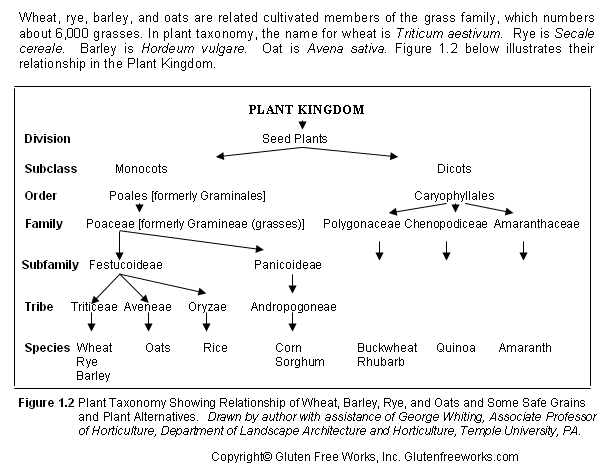
Gluten that is the cause of immune responses in susceptible individuals is a formless storage protein in wheat, rye, barley and oat grains. These grains belong to the grass family of seed plants, called cereal grains. Gluten is called a “storage protein” because it is stored, or inactive, until the seed begins to grow.
Cereals consist of 12-14 percent water, 65-75 percent carbohydrates, 2-6 percent lipids and 7-12 percent protein.1 Gluten constitutes about 80% of the proteins contained in wheat.
Each grain, or seed, is composed of a hull, bran, aleurone layer, endosperm and germ.
- The hull is a covering that seals and protects the embryonic plant from the environment.
- The bran is a layer of insoluble fiber that lies below the hull. Both hull and bran are high in cellulose, pentosans (complex sugars) and ash.
- The thin aleurone layer lies under the bran and covers the endosperm. The aleurone layer contains 25 times more minerals than the endosperm and is rich in fat. Its main purpose is to release energy from the endosperm for the growing plant and provide nutrients.
- The endosperm consists of stored nutrients and energy to be used by the plant upon germination. It contains mostly starch, has a lower protein content than the germ and the bran, and is low in fat and ash.
- The germ is a complete miniature living plant.
So we see that gluten is a protein combined with starch in the endosperm of wheat, barley, rye, and oat grains and as such it is distinct from the living protoplasm (germ).
Below is an illustration of a grain of wheat to show its structure.

Figure. 1.0. Wheat Seed Illustration By Joanna Libonati for Gluten Free Works, Inc. Identifies The Bran, Endosperm And Germ.
Gluten Is The Causal Trigger In Gluten Sensitive Reactions
Gluten is composed of a mixture of smaller parts called peptides. These peptides are of two types: 1) water soluble peptides called glutenins, and 2) alcohol soluble peptides called prolamines. Most modern wheat varieties contain up to 100 highly related, but distinct gluten proteins.2
The prolamines that trigger health problems (gluten sensitivity reactions, celiac disease reactions, allergies, and related health disorders) are gliadin in wheat, secalin in rye, hordein in barley, and avenin in oats. These prolamines are rich in proline and glutamine amino acid sequences (arrangements) that set the stage for immune reactivity.
- In wheat, the gliadin protein family contains α-gliadins, γ-gliadins, and ω-gliadins while the glutenin protein family contains low molecular weight (LMW) and high molecular weight (HMW) glutenins. The LMW glutenins bear strong resemblance to the γ-gliadins but the HMW glutenins are distinct from the other gluten proteins. The HMW glutenins are largely responsible for the baking quality of dough.3
- In oats, the globulins comprise 50–80% of the seed protein and the prolamins 10–20% which is opposite that found in wheat, barley, and rye. However, the prolamin component of the oat seed, the avenins, shares the basic feature of other cereal prolamins as being polypeptides relatively rich in proline and glutamine. It is these regions of the amino acid sequences that are associated with the elicitation of celiac disease.4 A study of avenin antibodies showed that they followed the same pattern as gliadin antibodies, but with a slightly lower magnitude.5
Gluten is poorly digested in the human intestine with or without celiac disease.6 High proline content renders these proteins resistant to complete proteolytic digestion by gastric, pancreatic, and brush border enzymes in the human intestine, since these enzymes are deficient in prolylendopeptidase activity, making it possible for large immunogenic gluten peptides to accumulate and reach the mucosal surface.7
In celiac disease, the peptides become immunogenic (able to trigger the immune system) after they have been modified by the naturally occurring enzyme tissue transglutaminase (TG2) in the small intestinal lining. This modification results in the conversion of glutamine residues in the gluten peptides into the negatively charged glutamic acid. This generates peptides that bind strongly to the disease predisposing HLA-DQ2.5 or HLA-DQ8 molecules (inherited genetic material) and this facilitates the induction of disease-inducing CD4 T cell responses.8
CD4 T cells are markers on the surface of immune cells that play central roles in the function of the immune system: They help B cells make antibody, enhance and maintain responses of CD8 T cells, regulate macrophage function, orchestrate immune responses against a wide variety of pathogenic microorganisms, and regulate/suppress immune responses both to control autoimmunity and to adjust the magnitude and persistence of responses. CD4 T cells are important mediators of immunologic memory.9
Gluten-Containing Grains As Food
Figure 1.1 Gluten-Containing Grains.
- WHEAT. Over 10,000 wheat varieties are known worldwide. Through natural hybridization, tetraploid and hexaploid wheat varieties have evolved from ancient diploid varieties. While the tetraploid varieties are known as pasta wheat, the hexaploid varieties are used for the preparation of bread. In contrast to the ancient diploid species, that often yield only small amounts of gluten and are thus of no or limited commercial interest, the presently used commercial pasta and bread wheat varieties have been selected to produce large amounts of gluten and the expression of those high molecular weight glutenins that are optimal for dough quality and baking properties.2
- By law, wheat is the grain referred to whenever the name “flour” is used alone. Any other use of “flour” must identify the grain, such as rye flour or rice flour. Gluten constitutes about 80% of the proteins contained in wheat. It is by far the most common source of gluten, appearing in about 95% of processed foods.
- Wheat grain is milled into white flour, whole wheat flour, and coarse meal for a great number of uses. Over the centuries, wheat flour has been preferred in baking over other flours due to its unique elasticity and stickiness. These properties trap the air produced by yeast or raising agents, making dough and batter rise. Gluten holds other ingredients in suspension, allowing for a great variety of baked goods. At baking temperatures gluten coagulates, which maintains the shape of the product.
- Flour and wheat starch are widely used as thickeners in condiments, sauces, gravies, soups, and casseroles.
- Flour is used to bind or coat foods, such as meat before frying. Frozen potato products, French fries for example, can be dusted with flour at the manufacturing facility to prevent sticking. Bread crumbs are used to fill or coat many dishes, including meat loaf, meatballs, sausage, patties and fried dishes.
- The whole grain is used in cereals, bread, and cooked as a side dish such as couscous.
- One hundred percent wheat gluten, called seitan, becomes firm to the bite and absorbs the surrounding broth and taste when cooked. It is substituted for meat by vegetarians. In other foods, such as bread and meat batters, gluten is added to increase the total protein content.
- RYE. Rye grain is milled into coarsely ground meal and rye flour. The flour is usually mixed with wheat for bread-making because the gluten in rye provides stickiness but lacks elasticity.
- Rye meal is used in cereal, crackers, crisps, and muffins.
- Rye is a grain used in making whiskey and other alcoholic products.
- BARLEY. Barley grain is milled into coarsely ground meal and flour for use in baked goods, such as breads, rolls, and crackers.
- Barley is added to cold cereals like flakes, puffs, and granolas. It appears as malt or malt flavoring to provide flavor and coat cereals in order to keep them crisp. This practice contaminates “safe” grain cereals, such as corn flakes, corn puffs, rice flakes, and rice puffs.
- Soups, casseroles, and side dishes use the whole grain pearl barley or pot barley.
- Barley is used in making traditional beer and ales.
- OAT. Oat grain is milled into flattened kernels and coarsely ground flour. The flour is mixed with wheat for bread and dough making.
- Oats are widely used in granola, cereals, cookies, muffins, soups, and as a thickener.
- Oat bran is milled separately.
Gluten-Containing Grains and Nutrition
The grains containing gluten are not necessary for good nutrition. Any nutritive benefit they have is cancelled by their damaging effect in a person with gluten sensitivity, particularly celiac disease.
Wheat, rye, barley, and oats can be replaced with other foods including gluten-safe grains such as rice and millet. In addition, alternative flour is also available made from ground nuts, vegetables like potatoes and tapioca, legumes that include beans, peas, lentils, and peanuts, and seeds such as buckwheat, amaranth, and quinoa. These safe foods have nourished people throughout history.
Sources:
- http://www.fao.org/docrep/x2184e/x2184e04.htm [↩]
- Koning F. Celiac disease: quantity matters. Semin Immunopathol. 2012 Jul;34(4):541-9. doi: 10.1007/s00281-012-0321-0. Epub 2012 Jun 26. [↩] [↩]
- Koning F. Celiac disease: quantity matters. Semin Immunopathol. 2012 Jul;34(4):541-9. doi: 10.1007/s00281-012-0321-0. Epub 2012 Jun 26. [↩]
- Anderson OD. The Spectrum of Major Seed Storage Genes and Proteins in Oats (Avena sativa). PLoS One. 2014; 9(7): e83569. Published online Jul 23, 2014. doi: 10.1371/journal.pone.0083569 [↩]
- Hollen E, Hogberg L, Stenhammar L, Falth-Magnusson K, Magnusson KE. Antibodies to oat prolamines (avenins) in children with coeliac disease. Scandanavian Journal of Gastroenterology. 2003;7:742-6. [↩]
- Ludvigsson JF1, Leffler DA, Bai JC, Biagi F, Fasano A, Green PH, Hadjivassiliou M, Kaukinen K, Kelly CP, Leonard JN, Lundin KE, Murray JA, Sanders DS,Walker MM, Zingone F, Ciacci C. The Oslo definitions for coeliac disease and related terms. Gut. 2013 Jan;62(1):43-52. doi: 10.1136/gutjnl-2011-301346. [↩]
- Pozo-Rubio T, Olivares M, Nova E, De Palma G, Mujico JR, Ferrer MD, Marcos A, Sanz Y. Immune development and intestinal microbiota in celiac disease. Clin Dev Immunol. 2012;2012:654143. [↩]
- Koning F. Celiac disease: quantity matters. Semin Immunopathol. 2012 Jul;34(4):541-9. doi: 10.1007/s00281-012-0321-0. Epub 2012 Jun 26. [↩]
- Zhu J, Yamane H, Paul WE. Differentiation of effector CD4 T cell populations (*). Annu Rev Immunol. 2010;28:445-89. doi: 10.1146/annurev-immunol-030409-101212. [↩]