Skip to content

PMS (Premenstrual Syndrome) 

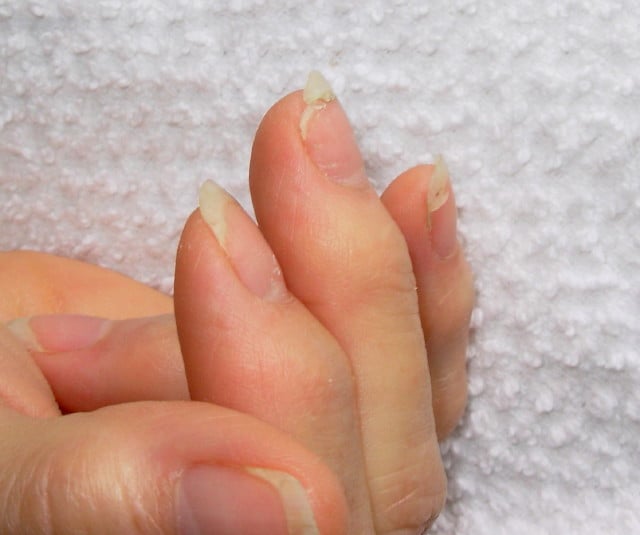
DSCN4758aWhat Are Brittle Nails?

B rittle nails are abnormalities of the nail plate that are characterized by poor nail structure affecting all fingernails and toenails seen as thin, dry nails that easily chip, split, and are difficult to maintain a clean edge. Usually longitudinal ridging occurs from the nail base to the tips.

Q: What is the nail plate?

A: The nail plate is the hard keratin cover protecting the finger tip and toe tip. The nail plate (non-living tissue) is produced by the nail matrix (living tissue) at the base of the nail plate under the lunula (moon), which is the site of brittle nail development.

Nail Anatomy. A. Nail plate; B. lunula; C. root; D. sinus; E. matrix; F. nail bed; G. hyponychium; H. free margin. Courtesy Wikipedia.org

Poor nail structure affecting all nails may be a feature of nutritional deficiency in poor diet or malabsorption such as occurs in celiac disease.

Some other causes are: idiopathic (unknown cause), the result of aging, the effects of certain drugs, or an association with systemic autoimmune disorders such as vitiligo, alopecia areata (with pitting), psoriasis (with pitting), and lichen planus. 

External (non-nutritional or disease) causes of dry, brittle nails, such as detergents and cleaners, would only affect fingernails but not toenails.

Note: It has been shown that working with your hands in water or soaking them through activities like swimming does not cause dry, brittle nails but will worsen them.

What Are Brittle Nails In Celiac Disease and/or Gluten Sensitivity?

Irritability

Small Bowel Volvulus, Courtesy  African Journal of Pediatric Surgery.
Small Bowel Volvulus Caused the  Enlarged Dark Loops. Courtesy African Journal of Pediatric Surgery.

What Is Volvulus?

V olvulus is twisting of a loop(s) of bowel onto itself which effectively closes it thus preventing digested matter from passing and causing engorgement of the closed loop with gas and fluid.

Q: How does the bowel get untwisted?

A: This condition usually necessitates surgical correction although some do return to their proper position.

The danger is that there may develop necrosis of the twisted loop(s) in which case, if left untreated, death will ensue.

What Is Volvulus In Celiac Disease and/or Gluten Sensitivity?

Melanoma

Enamel_celiac[1]What Are Dental Enamel Defects?

D ental enamel defects (DED) comprise a variety of abnormalities in the dental enamel of the second or permanent teeth and of primary or baby teeth.

Teeth may appear with pits, thin or missing enamel, non-white enamel (yellow, orange, or gray colored teeth), and demarcated opacities (very white spots) even if teeth are white.

Q: What is enamel?

A: Dental enamel is the shiny, hard, white, dense, inorganic substance covering the crowns of the teeth. The crown is the tooth portion above the gum. Under the enamel is hard dentin which surround the living pulp. In teeth with missing enamel, the areas with exposed dentin appear dull and tan colored.

What Are Dental Enamel Defects In Celiac Disease and/or Gluten Sensitivity?

Pityriasis Rubra Pilaris

Vitamin C Deficiency: Clean Teeth with Swollen Gums.
Vitamin C Deficiency: Swollen Gums.

What Are Bleeding / Swollen Gums?

B leeding and/or swollen gums is  an inflammatory disorder characterized by changes in gum integrity that may result in tooth loss.

Sponginess of the gum (swelling) indicates inflammation, called gingivitis. 

Q: What causes gingivitis?

A: Gingivitis that is caused by inadequate dental hygiene shows as pockets of swollen gum between or along the base of teeth where sticky plaque was allowed to build up. Plaque holds bacteria that inflames the gums where it occurs.

Gingivitis that is caused by vitamin C deficiency, pregnancy, certain drugs such as the anti-epileptic drug phenytoin, and leukemia affects the whole gum irrespective of mouth care.

What Are Bleeding / Swollen Gums In Celiac Disease and/or Gluten Sensitivity?

Lymphoma, B-Cell Non-Hodgkin’s

e3343bf0a689b5f974a852fa2e84a718What Is Laryngospasm?

L aryngospasm is an acute disorder of the larynx that is characterized by life-threatening spasms of the muscles of the larynx located in the throat.

Laryngospasm is a rare feature of hypocalcemia (low blood calcium level) characterized by severe alteration in nerve conduction and muscle contraction.

What Is Laryngospasm In Celiac Disease and/or Gluten Sensitivity?

Celiac Disease, Refractory

Anatomy of Upper Airway and Throat. Courtesy Wikipedia.org

What Is Post-Cricoid Carcinoma?

P ost-cricoid carcinoma is a rare malignancy arising in the hypopharynx.

Q: What is the hypopharynx?

A: The hypopharynx is the lower portion of the pharynx that opens into the larynx. It is comprised of the postcricoid region, pyriform sinus, and posterior hypopharyngeal wall.

Tumors rarely appear in the posterior pharyngeal wall or postcricoid region without also involving the pyriform sinus. The lack of anatomic barriers between these sites and a propensity for these tumors to develop in the pyriform sinus and spread outward account for this phenomenon.

Overall prognosis for these tumors is poor. Because of the rich organic lymphatic and vascular networks, aggressive growth and early cervical metastases (compared with cancers at other head and neck sites) characterize these cancers.

A study investigating the clinical course of 21 patients with post-cricoid carcinoma found the 5-year cause-specific survival rate was 52%. All the patients who eventually died did so within 3 years of the treatment. Seven patients had distant metastases, representing a higher frequency as compared with that of patients with recurrence of the primary focus and cervical lymph node metastasis. All of these patients who had been treated by surgery died of the cancer.1

Unfortunately, hypopharyngeal cancers are discovered at a later stage than other head and neck cancers. The delay in diagnosis from symptom onset averages 10 months.2

What Is Post-Cricoid Carcinoma In Celiac Disease and/or Gluten Sensitivity?

Sources:
  1. Asakage T, Nakao K, Ebihara Y, Fujishiro Y, Watanabe K. A clinical study of post-cricoid carcinoma. Acta Otolaryngol Suppl. 2007 Dec;(559):118-22. doi: 10.1080/03655230701599354. []
  2. http://emedicine.medscape.com/article/848359-overview []

Lymphomas, Extraintestinal

What Is Dysphagia? D ysphagia is a functional upper digestive disorder characterized by difficulty in swallowing or food getting stuck and swallowing that takes longer than 10 seconds to complete. Q: What determines the symptoms?… 

Diabetic Instability 

Vertebrae. Courtesy FreePik.com

What Is Elevated Bone Alkaline Phosphatase?

E levated bone alkaline phosphatase (BALP) is a laboratory result that indicates an abnormal blood level of this bone enzyme.

A bone alkaline phosphatase blood level is one of the most frequently used biochemical markers of bone formation.

Q: Why is the purpose of  bone alkaline phosphatase?

A: Bone alkaline phosphatase is produced by bone cells called osteoclasts in normal bone maintenance for the purpose of breaking down old or damaged bone so that other bone cells called osteoblasts can fill in the excavated areas with new bone. This process keeps bone stong and healthy.

Elevated bone alkaline phosphatase shows that more bone is being broken down than is being replaced. It can be caused by hyperparathyroidism, bone tumors from cancer, and malnutrition.

What Is Elevated Bone Alkaline Phosphatase (BALP) In Celiac Disease and/or Gluten Sensitivity?

Pancreatic Insufficiency

Model of coagulation factors found in blood.

What Are Low Coagulation Factors?

C oagulation factors II, VII, IX, X found in blood are essential for normal blood clotting.  Low coagulation factors on blood assay indicate an altered secondary coagulation disorder that is characterized by impaired clot formation.

Each coagulation factor must be present in sufficient quantity in order for normal clotting to occur, but the level required is different for each factor. Results are frequently reported as a percentage with 100% being normal. For example, a factor VIII that is 30% would be considered abnormally low.1

The production of the coagulation factors II, VII, IX, and X requires vitamin K without which the factors will be low.

Q: What happens when coagulation factors II, VII, IX, and X are low?

A: When any of the blood clotting factors are lacking or not working properly, the blood tests prothrombin (PT) and partial thromboplastin time (PTT) will be abnormally prolonged. Prothrombin and partial thromboplastin time measure the time it takes for blood to clot.  When you bleed, the body launches a series of activities that help the blood clot. This is called the coagulation cascade. There are three pathways to this event. These tests looks at coagulation factors, found in two of these pathways.2

What Are Low Coagulation Factors In Celiac Disease and/or Gluten Sensitivity?

Sources:
  1. http://labtestsonline.org/understanding/analytes/coagulation-factors/tab/test []
  2. http://www.nlm.nih.gov/medlineplus/ency/article/003653.htm []

Edema

Cachexia with Wasted Muscles, Weakness, and That Developed over 3 Years Time.
Cachexia with Wasted Muscles, Weakness, Weight Loss, Anemia, Skin Hemorrhages, Anorexia. GFW

What Is Cachexia?

C achexia is a state of ill health involving deteriorating body composition that is characterized by general malnutrition and loss of lean tissue such as muscle.

Q: What are typical findings in cachexia?

A: Arm muscle triceps (the muscles at the back of the upper arm), skin folds, subscapular skin folds, fat area index, and bone mineral content are significantly lower than normal.

Cachexia may develop in protein-losing enteropathy such as celiac disease, chronic or severe infection such as pneumonia, tuberculosis, malaria, or many chronic diseases such as heart failure and cancer.

Cachexia can develop in persons of any age.

What Is Cachexia In Celiac Disease and/or Gluten Sensitivity?