Skip to content

Colitis, Ulcerative

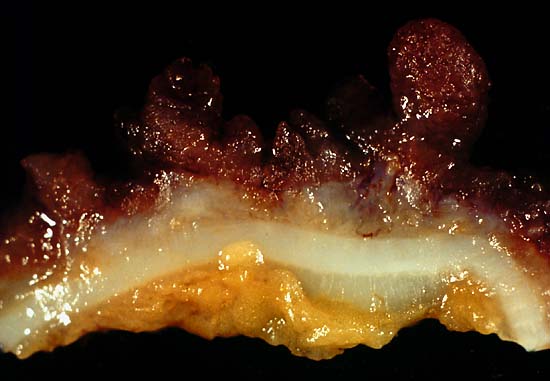
This photo was from a total colectomy done for clinically severe, intractable chronic ulcerative colitis. It shows a closer view of a longitudinal section through the colon wall. This demonstrates not only the angry red mucosa but also the tendency for the inflamed tissue to throw itself up into inflammatory pseudopolyps. Source: Ed Uthman, MD. Public domain.
This photo is from a total colectomy done for severe, intractable chronic ulcerative colitis. It shows a close view of a lengthwise section through the colon wall. This demonstrates not only the angry red mucosa, but also, the tendency for the inflamed tissue to throw itself up into inflammatory pseudopolyps.
Source: Ed Uthman, MD. Public domain.

What Is Ulcerative Colitis?

Ulcerative colitis is an inflammatory disorder of the colon characterized by continuous inflammation of the mucosa and submucosa usually with small ulcers, extending from the rectum and typically involving the distal colon, rectum, and anus and producing bloody diarrhea.

While the severity of ulcerative colitis varies among patients, iron deficiency anemia often develops due to blood loss especially when there are many bloody bowel movements in a day.

The onset of ulcerative colitis is most commonly in young adulhood.

Q: Is this disease painful?

A: Yes with the passage of stool.

Psychological stress and subsequent dysbiosis exacerbate ulcerative colitis.

Psychological stress activates multiple physiological processes aimed at maintaining balance within the body. These physiological processes also have the capacity to influence the composition of microbial communities in the digestive tract, and research now indicates that exposure to stressful stimuli leads to gut microbiota dysbiosis.1

While the relative abundance of many different bacterial types can be altered during stressor exposure, findings in nonhuman primates and laboratory rodents, as well as humans, indicate that bacteria in the genus Lactobacillus are consistently reduced in the gut during stress.2

Presently, ulcerative colitis cannot be cured. This condition has a course of remissions, when symptoms subside, and flares, when symtpoms get worse. Treatment is aimed to reduce flares and promote remission. In all cases, correction of dysbiosis improves the condition.

Ulcerative colitis is associated with increased incidence of cancer of the colon.3

What Is Ulcerative Colitis In Celiac Disease and/or Gluten Sensitivity?

Sources:
  1. Galley JD, Bailey MT. Impact of stressor exposure on the interplay between commensal microbiota and host inflammation. Gut Microbes. 2014 May 1;5(3):390-396. Epub 2014 Apr 1. []
  2. Galley JD, Bailey MT. Impact of stressor exposure on the interplay between commensal microbiota and host inflammation. Gut Microbes. 2014 May 1;5(3):390-396. Epub 2014 Apr 1. []
  3. Taber’s Cyclopedic Medical Dictionary. F. A. Davis. Philadelphia, PA []

Muscle Wasting 

Multiple Gastric Ulcerations. Courtesy Dr. Krum.

What Are Multiple Gastric Ulcerations?

M ultiple gastric ulcerations denote a stomach disorder that involves damage to the superficial mucosa characterized by many sores of the stomach antrum that are marked by inflammation, necrosis (death of the affected cells) and sloughing of destroyed tissue.

Q: Where is the stomach antrum?

A: The antrum is the lower region of the stomach before the pylorus which is nearest the duodenum (first part of the small intestine). The stomach and duodenum are separated by the powerful pyloric sphincter.

The stomach antrum propels food in the stomach against the pylorus which resists passage of food until it is turned into chyme. Chyme is highly acidic liquified food that has been thoroughly mixed with stomach juices.

Gastric ulcerations are typically associated with widespread gastritis (inflammation), inflammatory involvement of acid producing cells, and atrophy of acid and pepsin producing cells.1

The primary causes of gastric ulcerations are H. pylori infection, use of Aspirin and non-steroidal drugs (NSAIDS), and stress.1

What Are Multiple Gastric Ulcerations In Celiac Disease and/or Gluten Sensitivity?

Sources:
  1. Kathleen Mahan and Sylvia Escott-Stump, ed. Krause’s Food, Nutrition & Diet Therapy, 10th Edition. Philadelphia, PA. USA: W.B. Saunders Company, 2000. [] []

Helicobacter Pylori Infection (H. Pylori)

What Is Helicobacter Pylori (H. Pylori) Infection? Helicobacter pylori infection is a potentially deadly stomach disease characterized by chronic superficial inflammation and ulcerations in 100% of infected patients. This infection disrupts normal defense and repair… 

DHA (Docosahexaenoic Acid) Deficiency

Smoked Salmon...Brain Food that's Good for the Eyes!
Salmon…Brain Food That’s Good for Your Eyes, Heart, Blood Vessels, Blood Sugar, Liver, Muscles, and Fights Inflammation!

What Is DHA?

Docosahexaenoic acid (DHA) is an essential omega-3 fatty acid that is abundant in the brain, being crucial in brain structure. As such DHA is a key component of neuronal membranes together with arachidonic acid (a major opposing omega-6 fatty acid), making up 15-20% of the brain’s dry mass.

This polyunsaturated fatty acid is obtained from fish sources of food.

In healthy human volunteers, positron emission tomography (PET) has shown that the normal human brain consumes 4.6 mg/day of DHA.1

DHA is particularly concentrated in highly active membranes such as nerve synapses (junctions) and photoreceptors in the eye (retina).

Q: How much DHA is in the retina?

A: DHA makes up more than 30% of the retina.2

In other roles, DHA is an  important building material for the eicosanoids, a large group of highly bioactive hormone-like substances including prostaglandins, leukotrienes, and thromboxanes that are involved in blood clotting, inflammation, and vasoconstriction.

DHA has been shown to increase insulin sensitivity as opposed to the opposite problem of insulin resistance, to improve muscle mass, and protect against non-alcoholic fatty liver disease.3

Egert et al. in a study of people aged 19 to 43 years with normal cholesterol showed that DHA intake significantly increased serum HDL (good) cholesterol. Also, DHA significantly decreased fasting serum triglycerides.4

What Is DHA Deficiency In Celiac Disease and/or Gluten Sensitivity?

Sources:
  1. Rapoport SI. Brain arachidonic and docosahexaenoic acid cascades are selectively altered by drugs, diet and disease. Prostaglandins Leukot Essent Fatty Acids. 2008 Sep-Nov;79(3-5):153-6. Epub 2008 Oct 29. []
  2. Richardson AJ. The importance of omega-3 fatty acids for behavior, cognition, and mood. Scandinavian Journal of Nutrition. 2003;47(2):92-8 []
  3. Espinosa A, Valenzuela R, González-Mañán D, D’Espessailles A, Guillermo Gormaz J, Barrera C, Tapia G. Prevention of liver steatosis through fish oil supplementation: correlation of oxidative stress with insulin resistance and liver fatty acid content. Arch Latinoam Nutr. 2013 Mar;63(1):29-36. []
  4. Egert S, Kannenberg F, Somoza V, et al. Dietary alpha-linolenic acid, EPA, and DHA have differential effects on LDL fatty acid composition but similar effects on serum lipid profiles in normolipidemic humans. J Nutr. 2009;139:861–868. doi: 10.3945/jn.108.103861 []

EPA (Eicosapentaenoic Acid) Deficiency

Macherel...
Macherel…EPA Rich!

What Is EPA?

EPA (eicosapentaenoic acid) is an essential omega-3 fatty acid that is crucial for fetal brain and retina development and the child’s subsequent neurodevelopment among very many other activities in people of all ages.

Omega-3 fatty acids  are polyunsaturated long chain fatty acids which must be obtained from animal foods since they do not occur in plants.

In all ages, EPA is essential for normal brain function.

Q: Why is EPA essential to the way the brain works?

A: EPA helps nerve cells in the brain to communicate with each other.

In pregnancy, EPA may also play a role in determining the length of gestation and in preventing perinatal depression in the mother.1 and is essential for normal growth in children.

EPA is important building material for the eicosanoids, a large group of highly bioactive hormone-like substances including prostaglandins, leukotrienes, and thromboxanes that are involved in blood clotting, inflammation, and vasoconstriction. Its many important functions are described below.

What Is EPA Deficiency?

Sources:
  1. Coletta JM, Bell SJ, and Roman AS. Omega-3 Fatty Acids and Pregnancy. Rev Obstet Gynecol. 2010 Fall; 3(4): 163–171 []

Alpha-Linolenic Acid Deficiency

Flaxseed Crispbread is Loaded with Alpha-Linolenic Acid.
Flaxseed Crispbread…Loads of Alpha-Linolenic Acid.

What Is Alpha-Linolenic Acid?

Alpha-linolenic acid is an essential (need/can’t make) polyunsaturated omega-3 fatty acid that must be obtained in the diet. Alpha-linolenic acid is found in plant sources only.

Alpha-linolenic acid is required for normal brain function and nervous system health. It is an important building material for the eicosanoids.

Q: What are eicosanoids?

A: Eicosanoids are a large group of highly bioactive hormone-like substances including prostaglandins, leukotrienes, and thromboxanes that are involved in blood clotting, inflammation, and vasoconstriction (constriction of blood vessels).

Alpha-linolenic acid is a “parent” fatty acid because if sufficient amounts are present in the body, it can be used to produce both eicosapentanoic acid (EPA) and docosahexaenoic acid (DHA), two other critical omega-3 fatty acids.1 However, this conversion is limited. In healthy individuals, the conversion rate of ALA to EPA is less than 5 to 10% and ALA to DHA is only 2 to 5%.

Additionally, a deficient level of the mineral selenium can interfere with the conversion of alpha-linolenic acid into EPA and DHA. Also, folic acid supplement has been shown to increase omega-3 status and, conversely, to decrease omega-3 when folic acid is in deficient in animal models.

What Is Alpha-Linolenic Acid Deficiency?

Sources:
  1. Richardson AJ. The importance of omega-3 fatty acids for behavior, cognition, and mood. Scandinavian Journal of Nutrition. 2003; 47(2):92-8 []

Calcium Deficiency

active-milk-quality-picture-material_38-4418What Is Calcium?

Calcium is the most abundant mineral in the body, with 99% residing in teeth and bones where it constitutes 40% of skeletal bone weight along with 45% phosphorus.

As a component of hard tissues, calcium fulfills a structural role to maintain body size and acts as attachments for musculoskeletal tissues.

Q: What does the non-skeleton calcium do in the body?

A: The remaining 1% of calcium is present in blood and soft tissues. Calcium levels in the blood are maintained within very strict limits by dietary intake, hormonal regulation and a rapidly exchangeable pool in bone tissue. The many important functions are described below.

What Is Calcium Deficiency In Celiac Disease and/or Gluten Sensitivity?

Obesity

KONICA MINOLTA DIGITAL CAMERAWhat Is Obesity?

Obesity is an inflammatory metabolic disorder that is characterized by body mass index greater than 30% resulting from excessive body fat stored in adipose tissue.

Q: What is body fat?

A: Body fat is part of the body that functions as a reserve of stored energy. It is composed of fat cells, called adipocytes, having thin membranes between these cells. Adipocytes expand to store fat and shrink as fat is released as needed into the bloodstream for other body cells to use for metabolizing energy.

Each adipocyte contains a drop of triglyceride which is a type of lipid (fat). Triglycerides are a normal component in the bloodstream and, as such, are transported wherever needed as a form of energy. Excess triglycerides are the form of fat that is stored.

Initially, fat that is eaten in the diet is changed by digestive enzymes into the triglyceride form which is a molecule composed of three fatty acids and glycerol. Triglycerides are then absorbed through the small intestinal wall to be delivered to the liver. Of note, the liver can make triglycerides from excess protein and carbohydrates eaten in a meal, especially sugar and alcohol. The liver on the other hand makes cholesterol from triglycerides.

Triglyceride levels in the blood generally increase as weight increases. It is thought that an elevated blood triglyceride level hampers the body’s ability to feel full or satisfied with food that is eaten. Elevated triglyceride levels also increase the risk of clot formation because they cause the blood to become thicker. A normal triglyceride blood level is 150 mg/dL.

The causes of obesity are complex and varied. Those related to gluten sensitivity are discussed below.

What Is Obesity In Celiac Disease and/or Gluten Sensitivity?

Cardiomyopathy, Idiopathic Dilated

Heart showing dilated cardiomyopathy at autopsy. Courtesy
Enlarged heart showing dilated cardiomyopathy at autopsy. 

What Is Idiopathic Dilated Cardiomyopathy?

Idiopathic dilated cardiomyopathy (IDCM) is a disorder of myocardial (heart muscle) function characterized by dilation or enlargement of the cardiac chambers and reduction in the ability of the ventricles (lower chambers) to contract with the required force needed to pump blood out of the heart to the body.

Idiopathic means the cause is not known.

Q: What is the prognosis for idiopathic dilated cardiomyopathy?

A: This disorder often results in symptomatic heart failure due to the inability of the heart to pump blood as required to supply the body with oxygen and meet metabolic needs.

What Is Idiopathic Dilated Cardiomyopathy In Celiac Disease and/or Gluten Sensitivity?

Gastric (Stomach) Ulcer

Photo by gastroscopy showing ulcer in the antrum area of the stomach.
Photo by gastroscopy showing ulcer in the antrum area of the stomach (lower area).

What Is A Gastric Ulcer?

Gastric ulcer is a painful stomach disorder characterized by an open sore involving the mucosa lining and deeper muscle layer of the stomach.

Gastric ulcer is associated with lymphocytic gastritis which is inflammation of the mucosal lining of the stomach. The thick mucosal lining normally protects the stomach from the erosive action of stomach acid.

Q: How do ulcers develop?

A: Ulcers develop if  hydrochloric acid secreted by the gastric glands of the stomach for the purpose of digesting food damages the normally resistant mucosal walls of the stomach. In the reverse, ulcers may be accompanied by achlorhydria (insufficient acid production).

Damage occurs when there is a predisposing factor that alters the health of the mucosal lining. The most common cause is infection with a bacteria called h. pylori bacter, stress and chronic use of the pain relievers aspirin and non-steroidal drugs like ibuprofen.

Smoking tocacco and consuming alcohol aggravate an ulcer but do not cause it to develop.

The most common location for ulcer formation is along the stomach antrum which is the area of the stomach before the pylorus, the lower region that empties liquid stomach contents into the small intestine.

What Is A Gastric Ulcer In Celiac Disease and/or Gluten Sensitivity?