Skip to content

Arthritis, Juvenile Idiopathic

Lymphadenopathy.
Lymphadenopathy affecting a node in the neck.

What Is Lymphadenopathy?

L ymphadenopathy is an alteration of lymph nodes that is characterized by enlargement of lymph nodes greater than 1.5 cm caused by proliferation (increased production) of lymphocytes within the node.

Q: What are lymph nodes?

A: Lymph nodes are part of the lymphatic system, acting to protect body fluids by filtering out and destroying bacteria and other harmful substances from lymph that is continually carried to them by lymph vessels.

Cleaned lymph is carried away from the nodes by lymph vessels to the bloodsteam where it helps forms blood plasma. Lymph nodes produce various blood cells needed to fight infection which includes lymphocytes.

Lymphocytes are small white blood cells that plays a major role in defending the body against disease. There are two types of lynphocytes: B cells, which make antibodies that attack bacteria and toxins, and T cells which attack body cells themselves when they have been taken over by viruses or become cancerous.

Lymph nodes that become enlarged doing battle with an infection or as a result of injury nearby usually resolve with treatment of the infection or injury. However, if the cause is cancer, the nodes would need to be treated as well as the cancer.

What Is Lymphadenopathy In Celiac Disease and/or Gluten Sensitivity?

Sperm Abnormalities 

This 21 year-old woman (left) appears as old as her 70 year-old granny (right). Courtesy Prof Dr Chua Chung Nen
This 21 year-old woman (right) appears as old as her 70 year-old grandmother (left). Courtesy Prof Dr Chua Chung Nen

What Is Acquired Cutis Laxa?

A cquired cutis laxa is an uncommon skin disorder characterized by abnormal reduction and degeneration of elastic fibers of the skin that can appear simply as thick, saggy skin with loose folds to severe involvement showing a premature aged appearance.

Q: What are elastic fibers of the skin?

A: Elastic fibers of the skin are connective tissue found in the dermis, which is the layer of skin under the epidermis, or surface layer. They hold the shape of skin and are important for wound healing in the development of scars.

What Is Cutis Laxa In Celiac Disease and/or Gluten Sensitivity?

Tongue – Beefy Red, Smooth, Burning 

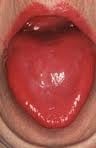
tongue in B12 deficiencyWhat Is Beefy Red, Smooth, Burning Tongue?

Beefy, red, smooth, burning tongue is an inflammatory alteration in tongue tissue characteristic of vitamin B12 deficiency.

Inflammation makes the tongue red and sore which, when untreated, progresses to atrophied papillae (shrunken taste buds) that makes the tongue smooth.

Q: Why does vitamin B12 alter the tongue?

A: Vitamin B12 is essential for the metabolism of all cells, especially for those of the digestive tract of which the tongue is an organ.1

These easily seen changes to tongue tissue are an important diagnostic feature of deficient vitamin B12, which causes other devastating unseen damage, because the discomfort generally causes the individual to seek medical care.

What Is Beefy Red, Smooth, Burning Tongue In Celiac Disease and/or Gluten Sensitivity?

Sources:
  1. Krause’s Food, Nutrition, & Diet Therapy. 10th Edition. Kathleen Mahan, Sylvia Escott-Stump. 2000. W.B. Saunders Company. []

Short Duration of Breast Feeding 

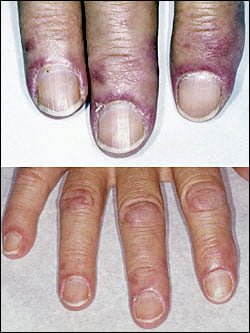
dermatomyositisWhat Is Dermatomyositis?

D ermatomyositis is a rare autoimmune systemic disease of the connective tissue that is characterized by inflammatory and debilitating degenerative changes in the muscles and in the skin. 

Dermatomyositis results in symmetric, proximal muscle weakness of limbs (upper arms and legs), and skin manifestations. 50-70% of patients have circulating myositis-specific auto-antibodies.

The course of dermatomyositis is unpredictable being marked by spontaneous flare-ups and remissions. It can begin slowly or abruptly according to the factor that is triggering the onset such as infection, medications like phenytoin, and autoimmune disease.

Q: What are the skin manifestations of dermatomyositis?

A: Classic skin manifestations of dermatomyositis include these features:

  • The heliotrope rash (lilac color) on upper eyelids.
  • Rash on face, neck, shoulders, upper chest, elbows, knees, knuckles, and back.
  • Gottron’s papules (scaly, red eruptions or  patches over the knuckles, elbows, and knees).
  • The V-sign (rash front of neck and chest).
  • The shawl sign (rash distribution on shoulders and back).1

Additional cutaneous manifestations are described below under symptoms.

Dermatomyositis is associated with an increased risk of  cancer, other autoimmune diseases, such as lupus and psoriasis, and it can be a complication of interferon-α therapy. About 1 person in 100,000 are affected according to various studies. While it affects all ages, women have twice the occurence of men.

There is no cure for dermatomyositis, but the symptoms can be treated.  Options include medication, physical therapy, exercise, heat therapy (including microwave and ultrasound), orthotics and assistive devices, and rest.  The standard treatment for dermatomyositis is a corticosteroid drug, given either in pill form or intravenously.  Immunosuppressant drugs, such as azathioprine and methotrexate, may reduce inflammation in people who do not respond well to prednisone.2

What Is Dermatomyositis In Celiac Disease and/or Gluten Sensitivity?

Sources:
  1. Marvi U, Chung L, Fiorentino DF. Clinical presentation and evaluation of dermatomyositis. Indian J Dermatol. 2012 Sep;57(5):375-81. doi: 10.4103/0019-5154.100486. []
  2. National Institute of Neurological Disorders and Stroke. []

Tongue – Fiery Red, Smooth, Burning

niacin deficiencyWhat Is A Fiery Red, Smooth, Burning Tongue?

A fiery red, smooth, burning tongue is an alteration in tongue tissue that is characteristic of advanced niacin deficiency.1

Q: How does niacin deficiency cause the tongue to be red and sore?

A: Niacin is an essential B vitamin that is required for a healthy tongue and by all body cells as well. Deficiency first shows in tissues with rapid cellular turnover, such as mucosal cells of the tongue.

When absorbed from the small intestines, niacin (the form in food) becomes the active form niacinamide. Niacinamide is converted by the body into co-enzymes which are present in all cells. These enzymes function in oxidation-reduction reactions essential for release of energy from carbohydrates, fats, and proteins and are needed as components for more than 200 enzymes involved in metabolism.

In addition to producing energy, niacinamide is essential for healthy skin and the mucosal lining of the digestive tract, normal functioning of the brain and nervous system, and production of steroid hormones from adrenal glands and hormones from sex glands.

What Is A Fiery Red, Smooth, Burning Tongue In Celiac Disease and/or Gluten Sensitivity?

Sources:
  1. Krause’s Food, Nutrition, & Diet Therapy. 10th Edition. Kathleen Mahan, Sylvia Escott-Stump. 2000. W.B. Saunders Company. []

Turner’s Syndrome 

Hyperkeratosis Back of Arm. GFW Photo.
Hyperkeratosis Back of Arm. GFW Photo

What Is Follicular Hyperkeratosis?

F ollicular hyperkeratosis is an abnormal skin condition characterized by disordered overgrowth of the horny layer of the epidermis with horny plugs filling the openings of hair follicles. The plugs look like bumps in hair follicles.

Follicular hyperkeratosis with corkscrew hairs (coiled hairs in the follicles) appears in scurvy, which is advanced vitamin C deficiency.1

Typical  hyperkeratotic papules first appear on the extensor surfaces of the extremities (e.g. the back of upper arms), shoulders, and buttocks.

Phrynoderma is a distinctive form of follicular hyperkeratosis with papule formation in dilated hair follicles believed to be a manifestation of severe malnutrition.

Q: Why does hyperkeratosis develop?

A: Follicular hyperkeratosis develops from lack of necessary nutrients to support healthy skin. Although originally thought to represent only vitamin A deficiency or vitamin C in the case of scurvy, several studies have demonstrated deficiencies of B vitamins and vitamin E. General malnutrition seems to be the strongest association. The clinical picture typically improves with enhanced nutritional status.2

What Is Follicular Hyperkeratosis In Celiac Disease and/or Gluten Sensitivity?

Sources:
  1. Krause’s Food, Nutrition, & Diet Therapy. 10th Edition. Kathleen Mahan, Sylvia Escott-Stump. 2000. W.B. Saunders Company. []
  2. Maronn M, Allen DM, Esterly NB. Phrynoderma: a manifestation of vitamin A deficiency?… The rest of the story. Pediatr Dermatol. 2005 Jan-Feb;22(1):60-3. []

Tongue – Pale, Smooth, Burning

Swollen Tongue Causing Tooth Indentations. GFW
Swollen Tongue Causing Tooth Indentations. Notice the Accompanying Denuded Area Due to Riboflavin Deficiency and Mild Candida Overgrowth. GFW

What Is A Pale, Smooth, Burning Tongue?

A pale, smooth, burning tongue is an alteration in tongue tissue characteristic of iron deficiency. The tongue is also swollen.1

Additionally, the sore tongue surface may be invaded by candida yeast which takes advantage of the sore tissue.

Iron deficiency itself increases susceptibility to infection.

Q: What is iron deficiency?

A: Iron deficiency results when the level within cells is too low to meet metabolic needs of the body for this mineral.

Deficiency is characterized by impaired red blood cell formation, free-radical disposal, oxygenation of cells, immune response to infection, enzyme activity, cognitive performance, digestion, nail structure, and fetal health.2

Iron is an essential mineral that is required for normal body function. Almost two-thirds of iron in the body is found in hemoglobin, the protein in red blood cells that carries oxygen to tissues. Smaller amounts of iron are found in myoglobin, a protein that helps supply oxygen to muscle, and in enzymes that assist biochemical reactions.

Iron is also found in proteins that store iron for future needs and that transport iron in blood. Iron stores are regulated by intestinal iron absorption.3

What Is A Pale, Smooth, Burning Tongue In Celiac Disease and/or Gluten Sensitivity?

Sources:
  1. Krause’s Food, Nutrition, & Diet Therapy. 10th Edition. Kathleen Mahan, Sylvia Escott-Stump. 2000. W.B. Saunders Company. []
  2. Kathleen Mahan and Sylvia Escott-Stump, ed. Krause’s Food, Nutrition & Diet Therapy, 10th Edition. Philadelphia, PA. USA: W.B. Saunders Company, 2000. []
  3. http://ods.od.nih.gov/factsheets/Iron-HealthProfessional accessed 12/11/12 []

Rickets

Seborrhea patches at the inner eyebrows. GFW

What Is Seborrhea Dermatitis?

S eborrhea dermatitis is a recurring inflammatory disorder of sebaceous glands characterized by scaly patches of skin, often with bumps.

Seborrhea dermatitis results from the body’s inflammatory reaction to invasion by pityrosporum yeast that naturally inhabits the scalp and skin.1 Inflammation is the normal response to tissue injury and germ invasion.

Pityrosporum is a yeast that is commonly present worldwide. Its development depends on various factors that predispose to pityriasis versicolor, a chronic and mild superficial yeast infection. These infections usually are asymptomatic without itching or pain and without cellular and/or antibody responses.2

Q: Why are the sebaceous glands particularly affected by this yeast?

A: Pityrosporum yeast is an organism that needs oil produced by sebaceous glands to grow. If conditions permit, this yeast invades the superficial layer of skin and hair shafts to reproduce, causing infection. Such conditions include weakened skin due to nutritional deficiencies, excessive build-up of oil on skin, and altered immunity due to systemic disease such as psoriasis.

In adults, areas of skin that are the most affected have the greatest number of sebaceous glands especially the scalp, back, underarms, and the face including the eyelids, eyebrows and side folds of the nose.

All ages are subject to seborrhea dermatitis, and males have a higher occurence than females.

What Is Seborrhea In Celiac Disease and/or Gluten Sensitivity?

Sources:
  1. Krause’s Food, Nutrition, & Diet Therapy. 10th Edition. Kathleen Mahan, Sylvia Escott-Stump. 2000. W.B. Saunders Company. []
  2. Zarei-Mahmoudabadi A, Zarrin.  M, Mehdinezhad F. Seborrheic dermatitis due to Malassezia species in Ahvaz, Iran. Iran J Microbiol. 2013 Sep;5(3):268-71. []

Vomiting

VomitingWhat Is Vomiting?

Vomiting is the regurgitation of swallowed food back out of the mouth.

What Is Vomiting In Celiac Disease and/or Gluten Sensitivity?

Short Stature

What Is Vitiligo? V itiligo is a pigmentation disorder of the skin characterized by permanent loss of melanocytes in defined areas and, in some patients, antibodies to melanin. Vitiligo has significant psychological impact if occurring before…