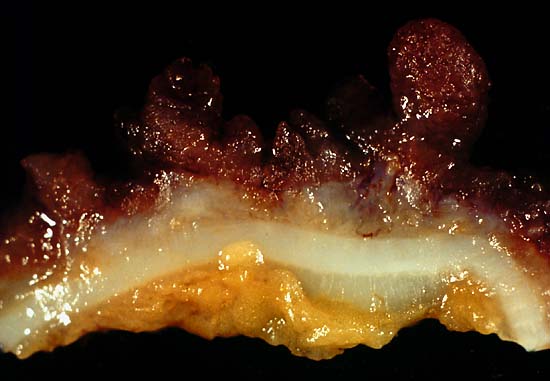
Mesenteric Lymph Node Cavitation. Courtesy McBride OM, Skipworth RJ, Leitch D, Yalamarthi S.
What Is Mesenteric Lymph Node Cavitation And Hyposplenism?
M esenteric lymph node cavitation and hyposplenism combination is a rare lymphatic entity. It is characterized by involution (degeneration) of a mesenteric lymph node (abdominal) and absence of functional spleen tissue.
Q: What is happening to the lymph nodes?
A: Lymph nodes are enlarged with central, partly cystic degeneration. When cut open either at surgery or autopsy, milky fluid exudes from the cut surface.
In regards to absent spleen function, the body is highly susceptible to bacterial invasion such as pneumonia because tissues of the spleen, called the pulp, produce specialized white blood cells that protect the body against bacterial invasion and trap foreign antigens.
What Is Mesenteric Lymph Node Cavitation And Hyposplenism In Celiac Disease and/or Gluten Sensitivity?
N eutropenia is a blood disorder characterized by presence of an abnormally low number of neutrophils.
Neutrophils are white blood cells (leukocytes) that serves as the primary defense against infections by destroying bacteria in the blood.
Specfically, neutrophils are a type of granulocyte that contain granules filled with potentchemicals to break down the microbes they ingest. Some of these chemicals, such as histamine, also contribute to inflammation and allergy.
The process of eating and digesting microbes is called phagocytosis. Neutrophils are phagocytes.1
Q: How do neutrophils eat microbes?
A: Segmented neutrophils are the mature phagocytes that migrate through tissues to destroy microbes and respond to inflammatory stimuli. Segmented neutrophils comprise 40-75 % of the peripheral leukocytes. They are usually 9 to 16 µm in diameter. The nuclear lobes, normally numbering from 2 to 5, may be spread out so that the connecting filaments are clearly visible, or the lobes may overlap or twist. The chromatin pattern is coarse and clumped. The cytoplasm is abundant with a few nonspecific granules and a full complement of rose-violet specific granules.1
What Is Neutropenia In Celiac Disease and/or Gluten Sensitivity?
This photo is from a total colectomy done for severe, intractable chronic ulcerative colitis. It shows a close view of a lengthwise section through the colon wall. This demonstrates not only the angry red mucosa, but also, the tendency for the inflamed tissue to throw itself up into inflammatory pseudopolyps. Source: Ed Uthman, MD. Public domain.
What Is Ulcerative Colitis?
U lcerative colitis is an inflammatory disorder of the colon characterized by continuous inflammation of the mucosa and submucosa usually with small ulcers, extending from the rectum and typically involving the distal colon, rectum, and anus and producing bloody diarrhea.
While the severity of ulcerative colitis varies among patients, iron deficiency anemia often develops due to blood loss especially when there are many bloody bowel movements in a day.
The onset of ulcerative colitis is most commonly in young adulhood.
Q: Is this disease painful?
A: Yes with the passage of stool.
Psychological stress and subsequent dysbiosis exacerbate ulcerative colitis.
Psychological stress activates multiple physiological processes aimed at maintaining balance within the body. These physiological processes also have the capacity to influence the composition of microbial communities in the digestive tract, and research now indicates that exposure to stressful stimuli leads to gut microbiota dysbiosis.1
While the relative abundance of many different bacterial types can be altered during stressor exposure, findings in nonhuman primates and laboratory rodents, as well as humans, indicate that bacteria in the genus Lactobacillus are consistently reduced in the gut during stress.2
Presently, ulcerative colitis cannot be cured. This condition has a course of remissions, when symptoms subside, and flares, when symtpoms get worse. Treatment is aimed to reduce flares and promote remission. In all cases, correction of dysbiosis improves the condition.
Ulcerative colitis is associated with increased incidence of cancer of the colon.3
What Is Ulcerative Colitis In Celiac Disease and/or Gluten Sensitivity?
Sources:
Galley JD, Bailey MT. Impact of stressor exposure on the interplay between commensal microbiota and host inflammation. Gut Microbes. 2014 May 1;5(3):390-396. Epub 2014 Apr 1. [↩]
Galley JD, Bailey MT. Impact of stressor exposure on the interplay between commensal microbiota and host inflammation. Gut Microbes. 2014 May 1;5(3):390-396. Epub 2014 Apr 1. [↩]
Taber’s Cyclopedic Medical Dictionary. F. A. Davis. Philadelphia, PA [↩]
Reproductive disorders such as abnormally short or prolonged gestations, inefficient labor with dystocia, and atonic uterine bleeding that may be a consequence of the endocrine derangements caused by any of these nutrient deficiencies: folate, iron,…
A metabolic bone disorder characterized by diminished bone mass (density) with retention of normal cell appearance, but fragile strength, and high bone turnover caused by deficiency of calcium and vitamin D in particular and other…
An development abnormality of the fetus that is characterized by failure to grow normally for the time of its gestational period (stage of pregnancy). Click Intrauterine Growth Retardation for full description.
An uncommon, non-hereditary, non-inflammatory cutaneous disorder resulting from malnutrition characterized by dry, rough skin with prominent symmetrical scaling that involves significant portions of the body.
Inability to either produce sperm or to produce viable sperm or mobile sperm resulting in prohibiting fertilization of the female ovum. Malnutrition is a major cause. Click for full description.
Cancel your subscription?
We're sorry to see you go.
Please select a reason for cancellation.
Please provide additional details.
Your subscription is cancelled
You won't be billed again. If you change your mind, you can subscribe again at any time.
Cancelled
Cancellation request submitted
We've received your request. Your subscription remains active while we process it. We'll email you once it's confirmed.
Cancellation pending
Pause subscription
Your subscription payments will be paused. Your existing access will remain active while your subscription is paused.
Please choose a valid future date.
Resume subscription
Your subscription payments will resume on the normal billing schedule.
Access Content
Affiliate Terms
By joining our Affiliate Program, you agree to the following terms:
1. Eligibility: You must be 18 years or older to participate. We reserve the right to refuse service to anyone for any reason at any time.
2. Promotional Guidelines: Affiliates must not engage in misleading advertising or spam. Promotions must accurately represent our brand and products.
3. Affiliate Links: You must use your unique tracking link to receive credit for referred sales.
4. Prohibited Use: You may not use our branding in a way that may confuse customers or misrepresent your relationship with us.
5. Termination: We reserve the right to terminate your account at any time for breach of these terms.
6. Changes to Agreement: We may update these terms at any time. Continued participation implies acceptance of any changes.
By continuing, you agree to the terms of this Affiliate Agreement.