Skip to content

Tuberculosis – Increased Susceptibility 

What Is Irritable Bowel Syndrome? [dropcap]I rritable bowel syndrome (IBS) is a motility disorder without anatomic cause involving the entire gastrointestinal tract that is characterized by these four features: 1) Abdominal pain usually relieved by… 

Bronchiectasis

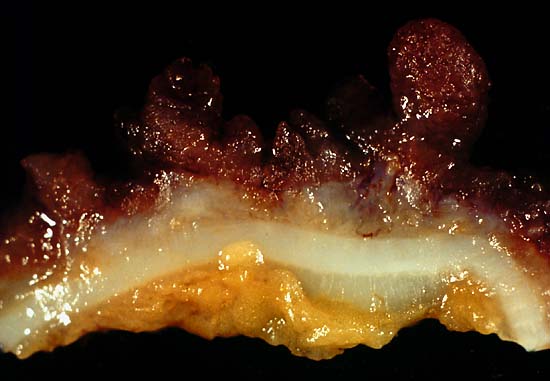
This photo was from a total colectomy done for clinically severe, intractable chronic ulcerative colitis. It shows a closer view of a longitudinal section through the colon wall. This demonstrates not only the angry red mucosa but also the tendency for the inflamed tissue to throw itself up into inflammatory pseudopolyps. Source: Ed Uthman, MD. Public domain.
This photo is from a total colectomy done for severe, intractable chronic ulcerative colitis. It shows a close view of a lengthwise section through the colon wall. This demonstrates not only the angry red mucosa, but also, the tendency for the inflamed tissue to throw itself up into inflammatory pseudopolyps.
Source: Ed Uthman, MD. Public domain.

What Is Ulcerative Colitis?

[dropcap]U lcerative colitis is an inflammatory disorder of the colon characterized by continuous inflammation of the mucosa and submucosa usually with small ulcers, extending from the rectum and typically involving the distal colon, rectum, and anus and producing bloody diarrhea.

While the severity of ulcerative colitis varies among patients, iron deficiency anemia often develops due to blood loss especially when there are many bloody bowel movements in a day.

The onset of ulcerative colitis is most commonly in young adulhood.

Q: Is this disease painful?

A: Yes with the passage of stool.

Psychological stress and subsequent dysbiosis exacerbate ulcerative colitis.

Psychological stress activates multiple physiological processes aimed at maintaining balance within the body. These physiological processes also have the capacity to influence the composition of microbial communities in the digestive tract, and research now indicates that exposure to stressful stimuli leads to gut microbiota dysbiosis.1

While the relative abundance of many different bacterial types can be altered during stressor exposure, findings in nonhuman primates and laboratory rodents, as well as humans, indicate that bacteria in the genus Lactobacillus are consistently reduced in the gut during stress.2

Presently, ulcerative colitis cannot be cured. This condition has a course of remissions, when symptoms subside, and flares, when symtpoms get worse. Treatment is aimed to reduce flares and promote remission. In all cases, correction of dysbiosis improves the condition.

Ulcerative colitis is associated with increased incidence of cancer of the colon.3

What Is Ulcerative Colitis In Celiac Disease and/or Gluten Sensitivity?

Sources:
  1. Galley JD, Bailey MT. Impact of stressor exposure on the interplay between commensal microbiota and host inflammation. Gut Microbes. 2014 May 1;5(3):390-396. Epub 2014 Apr 1. []
  2. Galley JD, Bailey MT. Impact of stressor exposure on the interplay between commensal microbiota and host inflammation. Gut Microbes. 2014 May 1;5(3):390-396. Epub 2014 Apr 1. []
  3. Taber’s Cyclopedic Medical Dictionary. F. A. Davis. Philadelphia, PA []

Pulmonary Permeability, Increased 

Erosions Of The Esophagus Can Be A Cause Of Gastrointestinal Bleeding.
Erosions Resulting From Esophagitis Can Be A Cause Of Gastrointestinal Bleeding.

What Is Occult Gastrointestinal Bleeding?

[dropcap]O ccult gastrointestinal bleeding is characterized by unseen or minute quantities of blood in stool. The origin of bleeding is from mucosa that lines the inside of the digestive tract at a site that must be found by medical testing and procedures to look at the lining.

Q: What tests and procedures are performed to locate the bleeding?

A: The simplest test to discover blood that cannot be seen is the stool test. This consists of a card with 3 spaces for 3 separate  stool collection over 3 separate days. A tiny smear of stool is placed on a test card space on each of three days. Then the card is examined for a reaction that indicates the existence of blood in the stool.

If the stool test is positive, the origin of bleeding must be located. This search requires certain procedures that look at the mucosal lining directly by a gastroenterologist, usually under light sedation.

  • Gastroscopy procedure can visualize the upper gastrointestinal tract, which includes the esophagus and stomach.
  • Endoscopy procedure can also visualize the upper small intestine. However, endoscopy procedure is limited in that it cannot visualize the middle small intestine (jejunum).
  • Colonoscopy can visualize the end of the small intestine and colon all the way to the rectum.
  • Capsule endoscopy procedure.  If  gastroendoscopy and colonoscopy fail to discover the source of bleeding, the physician may administer a capsule endoscopy which visualizes the entire gastrointestinal tract. In this procedure, the patient swallows a capsule size camera (encased) which takes constant pictures over the course of a day until expelled through the rectum.  Of course, the patient must be able to swallow the large size capsule.

What Is Occult Gastrointestinal Bleeding In Celiac Disease and/or Gluten Sensitivity?

Abscess Formation Causing Lung Cavities

Bristol Stool Chart Showing Normal and Abnormal Stool.

What Is Chronic Constipation Alternating With Diarrhea?

[dropcap]C hronic constipation alternating with diarrhea is an intestinal motility disorder, or irregularity, characterized by alteration in stool formation, consistency, and evacuation which results in a bowel movement that consists of some hard or balled stool along with some loose stool that can cause leakage.

Q: How do irregular movement patterns develop in the colon?

A: The colon produces irregular movements as a result of problems that originate in  the colon (large intestine) itself and/or the small intestine which then affects function of the colon.

Here are listed the many types of problems or diseases that cause these abnormal bowel movements:

  • Disorders that adversely affect the colon, an organ which must propel stool, remove excess water, absorb electrolytes, ferment undigested food material that passes into it, and produce nutrients from the fermentation process:
  • Poor diet that does not contain adequate nutrition, fiber, probiotics, prebiotics, and water to form normal stool.
  • Diet that contains irritating, toxic or allergenic food that cause spasms.
  • Diseases that inflame the mucosa lining such as collagenous colitis, altering the proper absorption of water and electrolytes.
  • Diseases that damage and swell the colon walls, such as Crohn’s disease, ulcerative colitis, and diverticulitis.
  • Diseases that obstruct the lumen or passageway so that stool passes with difficulty.
  • Diseases that hamper normal peristalsis (muscle action), such as irritable bowel syndrome (IBS), diabetes and thyroid disease.
  • Disorders that adversely affect the small intestine, an organ which must digest and absorb nutrients needed by the body while passing unabsorbed food material to the colon:  
  • Diet that conatins too much fat, sugar or artifical sweeteners, causing diarrhea.
  • Disorders that result in malabsorption, such as gluten enteropathy, milk enteropathy, steatorrhea (fat malabsorption), lactose intolerance, sucrose intolerance, maltose intolerance, and bacterial overgrowth, passing abnormal amounts of undigested food material to the colon where it is fermented producing excessive gas, diarrhea and spasm.
  • Disorders that impair peristalsis, such as active celiac disease, diabetes, scleroderma, and thyroid disease.
  • Tumors like cancer and lymphoma impair regular passage of material to colon.
  • Drugs that impair peristalsis, such as iron supplements, aluminum containing antacids, narcotics, some anti-depressants, some anti-seizure, and some diuretics.

What Is Chronic Constipation Alternating With Diarrhea In Celiac Disease and/or Gluten Sensitivity?

Bronchoalveolitis Leading to Bronchitis and Pneumonia

Constipation in a young child as seen on X-ray. Lowest circle shows hard feces in the pelvis. Source, James Heilman, MD.

What Is Chronic Constipation?

[dropcap]C hronic constipation is an intestinal motility disorder characterized by abnormal stool formation, consistency, and evacuation.

Motility disorder means the normal rhythmic movement of intestinal muscles, called peristalsis, that moves food matter through the gut is hampered or dysfunctional.

Studies show that methane gas present in the colon induces constipation by delaying transit time, which is the time it takes for stool to pass through the colon.

Researchers investigating the relationship between methane and constipation found that methane positivity was detected in 75% of patients with slow transit, 44% of patients with normal transit and and 28% of the patients who were controls. However, methane positivity was not related with stool consistency.1

Other researchers investigating the total amount of methane produced found that there was significantly more methane production in patients with constipation (21.1 ppm vs. 6.1 ppm, respectively) than in controls without constipation.2

Q. How does methane get into the colon?

A. Methane is produced in the colon by intestinal methanogens (microbes) that metabolize hydrogen, one of the end products of normal anaerobic (meaning without oxygen) bacterial fermentation.  Fermentation of the undigested starchy part of carbohydrates produces hydrogen in the intestine which is the substrate (food) for methane production by intestinal methanogens.

Hydrogen and methane are excreted in the flatus and in breath giving the opportunity to indirectly measure their production using breath testing. Methane is detected in 30%-50% of the healthy adult population worldwide.3

Other common causes of constipation include not getting enough exercise, not drinking enough fluids, not eating enough fiber in the diet, not eating foods that supply microbes needed by the colon (probiotics), not eating foods that nourish the good microbe population (prebiotics) and supply minerals needed for healthy movement of stool, and food sensitivities. Too much cows milk is a common cause of stool that forms into balls.

Who is Affected in the General Population? Chronic constipation is a remarkably common and costly condition that can negatively impact the quality of life and result in a major social and economic burden. Based on the definition, either self-reported or using Rome criteria, chronic constipation can affect up to 27% of the population. There is strong evidence that constipation occurs more frequently in women.4

What Is Chronic Constipation In Celiac Disease and/or Gluten Sensitivity?

Sources:
  1. Triantafyllou K, Chang C, Pimentel M. Methanogens, Methane and Gastrointestinal Motility. J Neurogastroenterol Motil. 2014 Jan;20(1):31-40. Epub 2013 Dec 30. []
  2. Triantafyllou K, Chang C, Pimentel M. Methanogens, Methane and Gastrointestinal Motility. J Neurogastroenterol Motil. 2014 Jan;20(1):31-40. Epub 2013 Dec 30. []
  3. Triantafyllou K, Chang C, Pimentel M. Methanogens, Methane and Gastrointestinal Motility. J Neurogastroenterol Motil. 2014 Jan;20(1):31-40. Epub 2013 Dec 30. []
  4. Sanchez MI, Bercik P. Epidemiology and burden of chronic constipation. Can J Gastroenterol. 2011 Oct;25 Suppl B:11B-15B. []

Pneumococcal Septicemia 

Endoscopic image of Crohn'sDisease showing deep ulceration in sigmoid colon.
Endoscopic Image of Crohn’s Disease Showing Deep Ulceration in the Sigmoid Colon.

What Is Crohn’s Disease?

[dropcap]C rohn’s disease is an inflammatory bowel disease characterized by patchy inflamed areas involving the full thickness of the intestinal wall that can occur anywhere in the intestinal tract, in addition to, mucosal disease.

In Crohn’s disease there is ongoing immune activation which produces inflammation and ulceration but the cause is not known and the severity varies among patients. At diagnosis of Crohn’s disease, factors predictive of subsequent 5-year aggressive disease are an age below 40 years, the presence of perianal disease, and the initial requirement for steroids.1

Dysbiosis is a factor that develops in and worsens Crohn’s disease and stress is a factor in both of these conditions. Psychological stress activates multiple physiological processes aimed at maintaining balance within the body. These physiological processes also have the capacity to influence the composition of microbial communities in the digestive tract, and research now indicates that exposure to stressful stimuli leads to gut microbiota dysbiosis.2

While the relative abundance of many different bacterial types can be altered during stressor exposure, findings in nonhuman primates and laboratory rodents, as well as humans, indicate that bacteria in the genus Lactobacillus are consistently reduced in the gut during stress.2

Q: Is there a cure for Crohn’s disease?

A: Presently, Crohn’s disease cannot be cured. This condition has a course of remissions, when symptoms subside, and flares, when symtpoms get worse. Treatment is aimed to reduce flares and promote remission.

What Is Crohn’s Disease In Celiac Disease and/or Gluten Sensitivity?

Sources:
  1. Beaugerie L, Seksik P, Nion-Larmurier I, Gendre JP, Cosnes J. Predictors of Crohn’s disease. Gastroenterology. 2006;130:650–656. []
  2. Galley JD, Bailey MT. Impact of stressor exposure on the interplay between commensal microbiota and host inflammation. Gut Microbes. 2014 May 1;5(3):390-396. Epub 2014 Apr 1. [] []