Skip to content

Sjögren’s Syndrome 

Testing the Eyes for Sjogren's Syndrome.
Testing the Eye for Tear Production (L) and Damage to Conjunctiva from Dryness (R).

What Is Sjögren’s Syndrome?

[dropcap]S[/dropcap]jögren’s syndrome is a systemic inflammatory autoimmune disease with a chronic, progressive course that primarily attacks the lacrimal glands of the eye and the salivary glands of the mouth, which are exocrine glands. Exocrine glands secrete the substances they produce through a duct.

Sjögren’s syndrome is ordinarily characterized by dysfunction of the lacrimal glands to produce tears causing dry eye and the salivary glands to produce saliva causing dry mouth, but is not limited by or to these features.

Besides involvement of these exocrine glands, there may be involvement of other parts of the body, termed extraglandular, which may be more severe than eye or mouth features.

There is not yet agreement on classifying Sjögren’s syndrome. Primary and secondary are the two forms generally accepted.1 Both forms can cause mild to severe disease, called the spectrum:

  • Primary Sjögren syndrome. Disease occurs without involvement of other linked autoimmune disorders. In addition to the eyes and mouth, the nose, throat and skin may also be affected and joints, lungs, kidneys, blood vessels, digestive organs and nerves as well.2 Systemic manifestations (other than eyes and mouth) concern a third of patients, including lymphoma in 5% of the patients.3
  • Secondary Sjögren’s syndrome. Disease complicates other autoimmune disease such as systemic lupus erythematosus, rheumatoid arthritis, primary biliary cirrhosis, and celiac disease.

Diagnosis  of Sjögren’s syndrome is made by most doctors based on Schimer’s test for tears and unstimulated whole salivary flow to assess objective eye and oral involvement, since these are the tests most physicians use in clinical practice.4 Specific antibody tests would be  positive for anti-Ro (SSA)/anti-La (SSB) autoantibodies. Sjögren’s syndrome should also be considered when extraglandular manifestations such as vasculitis, polyneuropathy or arthritis occur, even when the patients do not complain of dry eyes and mouth.5

There is no cure for Sjögren’s syndrome. Treatment is aimed to diminish symptoms. For example, steroids and Ibupropen are used to decrease inflammation and pain in joints. Artificial tears and ointments are used for dry eye.

Most people who develop Sjogren’s syndrome are older than 40 years. Nine of ten people with Sjögren’s syndrome are women.2

What Is Sjögren’s Syndrome In Celiac Disease and/or Gluten Sensitivity?

Sources:
  1. Huang YF, Cheng Q, Jiang CM, An S, Xiao L, Gou YC, Yu WJ, Lei L, Chen QM, Wang Y, Wang J. The immune factors involved in the pathogenesis, diagnosis, and treatment of Sjogren’s syndrome. Clin Dev Immunol. 2013;2013:160491. doi: 10.1155/2013/160491. Epub 2013 Jul 9. []
  2. nlm.nih.gov [] []
  3. Fazaa A, Bourcier T, Chatelus E, Sordet C, Theulin A, Sibilia J, Gottenberg JE. Classification criteria and treatment modalities in primary Sjögren’s syndrome. Expert Rev Clin Immunol. 2014 Apr;10(4):543-51. doi: 10.1586/1744666X.2014.897230. []
  4. Cornec D, Saraux A, Cochener B, Pers JO, Jousse-Joulin S, Renaudineau Y, Marhadour T, Devauchelle-Pensec V. Level of agreement between 2002 American-European Consensus Group and 2012 American College of Rheumatology classification criteria for Sjogren’s syndrome and reasons for discrepancies. Arthritis Res Ther. 2014 Mar 19;16(2):R74. []
  5. Witte T. Pathogenesis and diagnosis of Sjögren’s syndrome. Z  Rheumatol. 2010 Feb;69(1):50-6. doi: 10.1007/s00393-009-0519-2. []

Autoimmune Disorders In Celiac Disease

Each antibody binds to a specific antigen; an interaction similar to a lock and key. Courtesy Wikipedia.

What Are Autoimmune Disorders?

[dropcap]A[/dropcap]utoimmune disorders refer to those conditions that involve an abnormal immune attack on the body’s own tissues perpetuated by the production of autoantibodies directed against the body, or “self.” Auto means self.

Q: Why does the immune system attack the body?

A: The exact answer is not yet known why the immune system turns against body tissue or “self.” 

Normally, the immune system protects the body from harmful substances and pathogens and produces antibodies against the offending foreign substances, called antigens, to get rid of them. The immune system (humoral) thereafter remembers all antigens and is ready for the next encounter should it happen.

Production of autoimmune antibodies is catastrophic because there is no turning off the readiness to attack a remembered threat (antigen) which is unfortunately “self.” 

Yes, steroids and anti-inflammatory drugs can control symptoms, but nothing can undo the memory programmed into the immune system to produce autoantibodies. There is an enormous research effort ongoing for the answer. 

Autoimmune disorders cover a wide range of diseases that may target only a particular organ, such as autoimmune hepatitis (liver), while others are systemic because the autoantibodies target a particular tissue that is part of more than one organ, such as scleroderma (connective tissue).

Autoimmune diseases as a group affect approximately 8.5% of people worldwide.

What Are Autoimmune Disorders In Celiac Disease and/or Gluten Sensitivity?

Autoimmune Polyglandular Syndromes 

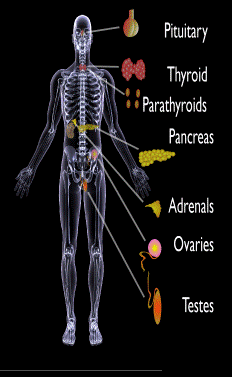
Body image showing endocrine glands that may be affected by polyglandular autoimmune syndrome. Courtesy endocrine101.com
Endocrine glands targeted in polyglandular autoimmune syndrome.

What Are Autoimmune Polyglandular Syndromes?

[dropcap]A[/dropcap]utoimmune polyglandular syndromes (APS) are rare clusterings of two or more endocrine and non-endocrine autoimmune disorders in the same affected person.

Polyglandular is somewhat of a misnomer since many of the manifestations of the diseases do not concern endocrine glands.1

Endocrine autoimmune disorders involve the abnormal production of autoantibodies that target and destroy the body’s own endocrine tissues, causing loss of essential hormone production by the targeted glands. Endocrine glands include the pituitary, thyroid, adrenal, parathyroid, islets of Langerhans (pancreas), testes in males, and ovaries in females.

First degree relatives (siblings of same parents, parents, children) have an increased incidence of latent, meaning not apparent, autoimmune pathology.2

Q: How many autoimmune polyglandular syndromes are described?

A: Three syndromes have been identified and they are all inherited: APS type-1, APS type-2, and APS type-3.

  • APS type-1 is a genetic mutation inherited in an autosomal recessive manner. A child with APS type-1 has inherited two mutated copies of a gene called the AIRE (autoimmune regulator) gene, which is on the long arm of 21st chromosome present in each cell.3 The parents, called carriers, are unaffected since they each have only a single copy of the AIRE mutated gene. Humans have a total of 23 pairs of chromosomes that contain genes inherited from each parent. Mutations in the genes cause disease.

Diagnosis criteria for autoimmune polyglandular syndrome type-1 includes these three disorders:

  1. Chronic candida infection (CMC), which usually develops first, typically attacks skin, but very commonly also nails, mouth, vagina, esophagus and intestine. CMC in APS type-1 patients is usually mild, and in most cases, it is chronic. It is found in 73–100 % of APS type-1 patients. 
  2. Hypoparathyroidism, causing loss of parathyroid function (hypoparathyreosis) is found in 76–93 % of APS type-1 patients.
  3. Autommune Addison’s disease, also called autoimmune adrenalitis, is found in 72-100 % of APS type-1 patients. Still many of them die for unrecognized or late diagnosed autoimmune Addison’s disease, so regular follow-up for children in suspicion of APS type-1 (with CMC or/and hypoparathyroidism) is necessary.4

Other assocated disorders that may develop, but are not required for diagnosis, include: vitiligo, premature menopause, pernicious anemia, parathyroid gland failure, alopecia, and celiac disease. Thyroid disease rarely occurs.5

  • APS type-2 is linked to the inheritance of HLA antigens on chromosome 6 and appears to be autosomal dominant with incomplete penetrance. This suggests the contribution of environmental factors, such as bacterial and viral infections, medications, psychological factors, etc.6 It does not have an identified mutation of the AIRE gene.

Diagnosis criteria for  autoimmune polyglandular syndrome type-2 includes these two disorders:

  1. Autommune Addison’s disease combined with
  2. Autoimmune thyroid disease (thyroid atrophy, hypertrophic goiter related to Hashimoto’s thyroiditis, Graves’ disease, asymptomatic autoimmune thyroiditis)6 and/or type I diabetes mellitus.  The conditions may occur in any order.

Polyglandular autoimmune syndrome type-2  is also known as Schmidt’s syndrome when adrenalitis (adrenal insufficiency) is associated with thyroiditis and Carpenter’s syndrome for adrenal insufficiency with hypoparathyreosis (impaired function of parathyroid glands).

Other disorders that may develop, but are not required for diagnosis, include:  type 1 diabetes (50%), frequently gonadal failure or vitiligos, also celiac disease, autoimmune hepatitis, alopecia, pernicious anemia, and myasthenia gravis.7 Decades may arise between the onset of one disease and the onset of the second in the same patient.8

Therapy of APS type-2 consists of hormone replacement therapy for each separate condition, except that treatment for adrenal insufficiency must be given before thyroid therapy is started when the conditions occur together.9 Thyroxin replacement may induce life-threatening adrenal failure in a patient with untreated Addison’s disease. Thus, in case of doubt hydrocortisone should be given before the thyroxine administration is started.10

  • APS type-3  has a strong genetic background. Diagnosis criteria for autoimmune polyglandular syndrome type-3 involves these conditions:
  1.  Autoimmune thyroiditis that occurs with another organ-specific autoimmune disease, but not with autoimmune Addison’s disease, and
  2. Other autoimmune diseases can include diabetes mellitus, pernicious anemia, vitiligo, alopecia, myasthenia gravis, celiac disease, and Sjögren’s syndrome. The most common APS type-3 combination is autoimmune disease of thyroid gland and pernicious anemia.11

Who is Affected in the General Population?

  • APS type-1 is usually apparent in childhood with the incidence of 1 in100,000 persons. It is more common among Finns (1 in 25,000), Sardinians (1 in 14,000), and Iranian Jews (1 in 6,500 to 1 in 9,000). The age of onset is usually early childhood, but new symptoms can develop throughout life. It affects both sexes equally.
  • APS type-2 has a peak onset in middle age, although the first signs usually develop between 20–30 years of age. Its prevalence is 1 in 20,000 persons. It is three times more frequent among women than men.12
  • APS type-3 is most frequent among middle-aged women.7[/box]

What Is Autoimmune Polyglandular Syndrome In Celiac Disease and/or Gluten Sensitivity?

Sources:
  1. Wémeau JL, Proust-Lemoine E, Ryndak A, Vanhove L. Thyroid autoimmunity and polyglandular endocrine syndromes. Hormones (Athens). 2013 Jan-Mar;12(1):39-45. []
  2. Femiano P, Castaldo V, Iossa C. Complex family association in autoimmune polyendocrine syndrome. Minerva Pediatrica. Apr 2003;55(2):163-70. []
  3. Wémeau JL, Proust-Lemoine E, Ryndak A, Vanhove L. Thyroid autoimmunity and polyglandular endocrine syndromes. Hormones (Athens). 2013 Jan-Mar;12(1):39-45. []
  4. http://autoimmune.pathology.jhmi.edu/diseases.cfm?systemID=3&DiseaseID=66 []
  5. Wémeau JL, Proust-Lemoine E, Ryndak A, Vanhove L. Thyroid autoimmunity and polyglandular endocrine syndromes. Hormones (Athens). 2013 Jan-Mar;12(1):39-45. []
  6. Wémeau JL, Proust-Lemoine E, Ryndak A, Vanhove L. Thyroid autoimmunity and polyglandular endocrine syndromes. Hormones (Athens). 2013 Jan-Mar;12(1):39-45. [] []
  7. http://autoimmune.pathology.jhmi.edu/diseases.cfm?systemID=3&DiseaseID=67 [] []
  8. http://www.dundee.ac.uk/medther/tayendoweb/images/polyglandular.htm []
  9. MAJERONI BA and PATEL P. Autoimmune Polyglandular Syndrome, Type II. Am Fam Physician. 2007 Mar 1;75(5):667-670. []
  10. Lipowsky C, Schorl-Schweikardt BA, Kehl O, Brändle M. 19-year-old patient with adrenal cortex insufficiency–only the tip of the iceberg. Polyendocrine autoimmune syndrome type II (Schmidt syndrome). Praxis (Bern 1994). 2008 Jan 23;97(2):77-81. []
  11. http://autoimmune.pathology.jhmi.edu/diseases.cfm?systemID=3&DiseaseID=68 []
  12. Van den Driessche A, Eenkhoorn V, Van Gaal L, De Block C. Type 1 diabetes and autoimmune polyglandular syndrome: a clinical review. Neth J Med. 2009 Dec;67(11):376-87. []

Autoimmune Disorders In Dermatitis Herpetiformis

Classic Dermatitis Herpetiformis

What Are Autoimmune Disorders?

[dropcap]A[/dropcap]utoimmune disorders refer to those conditions that involve an abnormal attack on the body’s own tissues perpetuated by the production of autoantibodies directed against self.

Q: What happens when autoantibodies attack the body’s own tissues?

A: This abnormal immune activity by autoantibodies causes inflammation and damage to targeted body tissues.

Dermatitis herpetiformis is a skin manifestation of celiac disease characterized by extremely itchy blisters that commonly erupt on forearms and knees but may appear on the face, scalp or buttocks.

Autoimmune diseases as a group affect approximately 8.5% of people worldwide.

What Are Autoimmune Disorders In Dermatitis Herpetiformis?