Enlarged heart showing dilated cardiomyopathy at autopsy.
What Is Idiopathic Dilated Cardiomyopathy?
[dropcap]I[/dropcap]diopathic dilated cardiomyopathy (IDCM) is a disorder of myocardial (heart muscle) function characterized by dilation or enlargement of the cardiac chambers and reduction in the ability of the ventricles (lower chambers) to contract with the required force needed to pump blood out of the heart to the body.
Idiopathic means the cause is not known.
Q: What is the prognosis for idiopathic dilated cardiomyopathy?
A: This disorder often results in symptomatic heart failure due to the inability of the heart to pump blood as required to supply the body with oxygen and meet metabolic needs.
What Is Idiopathic Dilated Cardiomyopathy In Celiac Disease and/or Gluten Sensitivity?
[dropcap]I[/dropcap]ron is an essential mineral that is required for normal body function.
Almost two-thirds of iron in the body is found in hemoglobin, the protein in red blood cells that carries oxygen to tissues. Smaller amounts of iron are found in myoglobin, a protein that helps supply oxygen to muscle, and in enzymes that assist biochemical reactions.
Iron is also found in proteins that store iron for future needs and that transport iron in blood.
Q: How are iron stores regulated?
A:Iron stores are regulated by intestinal iron absorption.1That is, whenever iron is needed, more iron is absorbed than when iron is sufficient. This mechanism prevents excess iron in the body which is harmful.
In the brain, iron is necessary to ensure oxygenation and to produce energy in the cerebral parenchyma (via cytochrome oxid. ase), and for the synthesis of neurotransmitters and myelin.
Iron concentrations in the umbilical artery are critical during the development of the fetus, and in relation with the IQ in the child.2
What Is Iron Deficiency In Celiac Disease and/or Gluten Sensitivity?
Bourre JM. Effects of nutrients (in food) on the structure and function of the nervous system: update on dietary requirements for brain. Part 1: micronutrients. J Nutr Health Aging. 2006 Sep-Oct; 10(5):377-85. [↩]
[dropcap]V[/dropcap]itamin B12, also called cobalamin, is a highly complex vitamin that functions in two coenzyme forms: adenosylcobalamin and methylcobalamin.
These forms of the vitamin play important roles in the physical and chemical processes by which amino acids become proprionate, proprionate that becomes acetate, and single carbons.
Q: Why are these steps important?
A: These steps are essential for normal function in the workings of all cells, especially for those of the digestive tract, bone marrow and nervous tissue.
Vitamin B12 is mainly excreted through bile into the duodenum (first part of the small intestine) for excretion in stool.1 However, if vitamin B12 is needed, it is reabsorbed in the ileum (end of the small intestine) while excess is excreted in stool and very little in urine.2
The blood level of vitamin B12 in healthy people ranges between 140 and 750 pg/ml.
What Is Vitamin B12 Deficiency In Celiac Disease and/or Gluten Sensitivity?
Sources:
Shibata K, Hirose J, Fukuwatari T. Relationship Between Urinary Concentrations of Nine Water-soluble Vitamins and their Vitamin Intakes in Japanese Adult Males. Nutr Metab Insights. 2014 Aug 5;7:61-75. doi: 10.4137/NMI.S17245. [↩]
Shinton N K. Vitamin B 12 and folate metabolism. Br Med J. Feb 26, 1972; 1(5799): 556–559. [↩]
What Is Vitamin B12 Deficiency Anemia? [dropcap]V itamin B12 deficiency anemia is a megaloblastic anemia that is characterized by defective DNA synthesis of red blood cells due to a lack of vitamin B12. Vitamin B12 is…
[dropcap]O bnoxious gas, or flatus, is gas that is not only offensive when passed but also lingers in the air longer than ordinary gas does.
Gas is a natural digestive product within the colon that is composed mainly of hydrogen and carbon dioxide gases. These gases are given off in the necessary bacterial breakdown of undigested fermentable food entering the colon from the small intestine.
Q: What makes gas obnoxious?
A: The production of obnoxious gas depends on the type and quantity of undigested food residue that is passed into the colon from the small intestine, dysfunctional motility instead of normal peristalsis, and dysbiosis. Dysbiosis is the condition of having unhealthy or insufficient populations of microbes responsible for digesting (fermenting) foodstuffs in the lower gut or colon.
Gases produced by intestinal microbes may modulate intestinal motor function (muscle movement) in individuals with functional bowel disease. Methane, produced by enteric bacteria in the human gut, is associated with slowed intestinal transit and constipation.1
What Is Obnoxious Gas In Celiac Disease and/or Gluten Sensitivity?
Sources:
Jahng J, Jung IS, Choi EJ, Conklin JL, Park H. The effects of methane and hydrogen gases produced by enteric bacteria on ileal motility and colonic transit time. Neurogastroenterol Motil. 2012 Feb;24(2):185-90, e92. doi: 10.1111/j.1365-2982.2011.01819.x. Epub 2011 Nov 20.
Methane is produced in the colon by intestinal methanogens (microbes) that metabolize hydrogen, one of the end products of normal anaerobic (meaning without oxygen) bacterial fermentation. Fermentation of the undigested starchy part of carbohydrates produces hydrogen in the intestine, which is the food for methane production by intestinal methanogens.
Hydrogen and methane are excreted in the flatus and in breath giving the opportunity to indirectly measure their production using breath testing. ((Triantafyllou K, Chang C, Pimentel M. Methanogens, Methane and Gastrointestinal Motility. J Neurogastroenterol Motil. 2014 Jan;20(1):31-40. Epub 2013 Dec 30. [↩]
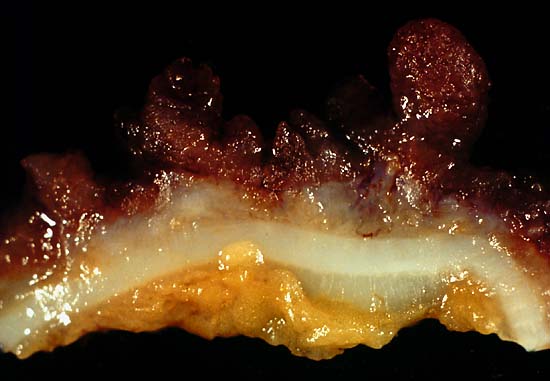
This photo is from a total colectomy done for severe, intractable chronic ulcerative colitis. It shows a close view of a lengthwise section through the colon wall. This demonstrates not only the angry red mucosa, but also, the tendency for the inflamed tissue to throw itself up into inflammatory pseudopolyps. Source: Ed Uthman, MD. Public domain.
What Is Ulcerative Colitis?
[dropcap]U lcerative colitis is an inflammatory disorder of the colon characterized by continuous inflammation of the mucosa and submucosa usually with small ulcers, extending from the rectum and typically involving the distal colon, rectum, and anus and producing bloody diarrhea.
While the severity of ulcerative colitis varies among patients, iron deficiency anemia often develops due to blood loss especially when there are many bloody bowel movements in a day.
The onset of ulcerative colitis is most commonly in young adulhood.
Q: Is this disease painful?
A: Yes with the passage of stool.
Psychological stress and subsequent dysbiosis exacerbate ulcerative colitis.
Psychological stress activates multiple physiological processes aimed at maintaining balance within the body. These physiological processes also have the capacity to influence the composition of microbial communities in the digestive tract, and research now indicates that exposure to stressful stimuli leads to gut microbiota dysbiosis.1
While the relative abundance of many different bacterial types can be altered during stressor exposure, findings in nonhuman primates and laboratory rodents, as well as humans, indicate that bacteria in the genus Lactobacillus are consistently reduced in the gut during stress.2
Presently, ulcerative colitis cannot be cured. This condition has a course of remissions, when symptoms subside, and flares, when symtpoms get worse. Treatment is aimed to reduce flares and promote remission. In all cases, correction of dysbiosis improves the condition.
Ulcerative colitis is associated with increased incidence of cancer of the colon.3
What Is Ulcerative Colitis In Celiac Disease and/or Gluten Sensitivity?
Sources:
Galley JD, Bailey MT. Impact of stressor exposure on the interplay between commensal microbiota and host inflammation. Gut Microbes. 2014 May 1;5(3):390-396. Epub 2014 Apr 1. [↩]
Galley JD, Bailey MT. Impact of stressor exposure on the interplay between commensal microbiota and host inflammation. Gut Microbes. 2014 May 1;5(3):390-396. Epub 2014 Apr 1. [↩]
Taber’s Cyclopedic Medical Dictionary. F. A. Davis. Philadelphia, PA [↩]
[dropcap]M acroamylasemia is an acquired enzyme disorder that causes elevated levels of the enzyme amylase (hyperamylasaemia) in the bloodstream. It is characterized by altered amylase molecules that have become abnormally bound with plasma proteins in the bloodstream, commonly IgG (immunoglobulin G) and/or IgA (immunoglobulin A).
The resulting molecule is too large to be properly filtered by the kidneys and excreted in the urine as would be normal unbound amylase, causing sustained elevation of amylase levels in the plasma.
With normal kidney function, a hyperamylasemia without an increase in urine amylase suggests the diagnosis of macroamylasemia, and is confirmed by identifying the macromolecular components.1
Amylase is a an enzyme produced by the pancreas and the parotid glands to digest starch in the diet. Comparatively small amounts are also produced by other organs.
Q: How do the pancreas and parotid glands deliver their amylase for digestion of starch?
A: The parotid glands deliver their amylase into the mouth. The action of amylase in the mouth starts the breakdown of starch as it is chewed and moistened with saliva.
After the starchy food is liquified in the stomach, the mass empties into the duodenum. Here pancreatic amylase is delivered through the common bile duct into the duodenum where it turns starch into maltose sugar. The next step to final digestion of starch is carried out by enzymes in the small intestinal lining that split maltose into its component sugar which is glucose.
Glucose is a simple sugar that can be absorbed into the bloodstream for use in the body. Humans cannot live without adequate glucose.
Distinquishing macroamylasemia from hyperamylasemia due to pancreatic disease is necessary to prevent needless treatment and investigation for pancreatitis.2
What Is Macroamylasemia In Celiac Disease and/or Gluten Sensitivity?
Sources:
Torrent Vernetta A, Segarra Cantón O, Soler Palacín P, Segura Cardona RM, Infante Pina D. Macroamylasaemia in paediatrics. An Pediatr (Barc). 2008 Nov;69(5):439-41. [↩]
Isham CA, Ridgeway NA, Hedrick R, Cate JC 4th. Screening for macroamylase in a community hospital. Clin Chem. 1984 May;30(5):741-2. [↩]
What Is Helicobacter Pylori (H. Pylori) Infection? [dropcap]H elicobacter pylori infection is a potentially deadly stomach disease characterized by chronic superficial inflammation and ulcerations in 100% of infected patients. This infection disrupts normal defense and…
[dropcap]G eographic tongue is a painful alteration in tongue tissue that is characteristic of riboflavin (vitamin B2) deficiency.1
Q: How does the tongue surface appear?
A: Areas of inflamed tissue with flattened papillae develop among areas of normal tissue, giving a map-like appearance to the tongue surface. There are often swollen papillae that hurt or sting, such as is seen in the photo to the left.
A diet that does not provide adequate amounts of riboflavin and any condition that 1) interferes with riboflavin absorption from the gut, 2) depletes the vitamin from the body, 3) overuses the vitamin in the body, or 4) adversely affects its use in the body will result in riboflavin deficiency causing geographic tongue.
Riboflavin is essential for converting foodstuffs into energy, maintaining the normal lifespan of red blood cells and maintaining healthy skin, eyes, hair, and nervous system. Riboflavin is converted into its active forms, flavin adenine dinucleotide (FAD) and flavin mononucleotide (FMN). These enzymes are primarily involved as co-factors in oxidation reduction reactions that are essential for cellular energy production and respiration.
Riboflavin is required for the conversion of pyridoxine (vitamin B6) to its functional form and the production of niacin (vitamin B3) from the amino acid tryptophan. Riboflavin has a role in antioxidant status by activating glutathione reductase, which regenerates used glutathione, a powerful antioxidant.
Respiratory infection, exercise, certain diseases, drugs and hormones can adversely influence riboflavin status.2 Stress is a major depleter of riboflavin.
What Is Geographic Tongue In Celiac Disease and/or Gluten Sensitivity?
[dropcap]A[/dropcap]ngina pectoris, or simply angina, is a coronary syndrome characterized by an oppressive substernal pain (pain under breastbone) or pressure brought on by exertion and relieved by rest that results from failure of coronary arteries to deliver adequate oxygen to heart tissue due to ischemic heart disease.
Q: Why do coronary arteries fail to deliver adequate oxygen to heart tissue?
A: Coronary arteries are the blood vessels that serve the heart. In angina, these vessels fail to deliver adequate oxygen to heart tissue because they are narrowed or blocked by fatty buildups, called atherosclerotic plaques or by a blood clot which impair their ability to carry adequate blood that carries the oxygen. Diseased coronary arteries cannot deliver adequate oxygenated blood pumped by the heart to its own muscle cells.
The heart is a muscular organ that is working all the time without rest, so it needs a constant supply of oxygen. When heart muscle has to work harder, it needs more oxygen. Lack of oxygen causes pain which makes the affected person stop activity and rest.
Angina can be stable or unstable. Unstable angina is much more serious and can be life-threatening.
Stable angina produces predictable pain and responds to rest and/or medication. It is less serious than unstable angina but can be very painful or uncomfortable. Anything that makes the heart muscle need more oxygen can cause an angina attack in someone with heart disease, including: smoking, cold weather, exercise, emotional stress, obesity, and large meals. Other causes of angina include: abnormal heart rhythms (usually ones that cause the heart to beat quickly), anemia, coronary artery spasm, heart failure, heart valve disease, and hyperthyroidism (overactive thyroid).1
Unstable angina produces unpredictable pain that may occur at rest, lasting more than 20 minutes. It is more severe than stable angina and less responsive to medication. Atherosclerosis is by far the most common cause of unstable angina. Oxidized low-density lipoprotein, so-called bad cholesterol, and oxysterols play an important role in atherogenesis, the development of atherosclerosis. Coronary arteries that are narrowed by atherosclerotic plaques can rupture causing injury to the coronary blood vessel resulting in blood clotting which blocks the flow of blood to the heart muscle. Blood clots may form, partially dissolve, and later form again and angina can occur each time a clot blocks blood flow in an artery. People with unstable angina are at increased risk of having a heart attack.2
What Is Angina In Celiac Disease and/or Gluten Sensitivity?