Skip to content

Autoimmune Disorders In Celiac Disease

Each antibody binds to a specific antigen; an interaction similar to a lock and key. Courtesy Wikipedia.

What Are Autoimmune Disorders?

[dropcap]A[/dropcap]utoimmune disorders refer to those conditions that involve an abnormal immune attack on the body’s own tissues perpetuated by the production of autoantibodies directed against the body, or “self.” Auto means self.

Q: Why does the immune system attack the body?

A: The exact answer is not yet known why the immune system turns against body tissue or “self.” 

Normally, the immune system protects the body from harmful substances and pathogens and produces antibodies against the offending foreign substances, called antigens, to get rid of them. The immune system (humoral) thereafter remembers all antigens and is ready for the next encounter should it happen.

Production of autoimmune antibodies is catastrophic because there is no turning off the readiness to attack a remembered threat (antigen) which is unfortunately “self.” 

Yes, steroids and anti-inflammatory drugs can control symptoms, but nothing can undo the memory programmed into the immune system to produce autoantibodies. There is an enormous research effort ongoing for the answer. 

Autoimmune disorders cover a wide range of diseases that may target only a particular organ, such as autoimmune hepatitis (liver), while others are systemic because the autoantibodies target a particular tissue that is part of more than one organ, such as scleroderma (connective tissue).

Autoimmune diseases as a group affect approximately 8.5% of people worldwide.
What Are Autoimmune Disorders In Celiac Disease and/or Gluten Sensitivity?

Polymyositis

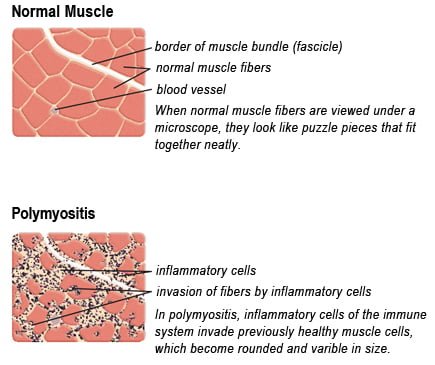
Drawing of Biopsy Showing Muscle Fibers Invaded by Immune Cells. Courtesy MDA.org

What Is Polymyositis?

[dropcap]P[/dropcap]olymyositis is a body-wide connective tissue disease resulting from autoimmune attack of skeletal muscles that is characterized by inflammatory and degeneratory changes. The course is unpredictable being marked by spontaneous flare-ups and remissions.

Polymyositis can begin slowly or abruptly according to the factor that is triggering the onset such as infection, medications like phenytoin, and autoimmune disease.

Progressive muscle weakness starts in the proximal skeletal muscles (muscles closest to the trunk of the body).

Skeletal muscles, also called voluntary, are muscles that move the body as we want, such as walking and  lifting objects, as opposed to those we cannot voluntarily control, such as the muscles of digestion. 

Q: What are the degeneratory changes in skeletal muscles?

A: In polymyositis, degeneratory changes in skeletal muscles means that muscles are being destroyed (called necrosis), resulting in fibrosis, or scarring. When scar tissue takes the place of lost muscle tissue, it cannot act like muscle to contract and relax.   Muscle destruction is what causes muscle pain and weakness.

After the clinical work-up of exams and blood studies to determine muscle damage, the diagnosis of polymyositis is confirmed by muscle biopsy. See image at above left. The black dots are inflammatory cells. Edema (fluid) between cells caused by inflammation pushes muscle fibers apart.

There is no cure for polymyositis, but the symptoms can be treated.  Options include medication, physical therapy, exercise, heat therapy (including microwave and ultrasound), orthotics and assistive devices, and rest.  The standard treatment for polymyositis is a corticosteroid drug, given either in pill form or intravenously.  Immunosuppressant drugs, such as azathioprine and methotrexate, may reduce inflammation in people who do not respond well to prednisone. 

Periodic treatment using intravenous immunoglobulin can also improve recovery.  Other immunosuppressive agents used to treat the inflammation associated with polymyositis include cyclosporine A, cyclophosphamide, and tacrolimus.  Physical therapy is usually recommended to prevent muscle atrophy and to regain muscle strength and range of motion.1

Diagnosis is based on elevated muscles enzymes, increased urinary creatine level, and electromyograph abnormalities.

Polymyositis can affect people at any age. It is most common in adults between ages 50 and 70, and in children ages 5 to 15. It affects women twice as often as men and is more common in African Americans than Caucasians.2 The major causes of death from polymyositis are cancer and lung disease, including pneumonia.  The 5-year mortality rate can be as high as 1 in 5 patients.2

What Is Polymyositis In Celiac Disease and/or Gluten Sensitivity?

Sources:
  1. National Institute of Neurological Disorders and Stroke []
  2. http://www.nlm.nih.gov/medlineplus/ency/article/000428.htm [] []

Polymyositis: definition

An uncommon autoimmune body-wide connective tissue disease characterized by inflammatory and degeneratory changes in skeletal muscles leading to muscle weakness, wasting, and loss.  Click for full description.