Skip to content

Low Stomach Acid Production

low-stomach-acid1What Is Low Stomach Acid Production?

[dropcap]L[/dropcap]ow stomach acid production is a common disorder in celiac disease and dermatitis herpetiformis that is characterized by lack of sufficient hydrochloric acid needed 1) to properly digest food, which results in malnutrition and subsequent nutritional deficiencies, and 2) to destroy swallowed bacteria and other microbes, which may allow infections to develop.

It is also common in the general population, as well, affecting 50% of people age 60 years and about 80% by age 85 years.  Nevertheless, low stomach acid is not generally looked for as a cause of acute and chronic disorders that rob health with far-reaching effects.

[box type=”shadow” ]Understanding Stomach Acid Production and Function

The stomach digests incoming food into a liquid state, thereby releasing nutrients so they can be absorbed by the small intestine. Powerful stomach muscles churn food and mix it with gastric juice, dissolving and breaking it down.

Gastric juice is produced by gastric glands located in the stomach lining. These numerous, microscopic glands produce about 3 liters of juice a day. Gastric juice is composed of a high concentration of

Muscle Weakness 

Microscopic View of Gastric  Biopsy Showing a Collagen Band Under the Surface Mucosal Cells. Courtesy Gastrolab.com
Microscopic View of Gastric Biopsy Showing a Collagen Band Stained Pink Under the Surface Mucosal Cells. Courtesy Gastrolab.com

What Is Collagenous Gastritis?

[dropcap]C ollagenous gastritis is a rarely reported stomach disorder characterized by the deposition of a subepithelial collagen band and accompanying inflammatory infiltrate in the stomach wall.

A subepithelial collagen band means that collagen, a tough fibrous protein, has abnormally accumulated under the surface layer of epithelial cells which form the mucosa lining the stomach.

The surface mucosa may remain intact and not show lymphocytosis and/or gastritis on endoscopic examination or it may become stripped off and bleed from entrapped capillaries. Biopsy is necessary to diagnose collagenous gastritis.1

Q: Why does collagen become deposited under the surface lining of the stomach?

A: It is thought that collagen deposition is preceded by inflammation and tissue damage. However, the natural history and pathogenesis of collagenous gastritis remain unclear.2

What Is Collagenous Gastritis In Celiac Disease and/or Gluten Sensitivity?

Sources:
  1. Jain R, Chetty R. Collagenous gastritis. Int J Surg Pathol. 2010 Dec;18(6):534-6. doi: 10.1177/1066896908329588. Epub 2008 Dec 22. []
  2. Leung ST, Chandan VS, Murray JA, Wu TT. Collagenous gastritis: histopathologic features and association with other gastrointestinal diseases. Am J Surg Pathol. 2009 May;33(5):788-98. doi: 10.1097/PAS.0b013e318196a67f. []

Short Duration of Breast Feeding 

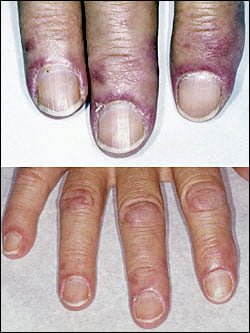
dermatomyositisWhat Is Dermatomyositis?

[dropcap]D ermatomyositis is a rare autoimmune systemic disease of the connective tissue that is characterized by inflammatory and debilitating degenerative changes in the muscles and in the skin. 

Dermatomyositis results in symmetric, proximal muscle weakness of limbs (upper arms and legs), and skin manifestations. 50-70% of patients have circulating myositis-specific auto-antibodies.

The course of dermatomyositis is unpredictable being marked by spontaneous flare-ups and remissions. It can begin slowly or abruptly according to the factor that is triggering the onset such as infection, medications like phenytoin, and autoimmune disease.

Q: What are the skin manifestations of dermatomyositis?

A: Classic skin manifestations of dermatomyositis include these features:

  • The heliotrope rash (lilac color) on upper eyelids.
  • Rash on face, neck, shoulders, upper chest, elbows, knees, knuckles, and back.
  • Gottron’s papules (scaly, red eruptions or  patches over the knuckles, elbows, and knees).
  • The V-sign (rash front of neck and chest).
  • The shawl sign (rash distribution on shoulders and back).1

Additional cutaneous manifestations are described below under symptoms.

Dermatomyositis is associated with an increased risk of  cancer, other autoimmune diseases, such as lupus and psoriasis, and it can be a complication of interferon-α therapy. About 1 person in 100,000 are affected according to various studies. While it affects all ages, women have twice the occurence of men.

There is no cure for dermatomyositis, but the symptoms can be treated.  Options include medication, physical therapy, exercise, heat therapy (including microwave and ultrasound), orthotics and assistive devices, and rest.  The standard treatment for dermatomyositis is a corticosteroid drug, given either in pill form or intravenously.  Immunosuppressant drugs, such as azathioprine and methotrexate, may reduce inflammation in people who do not respond well to prednisone.2

What Is Dermatomyositis In Celiac Disease and/or Gluten Sensitivity?

Sources:
  1. Marvi U, Chung L, Fiorentino DF. Clinical presentation and evaluation of dermatomyositis. Indian J Dermatol. 2012 Sep;57(5):375-81. doi: 10.4103/0019-5154.100486. []
  2. National Institute of Neurological Disorders and Stroke. []

Muscle Weakness: definition

Impaired status of muscle function mainly resulting from  nutritional deficiencies including any of these: protein, magnesium, thiamin (B1), niacin (B3), potassium, phosphorus, selenium, and vitamin D,  or due to chronic fatigue syndrome or hypoglycemia, and if… 

Osteomalacia: definition

A metabolic bone disorder characterized by generalized reduction in bone density (bone softening) in adults and increased risk of fractures, especially wrist and pelvis, with muscular weakness of upper arms and thighs, waddling walk, and…