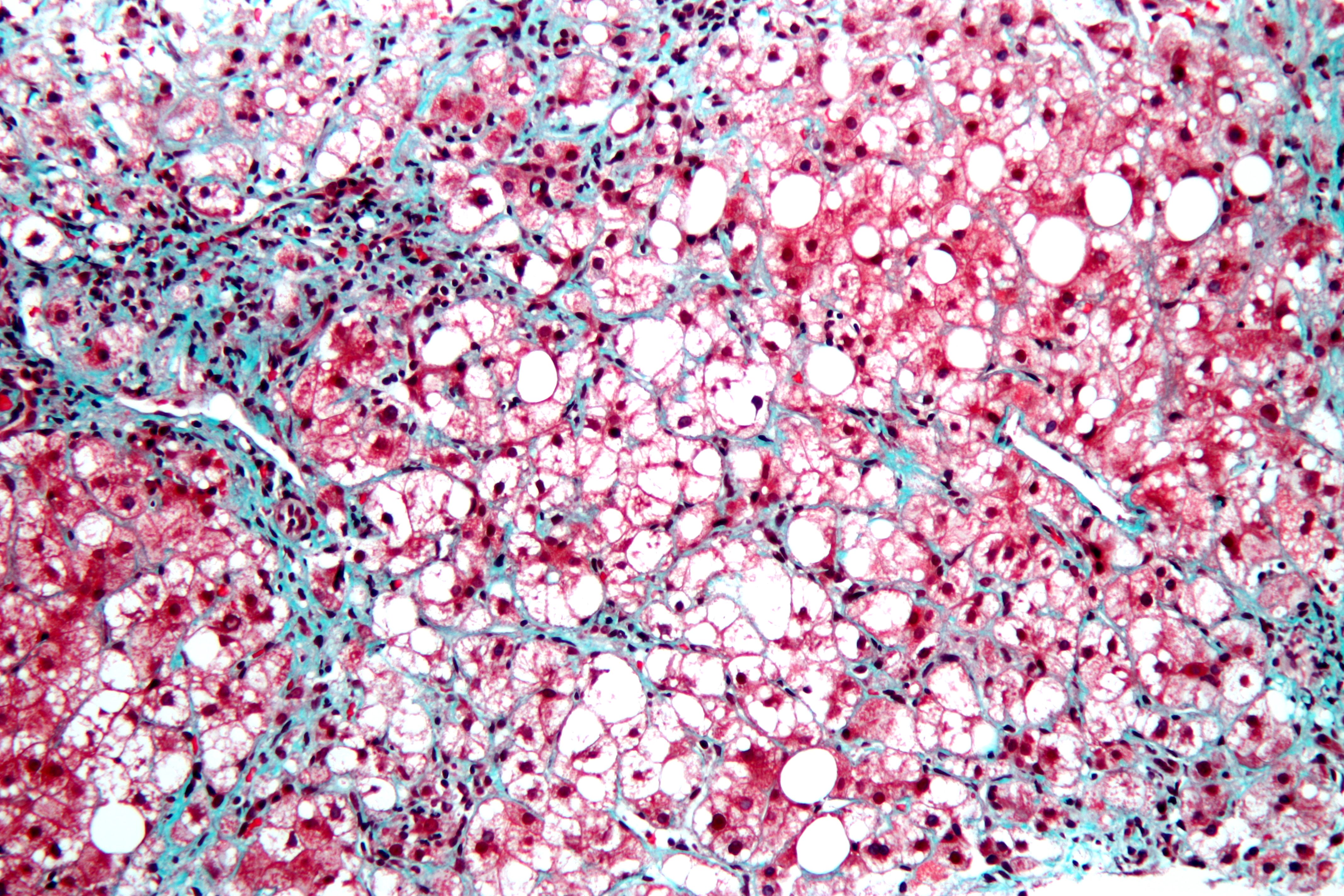
This is a stained liver biopsy sample showing advanced cellular changes in non-alcoholic fatty liver disease. Blue is fibrosis. White is fat accumulation in degenerated cells. Courtesy of Nephron’s work.
What Is Non-Alcoholic Fatty Liver Disease?
[dropcap]N[/dropcap]on-alcoholic fatty liver is a non-inflammatory liver disorder characterized by degenerative changes in the liver caused by excessive accumulation of lipid (fat) in hepatocytes (liver cells) that is called free fatty acid-generated lipotoxicity.
Non-alcoholic fatty liver shows an increase in liver enzymes called transaminases.
Q: What are the enzymes that increase?
A: The transaminases that increase are ALT and AST. ALT is the abbreviation for alanine aminotransferase enzyme and AST is the abbreviation for aspartate aminotransferase enzyme. They are commonly measured in blood tests to determine liver function and when elevated indicate inflammation.
What Is Non-Alcoholic Fatty Liver In Celiac Disease and/or Gluten Sensitivity?
[dropcap]R[/dropcap]eversible hypertension is a pressure disorder of arteries associated with increased systemic (body wide) blood vessel resistance to blood flow due to endothelial (cell) dysfunction of arterial blood vessels that can improve with nutritional treatment.
Hypertension itself is defined as a systolic blood pressure (SBP) of 140 mm Hg (mercury) or greater and/or diastolic blood pressure (DBP) of 90 mm Hg or greater.
Q: What is blood vessel (vascular) resistance to blood flow?
A: Vascular resistance to blood flow means the arteries carrying blood away from the heart cannot relax or dilate when needed to lower blood pressure but stay constricted, which in turn, keeps the pressure high.
Here’s an analogy: if you replace your garden hose having a one inch inside diameter with one that has a smaller half inch diameter and open the water valve as usual, the result would be water shooting out with more force.
What Is Reversible Hypertension In Celiac Disease and/or Gluten Sensitivity?
[dropcap]S[/dropcap]eborrhea dermatitis is a recurring inflammatory disorder of sebaceous glands characterized by scaly patches of skin, often with bumps.
Seborrhea dermatitis results from the body’s inflammatory reaction to invasion by pityrosporum yeast that naturally inhabits the scalp and skin.1 Inflammation is the normal response to tissue injury and germ invasion.
Pityrosporum is a yeast that is commonly present worldwide. Its development depends on various factors that predispose to pityriasis versicolor, a chronic and mild superficial yeast infection. These infections usually are asymptomatic without itching or pain and without cellular and/or antibody responses.2
Q: Why are the sebaceous glands particularly affected by this yeast?
A: Pityrosporum yeast is an organism that needs oil produced by sebaceous glands to grow. If conditions permit, this yeast invades the superficial layer of skin and hair shafts to reproduce, causing infection. Such conditions include weakened skin due to nutritional deficiencies, excessive build-up of oil on skin, and altered immunity due to systemic disease such as psoriasis.
In adults, areas of skin that are the most affected have the greatest number of sebaceous glands especially the scalp, back, underarms, and the face including the eyelids, eyebrows and side folds of the nose.
All ages are subject to seborrhea dermatitis, and males have a higher occurence than females.
What Is Seborrhea In Celiac Disease and/or Gluten Sensitivity?
Zarei-Mahmoudabadi A, Zarrin. M, Mehdinezhad F. Seborrheic dermatitis due to Malassezia species in Ahvaz, Iran. Iran J Microbiol. 2013 Sep;5(3):268-71. [↩]
Swollen Eyelids in Blepharitis. Courtesy Wikimedia
What Is Non-Infectious Blepharitis?
[dropcap]N[/dropcap]on-infectious blepharitis is an inflammatory condition of the eyelids that is NOT caused by an invading organism but rather nutritional deficiencies. It is characterized by non-ulcerative inflammation of the hair follicles and lacrimal glands along the eyelid edges.
Q: What is the difference between inflammation and an invading organism which causes inflammation?
A: An invading organism such as Staphylococcus aureus, a common bacteria on the body’s surface, is called a stye. Styes are treated with antibiotics and resolve. Whereas, non-infectious blepharitis does not respond to antibiotics because there is no infection.
The eyelids are an important structural defense against infection and threats to the eye through blinking and tear production. Their continual pattern of blinking every few seconds sweeps away debris and keeps the eye moistened with tears.
Tears are made by the meibomian glands in the eyelids and consist of fatty acids, water and mucous and also contain anti-microbial substances.
Failure of the meibomian glands to function properly, called meibomian gland dysfunction or MGD, is a chronic, diffuse abnormality characterized by terminal duct obstruction (plugs) and/or changes in the amount or quality of the glandular secretion called meibom (tears). This may result in alteration and/or insufficiency of the tear film, symptoms of eye irritation, clinically apparent inflammation, and disease of the eye surface.
What Is Non-Infectious Blepharitis In Celiac Disease and/or Gluten Sensitivity?
[dropcap]U[/dropcap]nexplained blurred vision is unclear or distorted vision that is not caused by allergy, poor refraction (eye test), medication side effects, metabolic disorders, or defects in any part of the eyeball, optic nerve, or in the occipital area of the brain resulting from such problems as calcifications, aneurysm, or tumors.
What Is Unexplained Blurred Vision In Celiac Disease and/or Gluten Sensitivity?
A menstrual disorder that occurs regularly during the last week of the luteal phase and starts to subside a few days before menstruation begins. PMS is an atypical symptom of celiac disease involving deficiencies of…
A chronic dermatitis characterized by hard, dry, deep seated, intensely itchy papules. It is an atypical symptom of celiac disease involving deficiencies of vitamin A and omega-3 fatty acids. Click for full description.
An autoimmune, chronic slowly progressive demyelinating (damage to nerve fibers) disease of the central nervous system characterized by multiple and varied neurologic symptoms and signs such as numbness, muscle weakness and visual disturbances, usually with…
Abnormalities of the nail plate that are characterized by poor nail structure of both fingernails and toenails resulting from deficiencies of protein, calcium, and omega-3 fatty acids. Click for full description.
Disorders of the mouth that are characterized by alterations in and sores of the mucosal lining of the mouth resulting from contact with gluten in food and any of the following nutrient deficiencies: iron, omega-3…
![Grade_1_hypertension[1]](https://glutenfreeworks.com/health/wp-content/uploads/sites/10/Grade_1_hypertension1.jpg)


