Skip to content

Vitamin C Deficiency

vitamin c gluten celiac disease symptomWhat Is Vitamin C?

[dropcap]V[/dropcap]itamin C, also called ascorbic acid or ascorbate, is an essential water soluble vitamin.

Fresh supplies of vitamin C are required every day to perform vital roles throughout the body among which are the production of connective tissue such as skin, blood vessels and bone, anti-inflammatory responses and anti-oxidant performance. See below for all roles.

Vitamin C fights for us! It has an anti-cancer effect stemming from its role as a potent anti-oxidant in blood plasma and within cells. It also protects nucleic acids (DNA) from oxidative damage and inhibits the formation of nitrosamines (carcinogenic compounds formed in the digestive tract).

Importantly, vitamin C can regenerate vitamin E from an oxidized state after vitamin E performs its own anti-oxidant role against free radicals and vitamin C works together with other anti-oxidants, such as beta-carotene and glutathione, to increase their overall anti-oxidant effect.

A study investigating the specific anti-inflammatory and anti-oxidant micronutrients that reduce oxidative stress found that in adolescents with metabolic syndrome (MetS) the lower the vitamin C level in blood the worse the MetS status and blood uric acid level.  MetS prevalence was estimated at 7% among boys and 3% among girls.1

Vitamin C reverses osteoporosis by reducing or preventing oxidative stress that destroys living bone tissue. Osteoporosis is a disorder of bone inflammation that results in thin, weak bones that may easily fracture. In normal bone structure, vitamin C is required to form collagen, which is living bone tissue.

In humans, vitamin C reduces the duration of common cold symptoms, even if its effect is not clear.2

Vitamin C must be obtained from food daily because our bodies, unlike monkeys and other animals, cannot produce it.

Urinary excretion of vitamin C cannot be detected when vitamin intake is below the required levels. On the other hand, when intake exceeds saturation in the body, the vitamin and/or its metabolites are actively excreted into urine to prevent excessive toxicity of the vitamins.3

What Is Vitamin C Deficiency In Celiac Disease and/or Gluten Sensitivity?

Sources:
  1. TGBeydoun MA, Canas JA, Beydoun HA, Chen X, Shroff MR, Zonderman AB. Serum antioxidant concentrations and metabolic syndrome are associated among U.S. adolescents in recent national surveys. J Nutr. 2012 Sep;142(9):1693-704. doi: 10.3945/jn.112.160416. []
  2. Shaik-Dasthagirisaheb YB, Varvara G, Murmura G, Saggini A, Caraffa A, Antinolfi P, Tete’ S, Tripodi D, Conti F, Cianchetti E, Toniato E, Rosati M, Speranza L,Pantalone A, Saggini R, Tei M, Speziali A, Conti P, Theoharides TC, Pandolfi F. Role of vitamins D, E and C in immunity and inflammation. J Biol Regul Homeost Agents. 2013 Apr-Jun;27(2):291-5. []
  3. Shibata K, Hirose J, Fukuwatari T. Relationship Between Urinary Concentrations of Nine Water-soluble Vitamins and their Vitamin Intakes in Japanese Adult Males. Nutr Metab Insights. 2014 Aug 5;7:61-75. doi: 10.4137/NMI.S17245. eCollection 2014. []

Systemic Lupus Erythematosus 

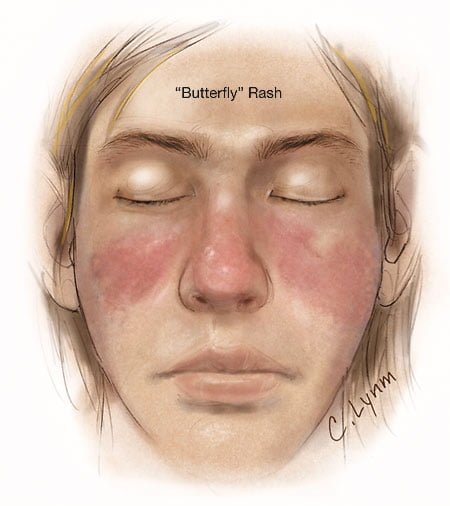
Image showing butterfly rash of SLE. Courtesy JAMA.
Image showing butterfly rash typical of SLE. Courtesy JAMA.

What Is Systemic Lupus Erythematosus?

[dropcap]S[/dropcap]ystemic lupus erythematosus (SLE) is a chronic autoimmune inflammatory disease that is characterized by involvement of multiple organs due to the production of antibodies to components of the cell nucleus.1 SLE has an unpredictable course of acute flare-ups and remissions.

Severity depends on the extent of organs affected with skin and nail involvement, called discoid lupus, being the least serious and inflammmation of the kidney, called lupus nephritis, being the worst.

Nevetheless, a classic presentation is development of a rash over the cheeks and nose that resembles a butterfy with wings spread hence the name “butterfly rash.”

Symptoms are many and varied depending on the tissues affected and are often not specific, for example hair loss has a variety of causes. Symptoms can be confused by co-existence with other autoimmune disease such as Sjogren’s syndrome.

Systemic lupus erythematosus should be managed by a specialist. Symptoms can be controlled with steroid therapy, but this disease can be a cause of premature death  mainly from active disease, organ failure (e.g., kidneys), infection, or cardiovascular disease from accelerated atherosclerosis.

Certain common medicines known to cause drug-induced lupus are:

  • Isoniazid
  • Hydralazine
  • Procainamide

Other less common drugs may also cause the condition. These may include:

  • Anti-seizure medications
  • Capoten
  • Chlorpromazine
  • Etanercept
  • Infliximab
  • Methyldopa
  • Minocycline
  • Penicillamine
  • Quinidine
  • Sulfasalazine

Symptoms tend to occur after taking the drug for at least 3 to 6 months.2

Although there is a strong familial aggregation, the disease is relatively uncommon and most cases are sporadic.1 According to the Center for Diseases (CDC), lupus most commonly affects women of childbearing age but also occurs in infants, children, adolescents, and men with peak occurrence between ages 15 and 40. Blacks (and possibly Hispanics, Asians, and Native Americans) are affected more than Whites.

What Is Systemic Lupus Erythematosus In Celiac Disease and/or Gluten Sensitivity?

Sources:
  1. http://www.cdc.gov/arthritis/basics/lupus.htm [] []
  2. www.nlm.nih.gov/medlineplus/ency/article/000446.htm []

Arthritis, Juvenile Idiopathic

Rheumatoid_arthritis_joint[1]What Is Juvenile Idiopathic Arthritis?

[dropcap]J[/dropcap]uvenile idiopathic arthritis (JIA) is a rheumatic disorder characterized by chronic, inflammatory disease of large and small synovial joints and other organs in children under age 16 years. Growth and development may be impaired in these children.1

Q: Which joints are affected in juvenile idiopathic arthritis?

A: In juvenile idiopathic arthritis the joints that are affected are variable and so are the manifestations.

According to the International League of Associations for Rheumatology (ILAR) classification system, there are seven different subtypes of  juvenile idiopathic arthritis. 

The main treatment to reduce inflammation and relieve pain is with non-steroidal inflammatories such as Ibuprofen.

What Is Juvenile Idiopathic Arthritis In Celiac Disease and/or Gluten Sensitivity?

Sources:
  1. Stagi S, Giani T, Simonini G, Falcini F. Thyroid function, autoimmune thyroiditis and coeliac disease in juvenile idiopathic arthritis. Rheumatology. Apr 2005;44(4):517-20. []

Scleroderma (Systemic Sclerosis)

sclerodermaWhat Is Scleroderma?

[dropcap]S[/dropcap]cleroderma is a chronic skin manifestation of progressive systemic sclerosis characterized by generalized thickened, edematous skin firmly bound to subcutaneous tissue which causes limited movement.

Systemic sclerosis a connective tissue disease that involves destructive changes in the skin, blood vessels, muscles, and internal organs. The course can be mild or it can be fatal. Cardiopulmonary complications from fibrosis are the most common cause of death.

Gastrointestinal problems mainly due to fibrosis affect 50 to 90% of patients.1

Q: Is there a cure for scleroderma?

A: There is no cure for scleroderma. Treatment is aimed at improving symptoms.

  • Heartburn (acid reflux) can be treated with antacid drugs.
  • Scleroderma kidney disease can be treated with blood pressure medications called “angiotensin converting enzyme inhibitors” (ACE inhibitors). These can often effectively control kidney damage if started early and use of these drugs has been a major advance for treating scleroderma.
  • Muscle pain and weakness can be treated with anti-inflammatory drugs such as prednisone, intravenous immunoglobin (IVIg), and/or immunosuppressive medications. Physical therapy may be useful to maintain joint and skin flexibility.2


What Is Scleroderma In Celiac Disease and/or Gluten Sensitivity?

Sources:
  1. Forbes A, Marie I. Gastrointestinal complications: the most frequent internal complications of systemic sclerosis. Rheumatology (Oxford). 2009 Jun;48 Suppl 3:iii36-9. doi: 10.1093/rheumatology/ ken485. []
  2. http://www.rheumatology.org []

Osteonecrosis

X-ray showing osteonecrosis of the femur. Courtesy Wikimedia.
X-ray showing osteonecrosis of the femur (right side). Courtesy Wikimedia.

What Is Osteonecrosis?

[dropcap]O[/dropcap]steonecrosis is a bone disorder resulting from insufficient blood flow to a part of the skeleton and is characterized by resulting death of bone cells (necrosis).

After a while the bone can collapse. If this condition is not treated, the joint will deteriorate and this will become severe arthritis.

It is most common in the hip and shoulder, but can affect other large joints such as knee, elbow, wrist and ankle.1

What Is Osteonecrosis In Celiac Disease and/or Gluten Sensitivity?

Sources:
  1. http://www.ncbi.nlm.nih.gov/pubmedhealth/PMH0004519/ []

Psoriatic Arthritis

Bone scintigraphy showing left elbow affected by psoriatic arthritis. Photo by P Kitsoulis et. al. Courtesy BioMed Central.
Bone scintigraphy rear view showing left elbow with psoriatic arthritis. Photo P. Kitsoulis et. al. Courtesy BioMed Central.

What Is Psoriatic Arthritis?

[dropcap]P[/dropcap]soriatic arthritis is a joint manifestation of psoriasis, a systemic autoimmune disease, characterized by asymmetric involvement in one or more joints, especially affecting the distal phalangeal joints of fingers and toes (joints nearest nails).

In some patients, psoriatic arthritis can occur only with peripheral enthesitis which is inflammation where tendons insert into bone, particularly Achilles tendinitis and plantar fascitis, and/or dactylitis. Dactylitis is inflammation of the entire toe, also called “sausage toe.”1

Early treatment is crucial to symptom control. Even a 6-month delay from symptom onset to the first visit with a rheumatologist contributes to the development of peripheral joint erosions and worse long-term physical function.2

Q: Does psoriatic arthritis get worse when skin symptoms get worse?

A: Joint symptoms may coincide with exacerbations and remissions of skin symptoms.

What Is Psoriatic Arthritis In Celiac Disease and/or Gluten Sensitivity?

Sources:
  1. Salvarani C, Cantini F, Olivieri I, Macchioni P, Niccoli L, Padula A, Ferri S, Portioli I. Isolated peripheral enthesitis and/or dactylitis: a subset of psoriatic arthritis. J Rheumatol. 1997 Jun;24(6):1106-10. []
  2. Haroon M, Gallagher P, Fitzgerald O. Diagnostic delay of more than 6 months contributes to poor radiographic and functional outcome in psoriatic arthritis. Ann Rheum Dis. 2014 Feb 13. doi: 10.1136/annrheumdis-2013-204858. []