

Those Wavy Fingernails Are Not a Sign of Good Health
I was sitting in the waiting room at the Honda dealer last Friday and a middle aged woman next to me mentioned she had celiac disease after hearing me turn down a complimentary pastry. We…
I was sitting in the waiting room at the Honda dealer last Friday and a middle aged woman next to me mentioned she had celiac disease after hearing me turn down a complimentary pastry. We…

Low iron levels have been associated with increased severity of restless leg syndrome. The following medical case report discusses four patients with low iron and restless leg syndrome who were tested positive for celiac disease…
 What Is Low Stomach Acid Production?
Low stomach acid production is a common disorder in celiac disease and dermatitis herpetiformis that is characterized by lack of sufficient hydrochloric acid needed 1) to properly digest food, which results in malnutrition and subsequent nutritional deficiencies, and 2) to destroy swallowed bacteria and other microbes, which may allow infections to develop.
It is also common in the general population, as well, affecting 50% of people age 60 years and about 80% by age 85 years. Nevertheless, low stomach acid is not generally looked for as a cause of acute and chronic disorders that rob health with far-reaching effects.
Understanding Stomach Acid Production and Function
The stomach digests incoming food into a liquid state, thereby releasing nutrients so they can be absorbed by the small intestine. Powerful stomach muscles churn food and mix it with gastric juice, dissolving and breaking it down.
Gastric juice is produced by gastric glands located in the stomach lining. These numerous, microscopic glands produce about 3 liters of juice a day. Gastric juice is composed of a high concentration of
What Is Helicobacter Pylori (H. Pylori) Infection? Helicobacter pylori infection is a potentially deadly stomach disease characterized by chronic superficial inflammation and ulcerations in 100% of infected patients. This infection disrupts normal defense and repair…
 What Is Iron?
Iron is an essential mineral that is required for normal body function.
Almost two-thirds of iron in the body is found in hemoglobin, the protein in red blood cells that carries oxygen to tissues. Smaller amounts of iron are found in myoglobin, a protein that helps supply oxygen to muscle, and in enzymes that assist biochemical reactions.
Iron is also found in proteins that store iron for future needs and that transport iron in blood.
Q: How are iron stores regulated?
A:Iron stores are regulated by intestinal iron absorption.1That is, whenever iron is needed, more iron is absorbed than when iron is sufficient. This mechanism prevents excess iron in the body which is harmful.
In the brain, iron is necessary to ensure oxygenation and to produce energy in the cerebral parenchyma (via cytochrome oxid. ase), and for the synthesis of neurotransmitters and myelin.
Iron concentrations in the umbilical artery are critical during the development of the fetus, and in relation with the IQ in the child.2

C ollagenous gastritis is a rarely reported stomach disorder characterized by the deposition of a subepithelial collagen band and accompanying inflammatory infiltrate in the stomach wall.
A subepithelial collagen band means that collagen, a tough fibrous protein, has abnormally accumulated under the surface layer of epithelial cells which form the mucosa lining the stomach.
The surface mucosa may remain intact and not show lymphocytosis and/or gastritis on endoscopic examination or it may become stripped off and bleed from entrapped capillaries. Biopsy is necessary to diagnose collagenous gastritis.1
Q: Why does collagen become deposited under the surface lining of the stomach?
A: It is thought that collagen deposition is preceded by inflammation and tissue damage. However, the natural history and pathogenesis of collagenous gastritis remain unclear.2
A distressing neurologic condition causing uncomfortable crawly and painful sensations in the legs that makes the sufferer need to move them for a brief relief of symptoms, especially at night.
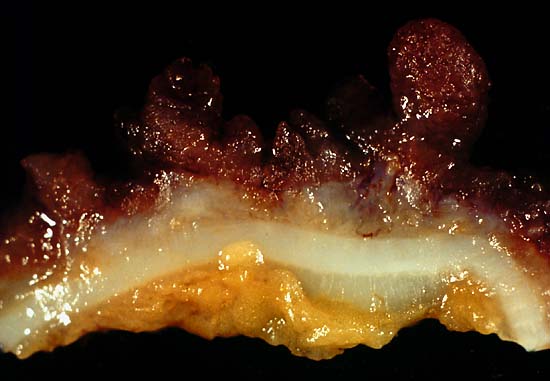
U lcerative colitis is an inflammatory disorder of the colon characterized by continuous inflammation of the mucosa and submucosa usually with small ulcers, extending from the rectum and typically involving the distal colon, rectum, and anus and producing bloody diarrhea.
While the severity of ulcerative colitis varies among patients, iron deficiency anemia often develops due to blood loss especially when there are many bloody bowel movements in a day.
The onset of ulcerative colitis is most commonly in young adulhood.
Q: Is this disease painful?
A: Yes with the passage of stool.
Psychological stress and subsequent dysbiosis exacerbate ulcerative colitis.
Psychological stress activates multiple physiological processes aimed at maintaining balance within the body. These physiological processes also have the capacity to influence the composition of microbial communities in the digestive tract, and research now indicates that exposure to stressful stimuli leads to gut microbiota dysbiosis.1
While the relative abundance of many different bacterial types can be altered during stressor exposure, findings in nonhuman primates and laboratory rodents, as well as humans, indicate that bacteria in the genus Lactobacillus are consistently reduced in the gut during stress.2
Presently, ulcerative colitis cannot be cured. This condition has a course of remissions, when symptoms subside, and flares, when symtpoms get worse. Treatment is aimed to reduce flares and promote remission. In all cases, correction of dysbiosis improves the condition.
Ulcerative colitis is associated with increased incidence of cancer of the colon.3

A pale, smooth, burning tongue is an alteration in tongue tissue characteristic of iron deficiency. The tongue is also swollen.1
Additionally, the sore tongue surface may be invaded by candida yeast which takes advantage of the sore tissue.
Iron deficiency itself increases susceptibility to infection.
Q: What is iron deficiency?
A: Iron deficiency results when the level within cells is too low to meet metabolic needs of the body for this mineral.
Deficiency is characterized by impaired red blood cell formation, free-radical disposal, oxygenation of cells, immune response to infection, enzyme activity, cognitive performance, digestion, nail structure, and fetal health.2
Iron is an essential mineral that is required for normal body function. Almost two-thirds of iron in the body is found in hemoglobin, the protein in red blood cells that carries oxygen to tissues. Smaller amounts of iron are found in myoglobin, a protein that helps supply oxygen to muscle, and in enzymes that assist biochemical reactions.
Iron is also found in proteins that store iron for future needs and that transport iron in blood. Iron stores are regulated by intestinal iron absorption.3

D ermatitis herpetiformis (DH) is an autoimmune extremely itchy, painful bullous skin rash (blistering eruptions) arising from the underlying dermis layer of skin as a consequence of gluten sensitivity.
Dermatitis herpetiformis is characterized by multiple intensely itchy, red blisters appearing on the elbows which can extend down the forearm to the wrist and the knees. Less usual areas involve the back, buttocks, scalp, and abdomen.
Q: Do the blisters leave a mark when healed?
A: Crops of skin eruptions begin with itching or a burning sensation in reddened papules. There are grouped vesicles and tense blisters. The blister contents may be serous or bloody, with symmetrical distribution (eg, both knees or both elbows). Fluid filled elements rupture leaving denuded areas of sore skin and crust. Subsequently, there is residual hypopigmentation (a white area) or hyperpigmentation (dark area).1
Rupture of blisters begins relief from intense burning and itching.

Primary care providers should be aware of this skin condition, as they are more likely than a gastroenterologist to be confronted with this type of presentation of celiac disease.2
Sources: