Attention Deficit Hyperactive Disorder (ADHD)
 What Is Attention Deficit Hyperactive Disorder (ADHD)?

[dropcap]A[/dropcap]ttention deficit hyperactive disorder (ADHD) is a maladaptive behavioral disorder characterized by a persistent pattern of inattention and impulsivity, or both, that are developmentally (age) inappropriate. For these problems to be diagnosed as ADHD, they must be out of the normal range for a child’s age and development.
Inattention results from difficulty concentrating which gives the impression of not listening. The person’s speech or writing, such as when telling stories, can be disorganized.
Most children with ADHD also have at least one other developmental or behavioral problem. Depression, lack of sleep, learning disabilities, tic disorders, and behavior problems may be confused with, or appear with, ADHD. Every child suspected of having ADHD should be carefully examined by a doctor to rule out possible other conditions or reasons for the behavior.
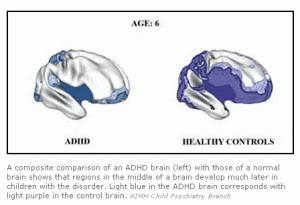
An MRI (magnetic resonance imaging) study investigating whole-brain cortical thickness (outer layer of the brain) in male and female children, adolescents, and adults with ADHD supports the hypothesis that brain abnormalities in ADHD represent abnormal brain development rather than developmental delay.
Q: What is the abnormal development problem?

A: Differences occur in the right side of the brain only. Reduced cortical thickness in people of all ages with ADHD was observed predominantly in the frontoparietal region (forehead and top). However, increased cortical thickness was observed predominantly in the occipital lobe (back). The brain thickness differences were correlated with severity of ADHD.1
ADHD is the most commonly diagnosed behavioral disorder of childhood. It affects about 3 – 5% of school aged children and is diagnosed much more often in boys than in girls.2
What Is ADHD In Celiac Disease and/or Gluten Sensitivity?
Sources:- Almeida Montes LG, Prado Alcántara H, Martínez García RB, De La Torre LB, Avila Acosta D, Duarte MG. Brain cortical thickness in ADHD: age, sex, and clinical correlations. J Atten Disord. 2013 Nov;17(8):641-54. doi: 10.1177/1087054711434351. [↩]
- http://www.ncbi.nlm.nih.gov/pubmedhealth/PMH0002518/ [↩]
