Skip to content

Dermatomyositis

dermatomyositisWhat Is Dermatomyositis?

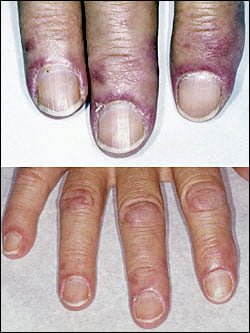
[dropcap]D[/dropcap]ermatomyositis is a rare autoimmune systemic disease of the connective tissue that is characterized by inflammatory and debilitating degenerative changes in the muscles and in the skin. 

Dermatomyositis results in symmetric, proximal muscle weakness of limbs (upper arms and legs), and skin manifestations. 50-70% of patients have circulating myositis-specific auto-antibodies.

The course of dermatomyositis is unpredictable being marked by spontaneous flare-ups and remissions. It can begin slowly or abruptly according to the factor that is triggering the onset such as infection, medications like phenytoin, and autoimmune disease.

Q: What are the skin manifestations of dermatomyositis?

A: Classic skin manifestations of dermatomyositis include these features:

  • The heliotrope rash (lilac color) on upper eyelids.
  • Rash on face, neck, shoulders, upper chest, elbows, knees, knuckles, and back.
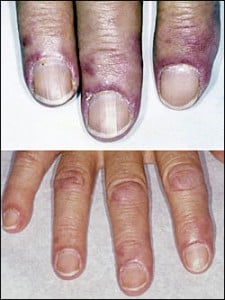
  • Gottron’s papules (scaly, red eruptions or  patches over the knuckles, elbows, and knees).
  • The V-sign (rash front of neck and chest).
  • The shawl sign (rash distribution on shoulders and back).1

Additional cutaneous manifestations are described below under symptoms.

Dermatomyositis is associated with an increased risk of  cancer, other autoimmune diseases, such as lupus and psoriasis, and it can be a complication of interferon-α therapy. About 1 person in 100,000 are affected according to various studies. While it affects all ages, women have twice the occurence of men.

There is no cure for dermatomyositis, but the symptoms can be treated.  Options include medication, physical therapy, exercise, heat therapy (including microwave and ultrasound), orthotics and assistive devices, and rest.  The standard treatment for dermatomyositis is a corticosteroid drug, given either in pill form or intravenously.  Immunosuppressant drugs, such as azathioprine and methotrexate, may reduce inflammation in people who do not respond well to prednisone.2

What Is Dermatomyositis In Celiac Disease and/or Gluten Sensitivity?

Sources:
  1. Marvi U, Chung L, Fiorentino DF. Clinical presentation and evaluation of dermatomyositis. Indian J Dermatol. 2012 Sep;57(5):375-81. doi: 10.4103/0019-5154.100486. []
  2. National Institute of Neurological Disorders and Stroke. []

Autoimmune Disorders In Celiac Disease

Each antibody binds to a specific antigen; an interaction similar to a lock and key. Courtesy Wikipedia.

What Are Autoimmune Disorders?

[dropcap]A[/dropcap]utoimmune disorders refer to those conditions that involve an abnormal immune attack on the body’s own tissues perpetuated by the production of autoantibodies directed against the body, or “self.” Auto means self.

Q: Why does the immune system attack the body?

A: The exact answer is not yet known why the immune system turns against body tissue or “self.” 

Normally, the immune system protects the body from harmful substances and pathogens and produces antibodies against the offending foreign substances, called antigens, to get rid of them. The immune system (humoral) thereafter remembers all antigens and is ready for the next encounter should it happen.

Production of autoimmune antibodies is catastrophic because there is no turning off the readiness to attack a remembered threat (antigen) which is unfortunately “self.” 

Yes, steroids and anti-inflammatory drugs can control symptoms, but nothing can undo the memory programmed into the immune system to produce autoantibodies. There is an enormous research effort ongoing for the answer. 

Autoimmune disorders cover a wide range of diseases that may target only a particular organ, such as autoimmune hepatitis (liver), while others are systemic because the autoantibodies target a particular tissue that is part of more than one organ, such as scleroderma (connective tissue).

Autoimmune diseases as a group affect approximately 8.5% of people worldwide.

What Are Autoimmune Disorders In Celiac Disease and/or Gluten Sensitivity?

Muscle Wasting: definition

A disorder of muscle tissue resulting mainly from any of these conditions: protein deficiency, vitamin C deficiency, thiamin deficiency (B1), and in the disorder, dermatomyositis. Click for full description.