Skip to content

Anxiety, Chronic

Fermentation of Grain by Yeast Releases Carbon Dioxide Which rises the Dough. Courtesy Johnson Mathey Catalyst
Bread is a Major Source of Maltose. Courtesy Johnson Mathey Catalyst

What Is Maltose Intolerance?

M altose intolerance is an enzymopathy (enzyme failure) characterized by inability of the gut to properly break down maltose sugar molecules in food due to low maltase enzyme activity of the small intestinal lining.

Q: What is maltose and maltase?

A: Maltose is a double sugar made up of two molecules of glucose and is derived from starch. Maltase is the enzyme required to digest or release glucose from maltose. Maltase is produced in the microscopic brush border (microvilli) at the base of villi.

Here’s what happens when maltose is not digested:

  • Undigested maltose cannot be absorbed into the body but remains inside the small intestine where it acts osmotically to draw an unnatural amount of water from the body into the intestine which produces diarrhea.
  • Additionally, normal gut bacteria ferment the abnormal abundance of unabsorbed maltose, thereby generating an abundance of short-chain fatty acids and hydrogen gas which result in bloating and pain.1
  • Positive response to a breath hydrogen test (BHT), involving 1 – 3 hours of time post ingestion of maltose test dose, signifies malabsorption in the small intestine and fermentation in the colon. If BHT is positive before 60 minutes, the result implies bacteria is abnormally present in the small intestine, causing fermentation there.

What Is Maltose Intolerance In Celiac Disease and/or Gluten Sensitivity?

Sources:
  1. Krause’s Food, Nutrition, & Diet Therapy. 10th Edition. Kathleen Mahan, Sylvia Escott-Stump. 2000. W.B. Saunders Company. []

Infertility in Females

Lost patch of hair at base of scalp due to alopecia areata. Courtesy Wikimedia,

What Is Alopecia Areata?

A lopecia areata is an autoimmune attack on hair follicles characterized by sudden hair loss involving scalp or beard, although any hairy area may be affected.

Areas of hair loss have a patchy pattern with sharply defined edges.

Q: Can all hair be affected?

A: All body hair may be lost, which is called alopecia universalis although this is uncommon.

In alopecia areata, white blood cells of the immune system attack the rapidly growing cells in the hair follicles. The affected hair follicles become small and drastically slow down hair production. Fortunately, the stem cells that continuously supply the follicle with new cells do not seem to be targeted. So the follicle always has the potential to regrow hair but regrowth is unpredictable.1

What Is Alopecia Areata In Celiac Disease and/or Gluten Sensitivity?

Sources:
  1. http://www.niams.nih.gov/Health_Info/Alopecia_Areata []

Insomnia

Sweet Bon Bons: Courtesy Freepik.
Sugary Bon Bons: Courtesy Freepik.

What Is Sucrose Intolerance And Sucrosemia?

S ucrose intolerance is the inability to digest sucrose, a widely available sugar, while sucrosemia is the abnormal presence of sucrose in the bloodstream.

Q: Why cannot the body digest sucrose?

A: Sucrose, such as cane or beet sugar, is a double molecule sugar which must first be digested before being absorbed from the gut into the bloodstream. That is, sucrose must be split into its component single molecules of fructose and glucose, which are then properly absorbed.

The inability to properly digest sucrose results directly from low production and activity of sucrase in the small intestine. Sucrase is the specific enzyme that splits or digests sucrose.

Undigested sucrose does not remain idle. Its presence acts osmotically to draw water from the body into the intestine, causing watery diarrhea.

Meanwhile, microbiota (normal bacteria) in the colon eagerly ferment the abnormally present sucrose that arrives from the small intestine. Fermentation generates short-chain fatty acids and hydrogen gas, which results in bloating pain.1

In sucrosemia, sucrose molecules abnormaly pass through an unhealthy small intestinal lining and enter the bloodstream where there presence is abnormal. Sucrose in the blood is filtered out by the kidneys and excreted in urine.

Positive response to a breath hydrogen test (BHT), involving 1 – 3 hours of time post ingestion of sucrose test dose, signifies malabsorption in the small intestine and fermentation in the colon. If BHT is positive before 60 minutes, the result implies bacteria is abnormally present in the small intestine, causing fermentation there. Endoscopy is used to measure sucrase activity in tissue samples.

What Is Sucrose Intolerance And Sucrosemia In Celiac Disease and/or Gluten Sensitivity?

Sources:
  1. Krause’s Food, Nutrition, & Diet Therapy. 10th Edition. Kathleen Mahan, Sylvia Escott-Stump. 2000. W.B. Saunders Company. []

Bone Fractures 

Proptosis and lid retraction are features of  Grave's disease, or hyperthyroidism. Courtesy of Wikimedia.
Proptosis and Lid Retraction are Features of Grave’s Disease, or Hyperthyroidism.

What Is Grave’s Disease (Hyperthyroidism)?

G rave’s disease, or hyperthyroidism, is an autoimmune thyroid disease characterized by diffuse nontender goiter, elevated thyroxine hormone levels (T4, T3), suppressed thyroid stimulating hormone (TSH), and presence of thyroid receptor antibodies in the blood.

The autoantibodies involved are anti-thyroid peroxidase and anti-thyroglobulin antibodies. They bind to the thyroid stimulating hormone receptors, causing thyroid stimulation. These antibodies are detected by blood tests.

Q: What happens to the thyroid gland in Grave’s disease?

A: The thyroid gland is located in the front of the neck. This butterfly shaped gland consists of a large number of closed vesicles that contain a homogenous substance called colloid, which contains the thyroglobulin. Thyroglobulin is an iodine-containing protein secreted by the thyroid gland and stored within its colloid, from which the thyroid hormones thyroxine (T4) and triiodothyroinine (T3) are derived.1

Thyroxine molecule, chemical structure. Thyroid gland hormone that plays a role in energy metabolism regulation. It is a iodine containing derivative of thyrosine. Atoms are represented as spheres with conventional color coding: hydrogen (white), carbon (grey), oxygen (red), nitrogen (blue), iodine (purple).
Thyroxine molecule. Atoms are represented as spheres with conventional color coding: hydrogen (white), carbon (grey), oxygen (red), nitrogen (blue), iodine (purple).

T3 is the active hormone and is made from T4. Thyroid hormones are released into the bloodstream as needed to control metabolism, brain development, breathing, heart and nervous system functions, body temperature, muscle strength, skin dryness, menstrual cycles, weight, and cholesterol levels.

Thyroid hormone production is regulated by thyroid-stimulating hormone (TSH), which is made by the pituitary gland in the brain. Normally, when thyroid hormone levels in the blood are low, the pituitary releases more TSH in response to stimulation by the nearby hypothalamus which is continually monitoring levels of thyroxin. When thyroid hormone levels are high, the pituitary decreases TSH production. So in Grave’s disease, release of TSH by the pituitary gland is suppressed by the hypothalamus because thyroid hormone is elevated. Goiter develops from growth stimulation by thyroid stimulating autoantibodies.

What Is Grave’s Disease In Celiac Disease and/or Gluten Sensitivity?

Sources:
  1. Taber’s Cyclopedic Medical Dictionary. 19th ed. F.A. Davis Company. Philadelphia, PA. []

Short Stature

What Is Vitiligo? V itiligo is a pigmentation disorder of the skin characterized by permanent loss of melanocytes in defined areas and, in some patients, antibodies to melanin. Vitiligo has significant psychological impact if occurring before… 

Bone Alkaline Phosphatase (BALP), Elevated

Vertebrae. Courtesy FreePik.com

What Is Elevated Bone Alkaline Phosphatase?

Elevated bone alkaline phosphatase (BALP) is a laboratory result that indicates an abnormal blood level of this bone enzyme.

A bone alkaline phosphatase blood level is one of the most frequently used biochemical markers of bone formation.

Q: Why is the purpose of  bone alkaline phosphatase?

A: Bone alkaline phosphatase is produced by bone cells called osteoclasts in normal bone maintenance for the purpose of breaking down old or damaged bone so that other bone cells called osteoblasts can fill in the excavated areas with new bone. This process keeps bone stong and healthy.

Elevated bone alkaline phosphatase shows that more bone is being broken down than is being replaced. It can be caused by hyperparathyroidism, bone tumors from cancer, and malnutrition.

What Is Elevated Bone Alkaline Phosphatase (BALP) In Celiac Disease and/or Gluten Sensitivity?

Secondary Hyperparathyroidism

Hepatitis-C-Healthy-Liver-and-Inflammation-of-Liver

What Are Elevated Liver Enzymes?

H ypertransaminasemia is a chronic condition of elevated blood liver transaminase enzymes, commonly called “liver enzymes,” that signifies hepatocellular (liver) injury.

Q: What are serum transaminases?

A: Transaminases are the liver enzymes ALT and AST. ALT is the abbreviation for alanine aminotransferase enzyme and AST is the abbreviation for aspartate aminotransferase enzyme.

Transaminases are commonly measured in routine blood tests to determine liver function. Elevated ALT and AST transaminases  indicate inflammation of the liver. Other specific tests must follow to determine the cause of inflammation.

What Is Hypertransaminasemia In Celiac Disease and/or Gluten Sensitivity?

Osteopenia In Childhood 

sclerodermaWhat Is Scleroderma?

S cleroderma is a chronic skin manifestation of progressive systemic sclerosis characterized by generalized thickened, edematous skin firmly bound to subcutaneous tissue which causes limited movement.

Systemic sclerosis a connective tissue disease that involves destructive changes in the skin, blood vessels, muscles, and internal organs. The course can be mild or it can be fatal. Cardiopulmonary complications from fibrosis are the most common cause of death.

Gastrointestinal problems mainly due to fibrosis affect 50 to 90% of patients.1

Q: Is there a cure for scleroderma?

A: There is no cure for scleroderma. Treatment is aimed at improving symptoms.

  • Heartburn (acid reflux) can be treated with antacid drugs.
  • Scleroderma kidney disease can be treated with blood pressure medications called “angiotensin converting enzyme inhibitors” (ACE inhibitors). These can often effectively control kidney damage if started early and use of these drugs has been a major advance for treating scleroderma.
  • Muscle pain and weakness can be treated with anti-inflammatory drugs such as prednisone, intravenous immunoglobin (IVIg), and/or immunosuppressive medications. Physical therapy may be useful to maintain joint and skin flexibility.2


What Is Scleroderma In Celiac Disease and/or Gluten Sensitivity?

Sources:
  1. Forbes A, Marie I. Gastrointestinal complications: the most frequent internal complications of systemic sclerosis. Rheumatology (Oxford). 2009 Jun;48 Suppl 3:iii36-9. doi: 10.1093/rheumatology/ ken485. []
  2. http://www.rheumatology.org []

Irritability

Small Bowel Volvulus, Courtesy  African Journal of Pediatric Surgery.
Small Bowel Volvulus Caused the  Enlarged Dark Loops. Courtesy African Journal of Pediatric Surgery.

What Is Volvulus?

V olvulus is twisting of a loop(s) of bowel onto itself which effectively closes it thus preventing digested matter from passing and causing engorgement of the closed loop with gas and fluid.

Q: How does the bowel get untwisted?

A: This condition usually necessitates surgical correction although some do return to their proper position.

The danger is that there may develop necrosis of the twisted loop(s) in which case, if left untreated, death will ensue.

What Is Volvulus In Celiac Disease and/or Gluten Sensitivity?

Bone Pain

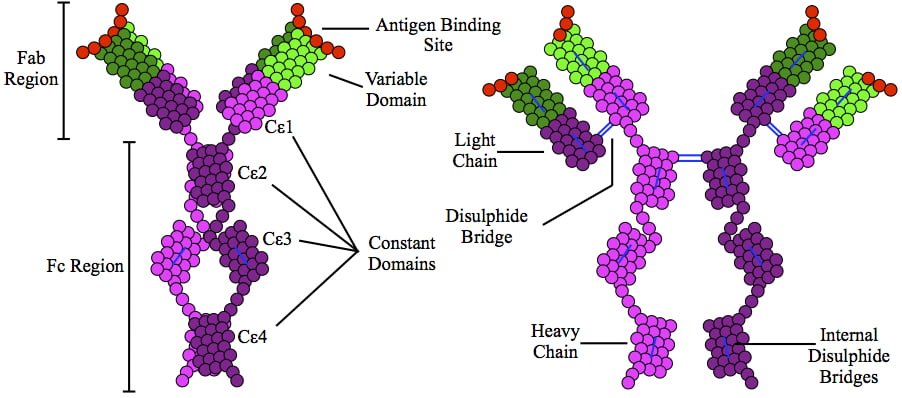
This is a depiction of immunoglobulin E (IgE) antibody which is elevated in allergic reactions.

What Is Allergic Rhinitis?

A llergic rhinitis is an immune disorder characterized by inflammation of the nasal mucosa by an IgE antibody reaction to an allergen.

An allergen is something that triggers an allergic immune response.

Q: What is the immune response?

A: Implicated in the response is an increase in T gamma-delta intraepithelial lymphocytes (IELs), which is a subset of pro-inflammatory T-cells located in the respiratory mucosa.  Lymphocytes are white blood cells.

When a person with allergic rhinitis breathes in an allergen such as pollen or dust, the body releases chemicals, including histamine that cause allergy symptoms. For example, hay fever involves an allergic reaction to pollen. A similar reaction occurs with allergy to mold, animal dander, dust, and other allergens that are breathed in.

What Is Allergic Rhinitis In Celiac Disease and/or Gluten Sensitivity?