Skip to content

Understanding and Treating Calcium Deficiency in Celiac Disease

Calcium is the most abundant mineral in the body. About 99% of this essential nutrient is contained in bones and teeth with the rest being in blood and other tissues. Calcium is needed for strong bones and teeth and for nerve conduction, muscle contraction, heart muscle function, blood pressure regulation, glycogen to glucose conversion, initiation of blood clotting, many hormone actions, many enzyme activities and making acetylcholine, an important chemical for nerve transmission. Calcium plays a part in the prevention of colon cancer.

Most importantly, calcium opposes phosphorus as a buffer to maintain the acid-alkaline balance of the blood and is critical for milk production in the nursing of infants.

Calcium absorption in the small intestine is complex and has specific requirements. 

Osteoporosis in Celiac Disease and How to Prevent It

osteoporosis celiac disease glutenOsteoporosis, or brittle bones, is a generalized bone disorder involving the slow loss of bone mass throughout the skeleton that results in diminished bone mineral density (BMD). Thinning, fragile bones maintain normal cell appearance but have a rapid turnover so that more bone is taken up and removed than is laid down. The result is bone weakness that predisposes people with osteoporosis to fractures.

Osteopenia refers to the progression of bone tissue loss in the range between normal to osteoporosis.

What are Bones?

Bones are dynamic structures made up of living connective tissue and certain minerals. Connective tissue provides the shape of bones and holds calcium phosphate mineral for hardness and

Low Stomach Acid Production

low-stomach-acid1What Is Low Stomach Acid Production?

Low stomach acid production is a common disorder in celiac disease and dermatitis herpetiformis that is characterized by lack of sufficient hydrochloric acid needed 1) to properly digest food, which results in malnutrition and subsequent nutritional deficiencies, and 2) to destroy swallowed bacteria and other microbes, which may allow infections to develop.

It is also common in the general population, as well, affecting 50% of people age 60 years and about 80% by age 85 years.  Nevertheless, low stomach acid is not generally looked for as a cause of acute and chronic disorders that rob health with far-reaching effects.

Understanding Stomach Acid Production and Function

The stomach digests incoming food into a liquid state, thereby releasing nutrients so they can be absorbed by the small intestine. Powerful stomach muscles churn food and mix it with gastric juice, dissolving and breaking it down.

Gastric juice is produced by gastric glands located in the stomach lining. These numerous, microscopic glands produce about 3 liters of juice a day. Gastric juice is composed of a high concentration of

Calcium Deficiency

active-milk-quality-picture-material_38-4418What Is Calcium?

Calcium is the most abundant mineral in the body, with 99% residing in teeth and bones where it constitutes 40% of skeletal bone weight along with 45% phosphorus.

As a component of hard tissues, calcium fulfills a structural role to maintain body size and acts as attachments for musculoskeletal tissues.

Q: What does the non-skeleton calcium do in the body?

A: The remaining 1% of calcium is present in blood and soft tissues. Calcium levels in the blood are maintained within very strict limits by dietary intake, hormonal regulation and a rapidly exchangeable pool in bone tissue. The many important functions are described below.

What Is Calcium Deficiency In Celiac Disease and/or Gluten Sensitivity?

Obesity

KONICA MINOLTA DIGITAL CAMERAWhat Is Obesity?

Obesity is an inflammatory metabolic disorder that is characterized by body mass index greater than 30% resulting from excessive body fat stored in adipose tissue.

Q: What is body fat?

A: Body fat is part of the body that functions as a reserve of stored energy. It is composed of fat cells, called adipocytes, having thin membranes between these cells. Adipocytes expand to store fat and shrink as fat is released as needed into the bloodstream for other body cells to use for metabolizing energy.

Each adipocyte contains a drop of triglyceride which is a type of lipid (fat). Triglycerides are a normal component in the bloodstream and, as such, are transported wherever needed as a form of energy. Excess triglycerides are the form of fat that is stored.

Initially, fat that is eaten in the diet is changed by digestive enzymes into the triglyceride form which is a molecule composed of three fatty acids and glycerol. Triglycerides are then absorbed through the small intestinal wall to be delivered to the liver. Of note, the liver can make triglycerides from excess protein and carbohydrates eaten in a meal, especially sugar and alcohol. The liver on the other hand makes cholesterol from triglycerides.

Triglyceride levels in the blood generally increase as weight increases. It is thought that an elevated blood triglyceride level hampers the body’s ability to feel full or satisfied with food that is eaten. Elevated triglyceride levels also increase the risk of clot formation because they cause the blood to become thicker. A normal triglyceride blood level is 150 mg/dL.

The causes of obesity are complex and varied. Those related to gluten sensitivity are discussed below.

What Is Obesity In Celiac Disease and/or Gluten Sensitivity?

Cataracts

Glucose Meter Reading Showing Hypoglycemia. Courtesy Abbott.
Glucose Meter Reading.Courtesy Abbott.

What Is Diabetic Instability?

D iabetic instability, also called brittle diabetes, is poor control of blood sugar characterized by frequent rise (hyperglycemia) and fall (hypoglycemia). These fluctuations can be life-threatening and cause unnecessary complications.

Q: What are complications in diabetes?

A: Complications of diabetes include any/all of the following:

  • Peripheral neuropathy that causes burning, numbness, or tingling in the extremities.
  • Skin infections and ulcers that do not heal and can lead to amputation of toes, feet or legs.
  • Damage to retina that can progress to blindness.
  • Cataracts and glaucoma that impair vision and can cause blindness.
  • Increased susceptibility to serious infections of the genitourinary tract, lung and upper respiratory tract that can become systemic and life-threatening.
  • Kidney disease that can lead to kidney failure.
  • Heart disease that can lead to heart failure.
  • Vascular disease that can lead to stroke.
  • Impaired motility in digestive tract that can lead to dyspepsia and constipation.
  • Pregnancy complications.
  • Shortened life expectancy.

The main causes of brittleness include malabsorption, certain drugs (alcohol, antipsychotics), defective insulin absorption or degradation, defect of hyperglycemic hormones especially glucocorticoid and glucagon, and above all delayed gastric emptying as a result of autonomic neuropathy.1

What Is Diabetic Instability In Celiac Disease and/or Gluten Sensitivity?

Sources:

  1. Vantyghem MC, Press M. Management strategies for brittle diabetes. Ann Endocrinol (Paris). 2006 Sep;67(4):287-96. []

Tetany

VomitingWhat Is Vomiting?

V omiting is the regurgitation of swallowed food back out of the mouth.

What Is Vomiting In Celiac Disease and/or Gluten Sensitivity?

Short Duration of Breast Feeding 

dermatomyositisWhat Is Dermatomyositis?

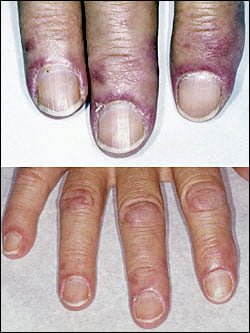
D ermatomyositis is a rare autoimmune systemic disease of the connective tissue that is characterized by inflammatory and debilitating degenerative changes in the muscles and in the skin. 

Dermatomyositis results in symmetric, proximal muscle weakness of limbs (upper arms and legs), and skin manifestations. 50-70% of patients have circulating myositis-specific auto-antibodies.

The course of dermatomyositis is unpredictable being marked by spontaneous flare-ups and remissions. It can begin slowly or abruptly according to the factor that is triggering the onset such as infection, medications like phenytoin, and autoimmune disease.

Q: What are the skin manifestations of dermatomyositis?

A: Classic skin manifestations of dermatomyositis include these features:

  • The heliotrope rash (lilac color) on upper eyelids.
  • Rash on face, neck, shoulders, upper chest, elbows, knees, knuckles, and back.
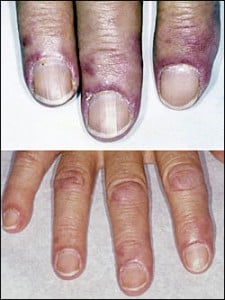
  • Gottron’s papules (scaly, red eruptions or  patches over the knuckles, elbows, and knees).
  • The V-sign (rash front of neck and chest).
  • The shawl sign (rash distribution on shoulders and back).1

Additional cutaneous manifestations are described below under symptoms.

Dermatomyositis is associated with an increased risk of  cancer, other autoimmune diseases, such as lupus and psoriasis, and it can be a complication of interferon-α therapy. About 1 person in 100,000 are affected according to various studies. While it affects all ages, women have twice the occurence of men.

There is no cure for dermatomyositis, but the symptoms can be treated.  Options include medication, physical therapy, exercise, heat therapy (including microwave and ultrasound), orthotics and assistive devices, and rest.  The standard treatment for dermatomyositis is a corticosteroid drug, given either in pill form or intravenously.  Immunosuppressant drugs, such as azathioprine and methotrexate, may reduce inflammation in people who do not respond well to prednisone.2

What Is Dermatomyositis In Celiac Disease and/or Gluten Sensitivity?

Sources:
  1. Marvi U, Chung L, Fiorentino DF. Clinical presentation and evaluation of dermatomyositis. Indian J Dermatol. 2012 Sep;57(5):375-81. doi: 10.4103/0019-5154.100486. []
  2. National Institute of Neurological Disorders and Stroke. []

Hypocalcemia (Low Blood Calcium)

hypocalcemia celiac disease gluten symptomWhat Is Hypocalcemia?

Hypocalcemia, or low plasma calcium, means the level of calcium in blood is too low to meet metabolic needs of the body for calcium.

Low blood calcium is characterized by bone and tooth demineralization (loss of calcium causing weak teeth and fragile bones), and these impaired functions: nerve conduction, muscle contraction, blood clotting, blood pressure regulation, glycogen to glucose conversion, many hormone actions, many enzyme activities, and acetylcholine production.

Q: Where is calcium found in the body?

A: Calcium is the most abundant mineral in the body, with 99% residing in bones and teeth where it constitutes 40% of skeletal bone weight along with 45% phosphorus. As a component of bone (hard tissue), calcium fulfills a structural role to maintain body size and act as attachments for musculoskeletal tissues. The remaining 1% of calcium is present in blood and soft tissues.

Calcium levels in the blood are maintained within very strict limits by dietary intake, hormonal regulation by the parathyroid gland and a rapidly exchangeable pool in bone tissue.

What Is Hypocalcemia In Celiac Disease and/or Gluten Sensitivity?

Laryngospasm

e3343bf0a689b5f974a852fa2e84a718What Is Laryngospasm?

Laryngospasm is an acute disorder of the larynx that is characterized by life-threatening spasms of the muscles of the larynx located in the throat.

Laryngospasm is a rare feature of hypocalcemia (low blood calcium level) characterized by severe alteration in nerve conduction and muscle contraction.

What Is Laryngospasm In Celiac Disease and/or Gluten Sensitivity?