Skip to content

Magnesium Deficiency

magnesium
Bananas Are a Good Source of Natural Magnesium.

What Is Magnesium?

[dropcap]M[/dropcap]agnesium is an essential mineral predominantly found in the body within cells, where it is vital for their functions.

Here is a summary of what magnesium does in our body:

  1. Co-factor for over 300 enzymes involved in the metabolism of food components and synthesis of many compounds.
  2. Required for nerve transmission.
  3. Required for muscle activity (acts to relax muscles in opposition to calcium which acts to contract).
  4. Acts to maintain heart rhythm.
  5. Required for membrane transport and interactions.
  6. Required for glucose metabolism and energy production within cells.
  7. Component of bone mineralization and tooth formation.
  8. Plays a key role in calcium and phosphorus metabolism and management by parathyroid hormone.
  9. Maintains the structural and functional integrity of vital eye tissues such as lens.1

Only 1% of magnesium is found in blood, but the body must keep blood levels of magnesium constant.

What Is Magnesium Deficiency In Celiac Disease and/or Gluten Sensitivity?

Sources:
  1. Agarwal R, Iezhitsa I, Agarwal P, Spasov A. Magnesium deficiency: does it have a role to play in cataractogenesis? Exp Eye Res. 2012 Aug; 101:82-9. doi: 10.1016/j.exer.2012.05.008. []

Systemic Lupus Erythematosus 

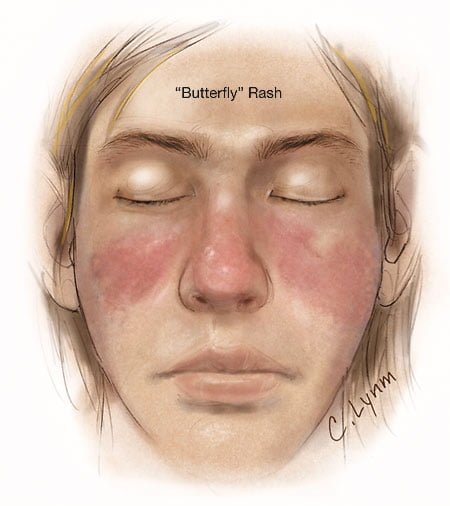
Image showing butterfly rash of SLE. Courtesy JAMA.
Image showing butterfly rash typical of SLE. Courtesy JAMA.

What Is Systemic Lupus Erythematosus?

[dropcap]S[/dropcap]ystemic lupus erythematosus (SLE) is a chronic autoimmune inflammatory disease that is characterized by involvement of multiple organs due to the production of antibodies to components of the cell nucleus.1 SLE has an unpredictable course of acute flare-ups and remissions.

Severity depends on the extent of organs affected with skin and nail involvement, called discoid lupus, being the least serious and inflammmation of the kidney, called lupus nephritis, being the worst.

Nevetheless, a classic presentation is development of a rash over the cheeks and nose that resembles a butterfy with wings spread hence the name “butterfly rash.”

Symptoms are many and varied depending on the tissues affected and are often not specific, for example hair loss has a variety of causes. Symptoms can be confused by co-existence with other autoimmune disease such as Sjogren’s syndrome.

Systemic lupus erythematosus should be managed by a specialist. Symptoms can be controlled with steroid therapy, but this disease can be a cause of premature death  mainly from active disease, organ failure (e.g., kidneys), infection, or cardiovascular disease from accelerated atherosclerosis.

Certain common medicines known to cause drug-induced lupus are:

  • Isoniazid
  • Hydralazine
  • Procainamide

Other less common drugs may also cause the condition. These may include:

  • Anti-seizure medications
  • Capoten
  • Chlorpromazine
  • Etanercept
  • Infliximab
  • Methyldopa
  • Minocycline
  • Penicillamine
  • Quinidine
  • Sulfasalazine

Symptoms tend to occur after taking the drug for at least 3 to 6 months.2

Although there is a strong familial aggregation, the disease is relatively uncommon and most cases are sporadic.1 According to the Center for Diseases (CDC), lupus most commonly affects women of childbearing age but also occurs in infants, children, adolescents, and men with peak occurrence between ages 15 and 40. Blacks (and possibly Hispanics, Asians, and Native Americans) are affected more than Whites.

What Is Systemic Lupus Erythematosus In Celiac Disease and/or Gluten Sensitivity?

Sources:
  1. http://www.cdc.gov/arthritis/basics/lupus.htm [] []
  2. www.nlm.nih.gov/medlineplus/ency/article/000446.htm []

Hypomagnesemia (Low Blood Level of Magnesium)

hypomagnesemiaWhat Is Hypomagnesemia?

[dropcap]H[/dropcap]ypomagnesemia means the level of magnesium in the bloodstream is too low to meet metabolic needs of the body for this mineral.

Q: What are the metabolic needs of the body for magnesium?

A: The metabolic needs of the body for magnesium are numerous which gives rise to very many distressing symptoms when this mineral is deficient.

A major function of magnesium is to stabilize the structure of an enzyme called adenosine triphosphate (ATP) within cells for the production of energy. In the brain, magnesium plays important roles in all the major metabolisms such as oxidation-reduction and regulation of ions (charged minerals).1

What Is Hypomagnesemia In Celiac Disease and/or Gluten Sensitivity?

Sources:
  1. Bourre JM. Effects of nutrients (in food) on the structure and function of the nervous system: update on dietary requirements for brain. Part 1: micronutrients. J Nutr Health Aging. 2006 Sep-Oct;10(5):377-85. []

Antiphospholipid Syndrome

Deep Vein Thrombosis in the Right Leg with Swelling and Redness. Coutesy wikipedia.
Deep Vein Thrombosis in the Right Leg with Swelling and Redness. Courtesy wikipedia.

What Is Antiphospholipid Syndrome?

Antiphospholipid syndrome (APS) is an autoimmune disease and a blood clotting disorder characterized by these clinical and laboratory criteria:

Clinical criteria – recurrent vascular thrombosis (clots in veins/arteries) from hypercoagulability (abnormal excessive clotting) and/or recurrent complications of pregnancy that include loss of the fetus  (miscarriage) and pre-eclampsia or eclampsia.

Laboratory criteria – persistently elevated anticardiolipin, anti–beta-2 glycoprotein I, and/or lupus anti-coagulant antibodies in blood.

In antiphospholipid syndrome autoantibodies are produced by the body and directed against negatively charged phospholipids that are found in the outer layer of cell membranes and platelets. B2-glycoprotein-I (a protein in blood plasma) has been found as a major target antigen for antiphospholipid antibodies.

Q: Are phospholipids important in the body?

A: Yes.  Phospholipid molecules are an essential part of cell membranes. They form a barrier around cells that protect the cell, allow movement of oxygen in and carbon dioxide out of the cell, and regulate other small molecules through the cell wall. Because phospholipids are widespread in the body, this disorder can produce a large variety of symptoms and affect many organs.

One severe effect of APS is the development of a blood clot in a vein deep in the arm or leg, called deep vein thrombosis (DVT). DVT can cause pain, swelling, redness, or increased warmth in the affected limb. Deep vein clots can break off, travel to the lungs, and cause pulmonary embolism.1 Pulmonary embolism is a medical emergency.

Treatment is with anticoagulant medications and blood monitoring.

What Is Antiphospholipid Syndrome In Celiac Disease and/or Gluten Sensitivity?

Sources:
  1. http://www.nhlbi.nih.gov/health/health-topics/topics/ebc/signs.html []