Skip to content

Systemic Lupus Erythematosus 
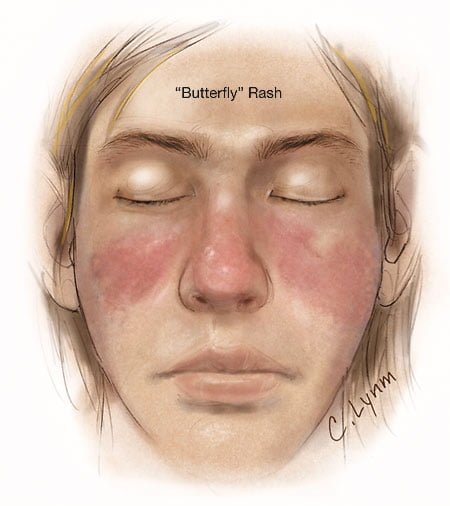
Image showing butterfly rash of SLE. Courtesy JAMA.
Image showing butterfly rash typical of SLE. Courtesy JAMA.

What Is Systemic Lupus Erythematosus?

[dropcap]S[/dropcap]ystemic lupus erythematosus (SLE) is a chronic autoimmune inflammatory disease that is characterized by involvement of multiple organs due to the production of antibodies to components of the cell nucleus.1 SLE has an unpredictable course of acute flare-ups and remissions.

Severity depends on the extent of organs affected with skin and nail involvement, called discoid lupus, being the least serious and inflammmation of the kidney, called lupus nephritis, being the worst.

Nevetheless, a classic presentation is development of a rash over the cheeks and nose that resembles a butterfy with wings spread hence the name “butterfly rash.”

Symptoms are many and varied depending on the tissues affected and are often not specific, for example hair loss has a variety of causes. Symptoms can be confused by co-existence with other autoimmune disease such as Sjogren’s syndrome.

Systemic lupus erythematosus should be managed by a specialist. Symptoms can be controlled with steroid therapy, but this disease can be a cause of premature death  mainly from active disease, organ failure (e.g., kidneys), infection, or cardiovascular disease from accelerated atherosclerosis.

Certain common medicines known to cause drug-induced lupus are:

  • Isoniazid
  • Hydralazine
  • Procainamide

Other less common drugs may also cause the condition. These may include:

  • Anti-seizure medications
  • Capoten
  • Chlorpromazine
  • Etanercept
  • Infliximab
  • Methyldopa
  • Minocycline
  • Penicillamine
  • Quinidine
  • Sulfasalazine

Symptoms tend to occur after taking the drug for at least 3 to 6 months.2

Although there is a strong familial aggregation, the disease is relatively uncommon and most cases are sporadic.1 According to the Center for Diseases (CDC), lupus most commonly affects women of childbearing age but also occurs in infants, children, adolescents, and men with peak occurrence between ages 15 and 40. Blacks (and possibly Hispanics, Asians, and Native Americans) are affected more than Whites.

What Is Systemic Lupus Erythematosus In Celiac Disease and/or Gluten Sensitivity?

Sources:
  1. http://www.cdc.gov/arthritis/basics/lupus.htm [] []
  2. www.nlm.nih.gov/medlineplus/ency/article/000446.htm []

Headache (Emicrania)

headache gluten celiac disease symptomWhat Is Headache Or Emicrania?

[dropcap]E[/dropcap]micrania is a headache resulting from stimulation of, or traction of, or pressure on any of the pain sensitive structures of the head characterized by pain felt anywhere in the head.

In addition to gluten sensitivity and nutritional deficiencies, there are many causes of headache including cardiac, cerebral, vascular, psychiatric, metabolic, and neurologic diseases. Recent studies have highlighted that obesity is significantly associated with headache and disability in adults. This rule also applies to children.1

What Is Headache In Celiac Disease and/or Gluten Sensitivity?

Sources:
  1. Laino D, Vitaliti G, Parisi P,   et. al. Headache, migraine and obesity: an overview on plausible links. J Biol Regul Homeost Agents. 2016 Apr-Jun;30(2):333-8. []

Helicobacter Pylori Infection (H. Pylori)

What Is Helicobacter Pylori (H. Pylori) Infection? [dropcap]H[/dropcap]elicobacter pylori infection is a potentially deadly stomach disease characterized by chronic superficial inflammation and ulcerations in 100% of infected patients. This infection disrupts normal defense and repair… 

Vitamin E Deficiency

Almonds for Vitamin E!

What Is Vitamin E?

[dropcap]V[/dropcap]itamin E is not a single vitamin but naturally occurs as a fat-soluble vitamin family that consists of at least 8 distinct molecules.

These molecules include 4 tocopherols (alpha, beta, gamma, and delta) and 4 tocotrienols (alpha, beta, gamma, and delta).

Generally, tocotrienols are more active against chronic disease while tocopherols are more protective of the nervous system.

Vitamin E (for short) is a powerful antioxidant that protects cell membranes and other fat-soluble compounds from oxidative damage by free radicals (molecules that damage cells).

Q: How does vitamin E protect cells from oxidative damage by free radicals?

A: As an example, the oxidative damage to low density cholesterol (LDL – bad type) appears to lead to the deposition of cholesterol in the arterial wall (plaque formation) leading to atherosclerotic disease, commonly called hardening of the arteries.

Regarding inflammation, mast cells are activated by oxidized LDL which results in increased expression of inflammatory cytokines. This finding suggests that vitamin E antioxidant activity in reducing oxidation of LDL lipoprotein may also reduce mast cell activation. Mast cells reside near small blood vessels and, when activated, release potent mediators involved in allergy and inflammation.1

In neutralizing free radicals, vitamin E itself is oxidized (changed) to a free radical. Importantly, conversion of vitamin E back to the original form occurs by reaction with vitamin C. These two vital anti-oxidants go hand in hand.

Vitamin E is essential for normal cerebellar brain function (lower brain), peripheral nerve health and healthy skin.

What Is Vitamin E Deficiency In Celiac Disease and/or Gluten Sensitivity?

Sources:
  1. Shaik-Dasthagirisaheb YB, Varvara G, Murmura G, Saggini A, Caraffa A, Antinolfi P, Tete’ S, Tripodi D, Conti F, Cianchetti E, Toniato E, Rosati M, Speranza L,Pantalone A, Saggini R, Tei M, Speziali A, Conti P, Theoharides TC, Pandolfi F. Role of vitamins D, E and C in immunity and inflammation. J Biol Regul Homeost Agents. 2013 Apr-Jun;27(2):291-5. []

Hypomagnesemia (Low Blood Level of Magnesium)

hypomagnesemiaWhat Is Hypomagnesemia?

[dropcap]H[/dropcap]ypomagnesemia means the level of magnesium in the bloodstream is too low to meet metabolic needs of the body for this mineral.

Q: What are the metabolic needs of the body for magnesium?

A: The metabolic needs of the body for magnesium are numerous which gives rise to very many distressing symptoms when this mineral is deficient.

A major function of magnesium is to stabilize the structure of an enzyme called adenosine triphosphate (ATP) within cells for the production of energy. In the brain, magnesium plays important roles in all the major metabolisms such as oxidation-reduction and regulation of ions (charged minerals).1

What Is Hypomagnesemia In Celiac Disease and/or Gluten Sensitivity?

Sources:
  1. Bourre JM. Effects of nutrients (in food) on the structure and function of the nervous system: update on dietary requirements for brain. Part 1: micronutrients. J Nutr Health Aging. 2006 Sep-Oct;10(5):377-85. []

Vitamin B6 (Pyridoxine) Deficiency

Lots of Pyridoxine In This Pie...Chicken, Cheese,Spinach, Tomato
Lots of Pyridoxine In This Pie…Chicken, Cheese,Spinach, Tomato

What Is Vitamin B6 (Pyridoxine)?

[dropcap]P[/dropcap]yridoxine is an essential vitamin that is required for the health of nerves, bones, blood, arteries, blood sugar, the immune system and metabolism of proteins.

Two important functions of pyridoxine involve coenzymes that are involved in regulating the metabolism of proteins like methionine and tryptophan and their intermediate amino acid building blocks.

In total, the coenzymic form of vitamin B-6, pyridoxal phosphate (PLP), serves as a coenzyme for over 140 enzymes in human metabolism.1  Functions are more fully described below.

Magnesium is required for pyridoxine to actually attach to enzymes dependent on it.

Because pyridoxine is excreted from the body by the kidneys, urinary excretion of it cannot be detected when vitamin intake is below the required levels. On the other hand, when intake exceeds saturation in the body, the vitamin and/or its metabolites are actively excreted into urine to prevent excessive toxicity of the vitamins.2

Smoking blocks use of pyridoxine.

What Is Pyridoxine Deficiency In Celiac Disease and/or Gluten Sensitivity?

Sources:
  1. Gregory JF 3rd1, Park Y, Lamers Y, Bandyopadhyay N, Chi YY, Lee K, Kim S, da Silva V, Hove N, Ranka S, Kahveci T, Muller KE, Stevens RD, Newgard CB, Stacpoole PW, Jones DP. Metabolomic analysis reveals extended metabolic consequences of marginal vitamin B-6 deficiency in healthy human subjects. PLoS One. 2013 Jun 11;8(6):e63544. doi: 10.1371/journal.pone.0063544. []
  2. Shibata K, Hirose J, Fukuwatari T. Relationship Between Urinary Concentrations of Nine Water-soluble Vitamins and their Vitamin Intakes in Japanese Adult Males. Nutr Metab Insights. 2014 Aug 5;7:61-75. doi: 10.4137/NMI.S17245. []

Vitamin B12 Deficiency

Clams Are Chock Full of Vitamin B12.
Lovely Clams For Vitamin B12.

What Is Vitamin B12?

[dropcap]V[/dropcap]itamin B12, also called cobalamin, is a highly complex vitamin that functions in two coenzyme forms: adenosylcobalamin and methylcobalamin.

These forms of the vitamin play important roles in the physical and chemical processes by which amino acids become proprionate, proprionate that becomes acetate,  and single carbons.

Q: Why are these steps important?

A: These steps are essential for normal function in the workings of all cells, especially for those of the digestive tract, bone marrow and nervous tissue.

Vitamin B12 is mainly excreted through bile into the duodenum (first part of the small intestine) for excretion in stool.1 However, if vitamin B12 is needed, it is reabsorbed in the ileum (end of the small intestine) while excess is excreted in stool and very little in urine.2

The blood level of vitamin B12 in healthy people ranges between 140 and 750 pg/ml.

What Is Vitamin B12 Deficiency In Celiac Disease and/or Gluten Sensitivity?

Sources:
  1. Shibata K, Hirose J, Fukuwatari T. Relationship Between Urinary Concentrations of Nine Water-soluble Vitamins and their Vitamin Intakes in Japanese Adult Males. Nutr Metab Insights. 2014 Aug 5;7:61-75. doi: 10.4137/NMI.S17245. []
  2. Shinton N K. Vitamin B 12 and folate metabolism. Br Med J. Feb 26, 1972; 1(5799): 556–559. []

Muscle Weakness 

Muscle fiber anatomy. Courtesy NIH.
Muscle Fiber Anatomy. Courtesy NIH.

What Is Muscle Weakness?

[dropcap]M[/dropcap]uscle weakness is the impaired status of muscle function characterized by decreased or low muscle strength and inability to perform normal work such as lifting a pot off the stove.

Q: How do muscles work?

A: Muscles do their work by contracting or shortening. For example, to move the foot up and down at the ankle, muscles attached to the foot by tendons must contract to shorten or relax to return to their resting length. Calf muscles contract to point the foot down (flexion) while the shin muscles relax (extension).  For the foot to point up, calf muscles relax while the opposing shin muscles contract.

Each muscle is made up of individual muscle fibers. A muscle fiber is a long cylindrical cell that contains many nuclei, mitochondria, and sarcomeres. Each muscle fiber is surrounded by a thin layer of connective tissue called the endomysium.

Approximately 20–80 of these muscle fibers are grouped together in a parallel arrangement called a muscle fascicle or fiber bundle that is encapsulated by a perimysium. A distinct muscle is formed by enveloping a large number of muscle fascicles in a thick collagenous external sheath extending from the tendons called the epimysium.1

Muscles fall into three types:

  • Voluntary muscles.  These muscles, also called skeletal, we can control by will. Voluntary muscles function by contracting their fibers to draw one part of the body toward another in flexion while opposing muscles that extend or pull a body part away from another. They move our bones to perform activities such as walking to get somewhere, chewing to eat food, lifting to do work, and moving the eyeball to look at something.
  • Involuntary muscles. These muscles work independently of our conscious control. They are needed for internal organs, sphincters, and other parts to do their work, such as peristalsis in the gut that must function at all times to digest and move food, the squirting of bile juice into the duodenum by the Sphincter of Odi in the presence of fat eaten, and action of the pupil to see.
  • Cardiac muscles. These muscles are specialized to keep the heart functioning at all times.

  Muscle weakness can involve all types of muscles.

What Is Muscle Weakness In Celiac Disease and/or Gluten Sensitivity?

Sources:
  1. http://www.ncbi.nlm.nih.gov/books/NBK57140/ []

Bronchiectasis

Bronchiectasis Image. Courtesy Quizlet.com

What Is Bronchiectasis?

[dropcap]B[/dropcap]ronchiectasis is a pulmonary disorder characterized by chronic dilation of bronchi (main airways) and bronchioles (small airways) with chronic inflammation and swelling, increasing the risk of infection.

In bronchiectasis, mucus produced to trap foreign substances, such as dust and bacteria, builds-up because the ability of airways to move it out is impaired. Normally, hair-like cilia that line airways beat mucus out of the lungs. Loss of this action increases mucus in the airways which increases risk of pneumonia.

The anatomy of airways is likened to a branching tree. The trachea, or windpipe, like the trunk of a tree, branches into two primary bronchi that connect it to the lungs. One bronchus connects to the left lung and the other to the right lung. Each bronchus further divides into smaller bronchi that connect to the lobes. Lobes are large subdivisions of lung tissue: two of the left lung and three of the right lung.

Lobe bronchi divide into smaller bronchial tubes ending in small bronchioles. The ends of bronchioles are surrounded with and attached to tiny alveoli which are air sacs that look like clusters of grapes.

Q: What effect does inflammation have on the lungs?

A: Alveoli are only one cell thick, where oxygen is obtained by the bloodsteam from air breathed into them and carbon dioxide is released from the bloodstream to air that is breathed out of air sacs through the pulmonary tree. Two things happen:

  1. Inflammation  impairs exchange of gases in alveoli, resulting in lack of sufficient oxygen (O2) for body cell functions, called hypoxia, and build-up of carbon dioxide (CO2) in blood, called CO2 retention.
  2. Inflammation narrows passageways, which reduces the movement of air to and from the alveoli, and this puts stress on the right side of the heart.

Bronchiectasis can affect one or both lungs or one segment or multiple segments of a lung. Treatment is with antibiotics, chest physiotherapy and good nutrition.

What Is Bronchiectasis In Celiac Disease and/or Gluten Sensitivity?

Adenocarcinoma Of Small Intestine (Cancer)

Section of small bowel surgically removed for adenocarcinoma that grew through the wall. By: CDC/ Dr. Edwin P. Ewing, Jr.

What Is Adenocarcinoma Of Small Intestine?

[dropcap]A[/dropcap]denocarcinomas are malignant tumors, or cancer, of the small bowel arising out of glandular tissue. They fall in the category of rare neoplasm, comprising only 3% of all gastrointestinal malignancies.

Primary adenocarcinoma is the most common histological (cell) subtype constituting 35–50% of cases.1 

Q: What does adenocarcinoma look like?

A: Adenocarcinoma may manifest as strictures, nodules, excavating masses, or annular lesions.2

What Is Adenocarcinoma Of Small Intestine In Celiac Disease and/or Gluten Sensitivity?

Sources:
  1. Benhammane H, El M’rabet FZ, Serhouchni KI, El yousfi M, Charif I, Toughray I, et al. Small Bowel Adenocarcinoma Complicating Coeliac Disease: A Report of Three Cases and the Literature Review. Case Rep Oncol Med. 2012; 2012: 935183. Published online 2012 December 1. doi: 10.1155/2012/935183 []
  2. Ramachandran I, Sinha R, Rajesh A, Verma R. Multidetector row CT of small bowel tumors.  Clinical Radiology. 2007; 62:607-614. []