Skip to content

Video AGAINST The Coeliac Society of Australia’s Proposed PPM Change

gluten free kelly nolan

anti ppm changes australia new zealandIssues of Concern with the undermining of Coeliac Disease care in Australia and New Zealand, the current Trade Practices Act stipulates that only products with no detectable levels of gluten are permitted to be labelled gluten free.

It has recently come to my attention that the Coeliac Society of Australia has not that long ago asked the ACCC to raise the allowable detection limit of gluten laws for a food to be labelled gluten free in Australia. They plan to change it from ‘no detectable gluten’ (currently <3ppm (parts per million) of gluten) to 20 ppm gluten. This will allow foods with small traces of gluten to be labelled ‘gluten free’ and meet world labelling definitions as up until this time Australia and New Zealand are of few countries with such strict gluten free labelling laws. In turn, this supposed to make our diets less

I’m deficient, You’re deficient, We’re all deficient? (Part 2)

In  Part 1 of this article about nutrient deficiencies in the gluten-free population, I posed four critiques and questions that I promised to answer in today’s part 2. Without further ado, here we go…

Critique #1 questioned the small sample size of the research. I can’t do anything about that, and there’s not much to be said about it, so let’s move on.

Next, I think it’s easiest to address critique #3: How did nutrient deficiencies in the gluten-free population compare to Americans as a whole? To answer that question, I pulled data regarding nationwide averages from the USDA’s Community Nutrition Mapping Project. If I amend yesterday’s table that showed the percent of the gluten-free population who are deficient in given nutrients, and add to it a column for the national averages, this is what you find:


Nutrient GF Deficiency Nationwide Deficiency
fiber 74% 92%
calcium 82% 69%
thiamin 59% 19%
riboflavin 25% 11%
B6 35% 26%
folate 85% 40%
B12 29% 20%
iron 41% 11%


These numbers change the perspective a bit, I think. It’s not simply that the gluten-free population is nutrient deficient. When you compare us to the national averages, it gets slightly more complex. In some cases, such as folate, riboflavin, thiamin, and iron, we’re two or more times as deficient (as a group) than the nation. However, in other cases, such as B12, B6, and calcium, we still have greater rates

Namaste Foods Gluten Free Bread Mix Review

Recently I made a loaf of bread using a bag of Namaste Foods Gluten Free Bread Mix. I bought this on sale at some point, and it subsequently sat in the pantry for a while. I’m not sure how long, but there’s another 8 months to go until the use-by date, so I’m not worried. I like to have stuff like this on hand because sometimes I get in the mood to eat bread, and that usually means I have to make it myself. This time, I was also in desperate need of clearing out some pantry space, so making this mix was the easy answer.
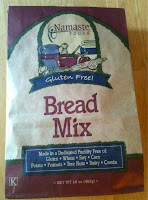
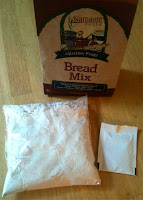
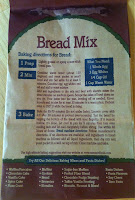
This is the third loaf of gluten free bread I’ve made from a mix (Pamela’s and Bob’s Red Mill were the other ones I tried), and it did fairly well. It rose way more than I thought it would, but it was still heavy and moist the first day, only to very quickly dry out by the third day after baking.

The bread mix consists of a flour blend made from brown rice flour,

Everyone on a Gluten Free Diet?

I have thought for a long time about this very question.  Who would suggest such a thing?

I would. The main reason I would dare to make such a statement is because we have been so negligent in recognizing and treating people with celiac disease.  Not a day goes by that I don’t hear about or speak to someone directly who has suffered needlessly for years.  The other main point I want to make is that NONE of the currently available testing is 100%.

The blood tests and endoscopic biopsies are great tools if they are positive. If they are negative, I have heard of too many people tell me ‘I don’t have celiac disease, my blood test/biopsy was negative’.  This is a major cause for concern to me.  Both of these tests do not confirm you don’t have, or will never develop celiac disease.  First, neither test is 100% reliable.  Second, both tests are simply a snapshot

Gluten Free Diets May Reduce Autistic Behavior


The CDC’s Autism and Developmental Disabilities Monitoring (ADDM) Network released data in 2007 that found about 1 in 150 (8-year-old) children in multiple areas of the United States had an Autism Spectrum Disorder (ASD). The number of diagnosed cases of autism is on the rise; the reason(s) for this is unclear.   Autism knows no racial, ethnic or social boundaries.  Family income, lifestyle, and educational levels do not appear to affect the chance of occurrence.

Fortunately, dietary changes can make a significant change in people with autism.  Research is profound on the positive impact that a gluten and casein free diet can make on children with autism.  Gluten and/or casein free diets have been implemented to reduce autistic behavior, in addition to special education, since the early eighties {Autism, Vol. 3, No. 1, 45-65 (1999)}.  The scientific studies include

Lactose Intolerance: What Is It And How Is It Diagnosed?

Lactose, commonly known as “milk sugar”, may not be digested well if you are either born with absent or low levels of the enzyme lactase or if your intestine has been injured resulting in absent or low levels of lactase. Lactose is a disaccharide or two sugars linked. It is a combination of the two sugars, glucose and galactose. If intestines lack or are deficient in lactase you will not adequately digest lactose and you will experience gas, bloating, abdominal cramps and diarrhea shortly after eating something containing lactose.

The lactase enzyme is on the surface of the intestine cells where it is very vulnerable to intestinal injury. Some people are born with absent or low levels of lactase, therefore have congenital alactasia or hypolactasia. Between 80-100% of people of Asian, Native American, or African ancestry are lactose intolerant for this reason compared to only 15% of those of Northern European ancestry.

Gluten Sensitivity (Non-Celiac Gluten Sensitivity)

Gluten Sensitivity is an umbrella term defined as “any and all problematic health responses to gluten in any body system.” (Recognizing Celiac Disease, p. IX) Anyone can experience Gluten Sensitivity as a normal immune response to the… 

Old Fashioned Stomped Lemon-ade

This tangy, refreshing lemon-ade has stood the test of time not just for extracting loads of vitamin C from the rind, but for exceptional taste. Someone can always be found to do the stomping, especially…