Skip to content

Testing for Nutrient Deficiencies: My Results

christie bessinger gluten free works

There are a number of nutrient deficiencies associated with Celiac and other autoimmune disorders. These occur not only BEFORE diagnosis, due to flattened villi and malabsorption, but AFTER diagnosis as well.  It’s up to us to choose healthy, naturally gluten-free foods (like fruits, veggies, lean protein and brown rice) in order to feel the best we can. Even then, we may still have deficiencies.

I was diagnosed about 5 years ago. Although I have experienced dramatic improvements in my health, sleep quality, and energy level, I have still been dealing with some “weird” symptoms that I wasn’t sure were going to go away. These include eye floaters (which I’ve noticed for about 2 years now), shakiness and rapid pulse especially during the first half of the day, and carbohydrate intolerance. (Eating high carb meals have been giving me headaches). So…. I was VERY excited when I heard that Gluten Free Works was going to be offering . I couldn’t wait to try it out.
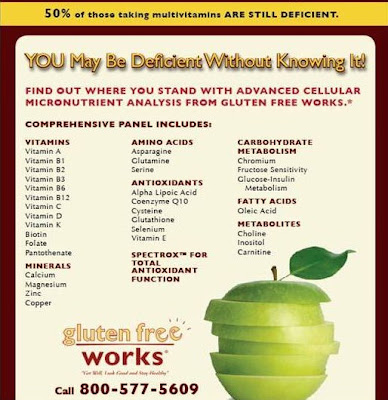
nutrition testing gluten free works


When I got my results back, I was AMAZED at how many nutrient deficiencies I still had after being Gluten-Free for this many years. I came up deficient in:

VITAMIN A (this explained the eye floaters)
CHROMIUM (I had never heard of chromium before now, but this explained my problem with carbs. I have since read that a deficiency in Chromium leads to DIABETES… so I’m glad I figured this out now, rather than later ;)
SELENIUM (had never heard of that one either)

Nutrient Deficiencies Symptom Chart: Know Where You Stand So You Can Control Your Health

Nutrient Deficiencies Symptom Chart: Know Where You Stand So You Can Control Your Health

nutrient deficiency symptoms
Know the Symptoms of Nutrient Deficiencies so You Can Be Healthy!

The impact of nutritional deficiencies on health should be common knowledge among the medical professional community. All doctors, nurses and other medical professionals should be able to quickly and accurately identify and diagnose functional nutritional deficiencies in patients and correct those deficiencies. Unfortunately, this is not the case.

Medical teaching institutions do not focus on nutrition, so many medical professionals are not equipped to recognize the signs of nutritional deficiencies until the patient is extremely sick. In most cases, the patient is able to function, just not at his or her potential. He or she may have weight issues, skin, hair or digestive problems, anxiety or difficulty concentrating. This is called a functional nutrient deficiency.

Celiac Disease & Excessive Gas in the Digestive Tract: What it is and How to Get Rid of It

Source: Buzzle.com

It’s a fact. Everyone produces gas. Ordinarily, most people produce about 1 to 3 pints of gas in a day. Gas is normally painless, creating a feeling of fullness until it is passed.

But sometimes pain is experienced, and when it does it can be either dull or sharp, leaving us feeling bloated or tender in places. It can be localized in one spot, or felt throughout the abdomen.

About 50% of people with celiac disease complain of chronic discomfort from gas at the time of diagnosis.

What is Gas?

The accumulation of gas in the digestive tract is called flatus, and having

The Gluten-free Diet Saved Me from Crohn’s Disease

Photo: Sheknows.com

I have always had a funky stomach. As a very young child I recall laying on my stomach on the living room floor trying to alleviate the horrible cramps and pains I used to get on a regular basis. Coming from a family full of tummy trouble, I thought it was normal and never complained. As a teenager the pains became worse and my Mom and I took a trip to the pediatrician to find out what was wrong. He said I had a spastic colon and that I needed to eat healthier and

Giving Thanks for Health…My Story :)


Here's me at 1 year gluten-free

 This Holiday Season I am especially thankful for the health I now enjoy… it’s been a long journey these past 10 years or so…but I am so thankful for the knowledge I’ve gained about living a Gluten-Free lifestyle…the benefits that have come from it, and that after 10 years, I can finally say that I feel like “me” again. :) 
 
I’ve never really shared my entire experience, and normally don’t write posts that are too personal… but perhaps this can help someone out there who is wondering if they might have Gluten Intolerance or Celiac Disease… or someone who has been diagnosed  and wonders if it is really a “big deal” if they HAVE to go gluten-free or not. I can tell you from personal experience that it WILL CHANGE YOUR LIFE!!! It changed mine… and here’s how: 

It all started back in junior high and high school. I just felt “tired” all the time. I can’t even tell you how many times a day someone would come up to me and say, “What’s wrong? You look tired.” I even remember someone saying to me once, “You look dead.” (ouch!) It seemed like maybe I was just depressed or

Two Simple Ideas for Preventing Colon Cancer

Colon cancer starts with colon polyps. Polyps are growths in the inner lining of your colon walls. They are formed when the inner lining is irritated or attacked by fecal matter toxins. When you have colon polyps, you dramatically increase your risk of getting colon cancer.

To prevent getting colon cancer you need to prevent getting polyps. If you have polyps then you need to prevent them from becoming cancerous.

Here are some ideas that you can use in preventing colon cancer whether you have or do not have polyps.

Honey May Be Best for Cough, Study Finds

Dec. 5, 2007. Courtesy JAMA and Archives Journals and World Science staff


Honey. Photo: Andreas Praefcke

A bit of buck­wheat hon­ey beat the lead­ing over-the-coun­ter chil­dren’s cough rem­edy in re­liev­ing kids’ cough and as­so­ci­at­ed sleep trou­bles, a study has found.

 
But the re­search—though pub­lished in a re­spected med­i­cal jour­nal—was funded by the U.S. hon­ey in­dus­try. Its au­thors rec­om­mend­ed fur­ther stud­ies to con­firm the re­sults, while not­ing that safe­ty and ef­fi­cacy ques­tions have aris­en around over-the-coun­ter kids’ cough med­i­cines. “Cough is the rea­son for nearly three per­cent of all out­pa­tient vis­its in the Un­ited States, more than any oth­er symp­tom,” they wrote in the re­port. “It most com­monly oc­curs in con­junc­tion with an up­per res­pi­ra­to­ry tract in­fec­tion,” and of­ten dis­rupts sleep.

Celiac Disease Health in Depth: Natural Remedies for Chronic Constipation

About 20% of people with untreated celiac disease have chronic constipation instead of the classic symptom of diarrhea. As the rate of diagnosis improves, constipation is becoming recognized as a common symptom of celiac disease.

Constipation is a common problem in the general population of the United States. According to the National Institutes of Health, about 4 million people have frequent constipation. It is one of the most common digestive complaints in the United States, resulting in about 2.5 million doctor visits and 92,000 hospitalizations annually, although most people treat themselves. This high rate of constipation results in annual laxative sales of over $735 million in this country.

This article will discuss the following topics:

1. How to recognize constipation.

2. Natural remedies that have been shown to help constipation.

3. How to induce a bowel movement.

WHAT IS CONSTIPATION?

Constipation involves problems with stool formation, consistency, and evacuation. It is characterized by one or more of these features:

· Hard, dry stool or soft, putty-like stool.

· Difficult defecation.

· Infrequent defecation, less than one bowel movement per day.

· A feeling of incomplete evacuation following bowel movement.

Constipation can give rise to many different ailments including indigestion, a white coated tongue, bad breath, gas, hemorrhoids, hernia, body odor, depression, fatigue, headache, insomnia, and varicose veins.

The three main causes of constipation are abnormal bowel motility, malabsorption and dysbiosis. Each one, or all three together can cause constipation.

1. Abnormal bowel motility is altered peristalsis, where food passes through the intestine too slowly, due to ineffective muscle action of the intestines. It may take the form of spastic colon or atonic colon.

· Spastic colon is characterized by a spasms, (irregular and excessive muscle contractions of the intestinal walls), so that the muscles resist stretching and thereby decrease the diameter of the inside of the intestine. This restricts the passage of food.

Hard, dry stools are produced as the colon absorbs too much water from the slowly advancing stool. Spasms can result from magnesium deficiency, chronic stress, lack of exercise, lack of water or lack of fiber in the diet.

Spastic constipation is associated with variable degrees of abdominal pain or distress, erratic frequency of bowel action, and variation in stool consistency.