Skip to content

Osteoporosis

Woman with long standing osteoporosis. Courtesy of Wikimedia.

What Is Osteoporosis?

Osteoporosis is a metabolic bone disorder characterized by diminished bone mass (density) with normal cell appearance but fragile bone strength that prediposes to broken bones, and with high bone turnover.

This condition usually goes undetected until late when loss of height or a bone fracture occurs. In fact, each year  1.5 million fractures mainly of the hip, spine and wrist are attributed to osteoporosis. Compression fractures of vertebrae bones are the most common, accounting for 700,000 cases.

Bone is composed of specialized connective tissue called osseous tissue. Osseous tissue is made up of living bone cells (osteocytes) that are embedded in a hard matrix (framework) of calcified substance.

Bone matrix contains collagen fibers and the minerals calcium phosphate and calcium carbonate, which provide strength to bone. The copper enzyme, lysyl oxidase, is involved in the cross-linking of collagen in forming the framework for depositing calcium and other minerals to build and repair bone.

Q: How do osteocytes function in bone?

A: Osteocytes maintain the health of bone by their metabolic activity in regulating normal bone turnover. Bone turnover is the breaking down and removal of old or damaged bone and rebuilding or remodeling of healthy bone that is ongoing throughout life. The bone formation process takes about 3 months to complete.

Osteoporosis develops from failure of the body to maintain health and to provide bone tissue with adequate nutrition for proper function. Risk factors that can be modified include: low calcium intake, sedentary lifestyle, smoking, drinking alcohol excessively, eating a diet with excessive caffeine, protein, and phosphate, and taking certain medications over a long time such as steroids, thyroid preparations, the anti-convulsive drug phenytoin, aspirin, antacids, anticoagulants, some diuretics, and some chemotherapeutic drugs. See below for a fuller description.

In addition to celiac disease, osteoporosis is associated with advancing age, family history, nulliparity (no pregnancies) and post-menopause in females, certain disorders such as hyperthyroidism, hypogonadism, inflammatory bowel disease like Crohn’s disease, multiple myeloma, anorexia nervosa, and Cushing’s disease.

Bone strength is easily measured by testing bone mineral density (BMD). BMD is evaluated by DEXA scan (dual-energy X-ray absorptiometry).  DEXA at the femoral neck and lumbar spine is considered the gold standard to confirm the diagnosis of osteoporosis.  Results are expressed as T and Z scores. T scores compare the result with a 20 to 40 year old helathy person while  Z scores compare the result with persons in the same age group. Both are measured in standard deviations (SD).

According to WHO criteria (World Health Organization), a T-score of -1 SD or greater denotes normal bone, a T-score between −1 to −2.5 SD denotes osteopenia, and a T-score of −2.5 or more denotes osteoporosis.1

Treatment is aimed to preserve and increase bone density, minimize symptoms for better quality of life and reduce risk of bone fractures.

What Is Osteoporosis In Celiac Disease and/or Gluten Sensitivity?

The cumulative effects of gluten-induced inflammation, treatment delay, and malabsorption result in lower bone density and bone fragility.2

Sources:
  1. Pantaleoni S, Luchino M, Adriani A, Pellicano R, Stradella D, Ribaldone DG, Sapone N, Isaia GC, Di Stefano M, Astegiano M. Bone mineral density at diagnosis of celiac disease and after 1 year of gluten-free diet. ScientificWorldJournal. 2014;2014:173082. doi: 10.1155/2014/173082. []
  2. Grace-Farfaglia P. Bones of Contention: Bone Mineral Density Recovery in Celiac Disease-A Systematic Review. Nutrients. 2015 May 7;7(5):3347-3369. []

Bone Tissue: definition

Called osseous tissue. Bone is composed of specialized connective tissue (collagen) made up of living bone cells (osteocytes) that are embedded in a hard matrix (framework) of calcified substance. Bone matrix contains collagen fibers and… 

Bone Fractures 

Proptosis and lid retraction are features of  Grave's disease, or hyperthyroidism. Courtesy of Wikimedia.
Proptosis and Lid Retraction are Features of Grave’s Disease, or Hyperthyroidism.

What Is Grave’s Disease (Hyperthyroidism)?

G rave’s disease, or hyperthyroidism, is an autoimmune thyroid disease characterized by diffuse nontender goiter, elevated thyroxine hormone levels (T4, T3), suppressed thyroid stimulating hormone (TSH), and presence of thyroid receptor antibodies in the blood.

The autoantibodies involved are anti-thyroid peroxidase and anti-thyroglobulin antibodies. They bind to the thyroid stimulating hormone receptors, causing thyroid stimulation. These antibodies are detected by blood tests.

Q: What happens to the thyroid gland in Grave’s disease?

A: The thyroid gland is located in the front of the neck. This butterfly shaped gland consists of a large number of closed vesicles that contain a homogenous substance called colloid, which contains the thyroglobulin. Thyroglobulin is an iodine-containing protein secreted by the thyroid gland and stored within its colloid, from which the thyroid hormones thyroxine (T4) and triiodothyroinine (T3) are derived.1

Thyroxine molecule, chemical structure. Thyroid gland hormone that plays a role in energy metabolism regulation. It is a iodine containing derivative of thyrosine. Atoms are represented as spheres with conventional color coding: hydrogen (white), carbon (grey), oxygen (red), nitrogen (blue), iodine (purple).
Thyroxine molecule. Atoms are represented as spheres with conventional color coding: hydrogen (white), carbon (grey), oxygen (red), nitrogen (blue), iodine (purple).

T3 is the active hormone and is made from T4. Thyroid hormones are released into the bloodstream as needed to control metabolism, brain development, breathing, heart and nervous system functions, body temperature, muscle strength, skin dryness, menstrual cycles, weight, and cholesterol levels.

Thyroid hormone production is regulated by thyroid-stimulating hormone (TSH), which is made by the pituitary gland in the brain. Normally, when thyroid hormone levels in the blood are low, the pituitary releases more TSH in response to stimulation by the nearby hypothalamus which is continually monitoring levels of thyroxin. When thyroid hormone levels are high, the pituitary decreases TSH production. So in Grave’s disease, release of TSH by the pituitary gland is suppressed by the hypothalamus because thyroid hormone is elevated. Goiter develops from growth stimulation by thyroid stimulating autoantibodies.

What Is Grave’s Disease In Celiac Disease and/or Gluten Sensitivity?

Sources:
  1. Taber’s Cyclopedic Medical Dictionary. 19th ed. F.A. Davis Company. Philadelphia, PA. []

Rickets

Seborrhea patches at the inner eyebrows. GFW

What Is Seborrhea Dermatitis?

S eborrhea dermatitis is a recurring inflammatory disorder of sebaceous glands characterized by scaly patches of skin, often with bumps.

Seborrhea dermatitis results from the body’s inflammatory reaction to invasion by pityrosporum yeast that naturally inhabits the scalp and skin.1 Inflammation is the normal response to tissue injury and germ invasion.

Pityrosporum is a yeast that is commonly present worldwide. Its development depends on various factors that predispose to pityriasis versicolor, a chronic and mild superficial yeast infection. These infections usually are asymptomatic without itching or pain and without cellular and/or antibody responses.2

Q: Why are the sebaceous glands particularly affected by this yeast?

A: Pityrosporum yeast is an organism that needs oil produced by sebaceous glands to grow. If conditions permit, this yeast invades the superficial layer of skin and hair shafts to reproduce, causing infection. Such conditions include weakened skin due to nutritional deficiencies, excessive build-up of oil on skin, and altered immunity due to systemic disease such as psoriasis.

In adults, areas of skin that are the most affected have the greatest number of sebaceous glands especially the scalp, back, underarms, and the face including the eyelids, eyebrows and side folds of the nose.

All ages are subject to seborrhea dermatitis, and males have a higher occurence than females.

What Is Seborrhea In Celiac Disease and/or Gluten Sensitivity?

Sources:
  1. Krause’s Food, Nutrition, & Diet Therapy. 10th Edition. Kathleen Mahan, Sylvia Escott-Stump. 2000. W.B. Saunders Company. []
  2. Zarei-Mahmoudabadi A, Zarrin.  M, Mehdinezhad F. Seborrheic dermatitis due to Malassezia species in Ahvaz, Iran. Iran J Microbiol. 2013 Sep;5(3):268-71. []

Arthritis, Enteropathic

Classic Dermatitis Herpetiformis

What Are Autoimmune Disorders?

A utoimmune disorders refer to those conditions that involve an abnormal attack on the body’s own tissues perpetuated by the production of autoantibodies directed against self.

Q: What happens when autoantibodies attack the body’s own tissues?

A: This abnormal immune activity by autoantibodies causes inflammation and damage to targeted body tissues.

Dermatitis herpetiformis is a skin manifestation of celiac disease characterized by extremely itchy blisters that commonly erupt on forearms and knees but may appear on the face, scalp or buttocks.

Autoimmune diseases as a group affect approximately 8.5% of people worldwide.

What Are Autoimmune Disorders In Dermatitis Herpetiformis?

Osteopenia In Childhood 

sclerodermaWhat Is Scleroderma?

S cleroderma is a chronic skin manifestation of progressive systemic sclerosis characterized by generalized thickened, edematous skin firmly bound to subcutaneous tissue which causes limited movement.

Systemic sclerosis a connective tissue disease that involves destructive changes in the skin, blood vessels, muscles, and internal organs. The course can be mild or it can be fatal. Cardiopulmonary complications from fibrosis are the most common cause of death.

Gastrointestinal problems mainly due to fibrosis affect 50 to 90% of patients.1

Q: Is there a cure for scleroderma?

A: There is no cure for scleroderma. Treatment is aimed at improving symptoms.

  • Heartburn (acid reflux) can be treated with antacid drugs.
  • Scleroderma kidney disease can be treated with blood pressure medications called “angiotensin converting enzyme inhibitors” (ACE inhibitors). These can often effectively control kidney damage if started early and use of these drugs has been a major advance for treating scleroderma.
  • Muscle pain and weakness can be treated with anti-inflammatory drugs such as prednisone, intravenous immunoglobin (IVIg), and/or immunosuppressive medications. Physical therapy may be useful to maintain joint and skin flexibility.2


What Is Scleroderma In Celiac Disease and/or Gluten Sensitivity?

Sources:
  1. Forbes A, Marie I. Gastrointestinal complications: the most frequent internal complications of systemic sclerosis. Rheumatology (Oxford). 2009 Jun;48 Suppl 3:iii36-9. doi: 10.1093/rheumatology/ ken485. []
  2. http://www.rheumatology.org []

Bone Pain

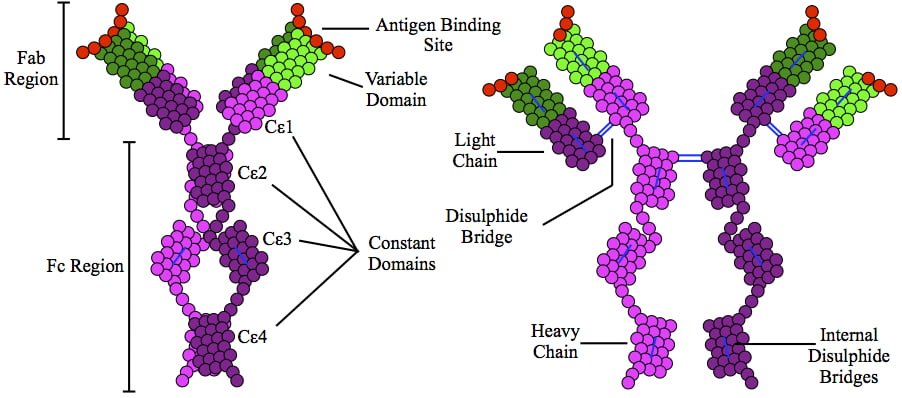
This is a depiction of immunoglobulin E (IgE) antibody which is elevated in allergic reactions.

What Is Allergic Rhinitis?

A llergic rhinitis is an immune disorder characterized by inflammation of the nasal mucosa by an IgE antibody reaction to an allergen.

An allergen is something that triggers an allergic immune response.

Q: What is the immune response?

A: Implicated in the response is an increase in T gamma-delta intraepithelial lymphocytes (IELs), which is a subset of pro-inflammatory T-cells located in the respiratory mucosa.  Lymphocytes are white blood cells.

When a person with allergic rhinitis breathes in an allergen such as pollen or dust, the body releases chemicals, including histamine that cause allergy symptoms. For example, hay fever involves an allergic reaction to pollen. A similar reaction occurs with allergy to mold, animal dander, dust, and other allergens that are breathed in.

What Is Allergic Rhinitis In Celiac Disease and/or Gluten Sensitivity?

Osteitis Fibrosa Cystica 

Deep Vein Thrombosis in the Right Leg with Swelling and Redness. Coutesy wikipedia.
Deep Vein Thrombosis in the Right Leg with Swelling and Redness. Courtesy wikipedia.

What Is Antiphospholipid Syndrome?

Antiphospholipid syndrome (APS) is an autoimmune disease and a blood clotting disorder characterized by these clinical and laboratory criteria:

Clinical criteria – recurrent vascular thrombosis (clots in veins/arteries) from hypercoagulability (abnormal excessive clotting) and/or recurrent complications of pregnancy that include loss of the fetus  (miscarriage) and pre-eclampsia or eclampsia.

Laboratory criteria – persistently elevated anticardiolipin, anti–beta-2 glycoprotein I, and/or lupus anti-coagulant antibodies in blood.

In antiphospholipid syndrome autoantibodies are produced by the body and directed against negatively charged phospholipids that are found in the outer layer of cell membranes and platelets. B2-glycoprotein-I (a protein in blood plasma) has been found as a major target antigen for antiphospholipid antibodies.

Q: Are phospholipids important in the body?

A: Yes.  Phospholipid molecules are an essential part of cell membranes. They form a barrier around cells that protect the cell, allow movement of oxygen in and carbon dioxide out of the cell, and regulate other small molecules through the cell wall. Because phospholipids are widespread in the body, this disorder can produce a large variety of symptoms and affect many organs.

One severe effect of APS is the development of a blood clot in a vein deep in the arm or leg, called deep vein thrombosis (DVT). DVT can cause pain, swelling, redness, or increased warmth in the affected limb. Deep vein clots can break off, travel to the lungs, and cause pulmonary embolism.1 Pulmonary embolism is a medical emergency.

Treatment is with anticoagulant medications and blood monitoring.

What Is Antiphospholipid Syndrome In Celiac Disease and/or Gluten Sensitivity?

Sources:
  1. http://www.nhlbi.nih.gov/health/health-topics/topics/ebc/signs.html []

Osteomalacia

Drawing shows changes in airways during asthma attack. wikipedia

What Is Asthma?

Asthma is a chronic immune respiratory condition characterized by narrowing and inflammation of the lung airways (large bronchi, bronchial tubes and small bronchioles) in response to an allergen as the trigger or stimulus. As such, asthma occurs in episodes and does not result in progressive loss of pulmonary function.

During an asthma attack, airways constrict, trapping air so lungs become overinflated.  Normally, bronchial airways bring air to millions of air sacs that are attached to the ends of bronchioles. Air sacs, called alveoli, are only one cell thick to allow for rapid exchange of gases.

That is, oxygen from air breathed into the sacs moves into the bloodsteam and carbon dioxide is released from the bloodstream to air that is breathed out of air sacs.

The outer walls of bronchioles are made up of muscles which, in the process of breathing, normally contract on expiration to help expel air and then relax. During an asthma attack, these muscles abnormally constrict, impairing airflow into and out of the alveoli. This is called bronchospasm.

Common  allergens that cause inflammation include airborne dust mite feces, mold, and pollen and foods such as wheat, cow’s milk, eggs, and peanuts. Non-allergenic triggers include exercise, air pollution, smoking, and viral respiratory infection.

Q: What effect does inflammation have on the lungs?

A: Inflammation causes local tissue edema or swelling of the bronchioles and mucus formation. Inflammation with increased mucus secretions and edema narrows the airways that connect to alveoli which makes breathing difficult.  Two things happen:

  1. Inflammation  impairs exchange of gases in alveoli, resulting in lack of sufficient oxygen (O2) for body cell functions, called hypoxia, and build-up of carbon dioxide (CO2) in blood, called CO2 retention.
  2. Inflammation narrows passageways because of swelling, which reduces the movement of air to and from the alveoli through the airways, and this puts stress on the right side of the heart.

Treatment is aimed at controlling bronchospasm and reducing inflammation. Untreated asthma can be disabling and life threatening.

What Is Asthma In Celiac Disease and/or Gluten Sensitivity?

Osteonecrosis

Each antibody binds to a specific antigen; an interaction similar to a lock and key. Courtesy Wikipedia.

What Are Autoimmune Disorders?

A utoimmune disorders refer to those conditions that involve an abnormal immune attack on the body’s own tissues perpetuated by the production of autoantibodies directed against the body, or “self.” Auto means self.

Q: Why does the immune system attack the body?

A: The exact answer is not yet known why the immune system turns against body tissue or “self.” 

Normally, the immune system protects the body from harmful substances and pathogens and produces antibodies against the offending foreign substances, called antigens, to get rid of them. The immune system (humoral) thereafter remembers all antigens and is ready for the next encounter should it happen.

Production of autoimmune antibodies is catastrophic because there is no turning off the readiness to attack a remembered threat (antigen) which is unfortunately “self.” 

Yes, steroids and anti-inflammatory drugs can control symptoms, but nothing can undo the memory programmed into the immune system to produce autoantibodies. There is an enormous research effort ongoing for the answer. 

Autoimmune disorders cover a wide range of diseases that may target only a particular organ, such as autoimmune hepatitis (liver), while others are systemic because the autoantibodies target a particular tissue that is part of more than one organ, such as scleroderma (connective tissue).

Autoimmune diseases as a group affect approximately 8.5% of people worldwide.

What Are Autoimmune Disorders In Celiac Disease and/or Gluten Sensitivity?